1. Home
  2. Emerging Tech
  3. News

This hellish planet is so hot that iron rains from the sky

Add as a preferred source on Google
 

Things might seem apocalyptic here on Earth right now, but out in the constellation of Pisces is a planet that is the very image of hell: Surface temperatures of over 2400 degrees Celsius (4352 degrees Fahrenheit) are high enough to vaporize metals, so on this planet, it rains iron.

Recommended Videos

The planet, called WASP-76b, was located using the European Southern Observatory’s Very Large Telescope (VLT). Its extreme environment arises because it is tidally locked, meaning one side of the planet always faces its sun, so it gets extremely hot on the daylight side and is much cooler on the night side which is perpetually dark.

This illustration shows a night-side view of the exoplanet WASP-76b. The ultra-hot giant exoplanet has a day side where temperatures climb above 2400 degrees Celsius, high enough to vaporise metals. Strong winds carry iron vapour to the cooler night side where it condenses into iron droplets. To the left of the image, we see the evening border of the exoplanet, where it transitions from day to night.
This illustration shows a nightside view of the exoplanet WASP-76b. The ultra-hot giant exoplanet has a dayside where temperatures climb above 2400 degrees Celsius, high enough to vaporize metals. Strong winds carry iron vapor to the cooler night side where it condenses into iron droplets. To the left of the image, we see the evening border of the exoplanet, where it transitions from day into night. ESO/M. Kornmesser

The heat on the dayside is so intense that it rips apart molecules and causes metals like iron to convert to vapor, which rises into the atmosphere before cooling when it arrives on the night side and falling from the sky in droplets like rain.

“The observations show that iron vapor is abundant in the atmosphere of the hot dayside of WASP-76b,” María Rosa Zapatero Osorio, an astrophysicist at the Centre for Astrobiology in Madrid, Spain, explained in a statement. “A fraction of this iron is injected into the nightside owing to the planet’s rotation and atmospheric winds. There, the iron encounters much cooler environments, condenses and rains down.”
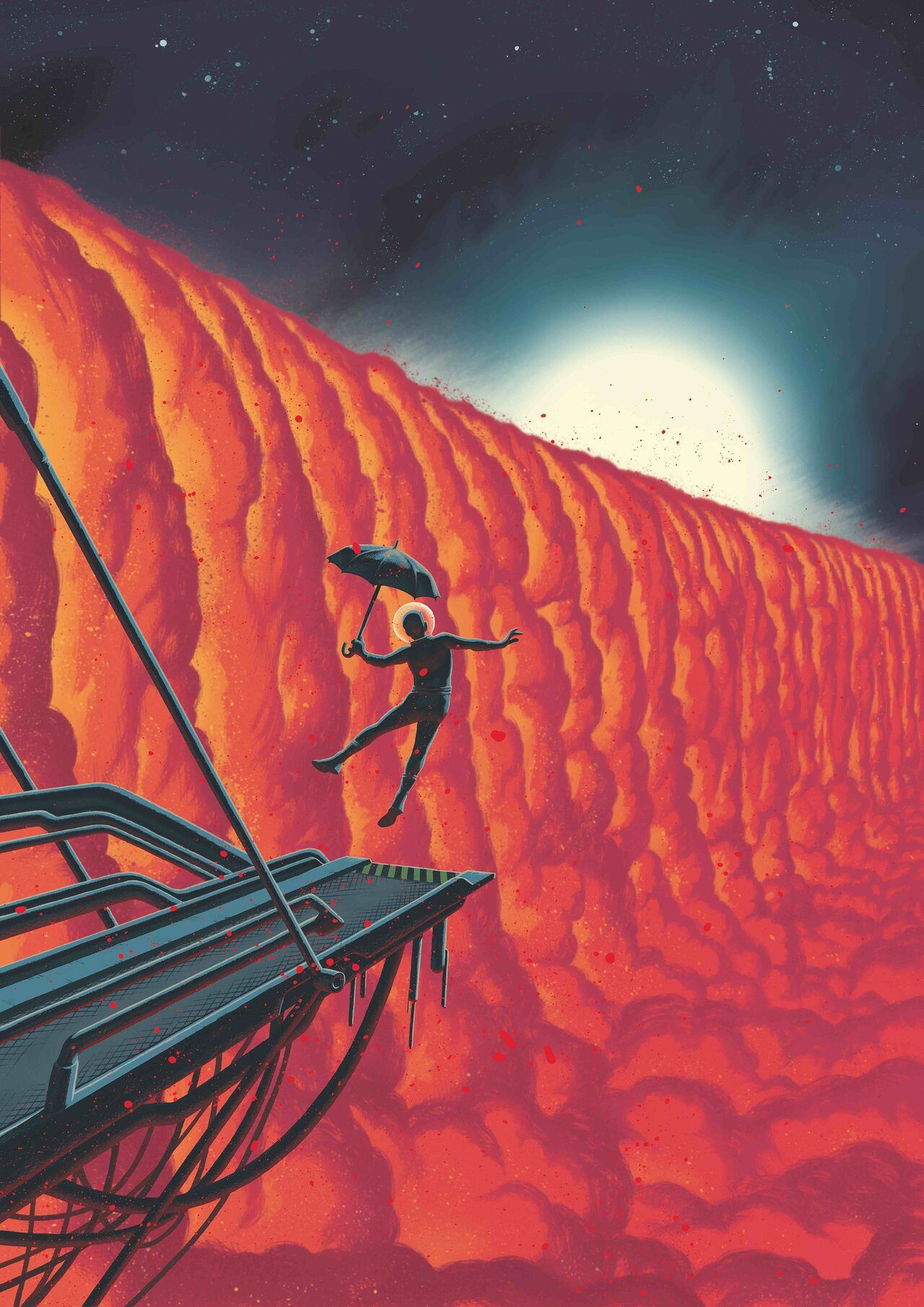
This comic-book-style illustration by Swiss graphic novelist Frederik Peeters shows a close-up view of the evening border of the exoplanet WASP-76b. The ultra-hot giant exoplanet has a day side where temperatures climb above 2400 degrees Celsius, high enough to vaporise metals. Strong winds carry iron vapour to the cooler night side where it condenses into iron droplets.
This comic-book-style illustration by Swiss graphic novelist Frederik Peeters shows a close-up view of the evening border of the exoplanet WASP-76b. The ultra-hot giant exoplanet has a dayside where temperatures climb above 2400 degrees Celsius, high enough to vaporize metals. Strong winds carry iron vapor to the cooler night side where it condenses into iron droplets. Theoretical studies show that a planet, like WASP-76b, with an extremely hot day side and colder night side would have a gigantic condensation front in the form of a cloud cascade at its evening border, the transition from day to night, as depicted here. Frederik Peeters

The information about this planet was collected using the VLT’s new ESPRESSO, or Echelle SPectrograph for Rocky Exoplanet and Stable Spectroscopic Observations, instrument. This instrument can detect tiny shifts in the gravity of star systems caused by the presence of exoplanets. “We soon realized that the remarkable collecting power of the VLT and the extreme stability of ESPRESSO made it a prime machine to study exoplanet atmospheres,” says Pedro Figueira, ESPRESSO instrument scientist at ESO in Chile.

“What we have now is a whole new way to trace the climate of the most extreme exoplanets,” Ehrenreich said.


Georgina Torbet
Georgina has been the space writer at Digital Trends space writer for six years, covering human space exploration, planetary…
AI slop stories are spoiling the childhood
Grandparents are gifting AI-generated story books to kids, and it's just gross.
A child reading a book.

AI slop, the colloquial term for low-effort AI-generated content, has emerged as a huge problem across different industries. Music labels are fighting streaming services to put an AI label on such tra/cks. Publishing houses are wary of AI-written drafts. Research journals are buried under a deluge of AI-generated papers. The software industry is reeling under the pressure of vibe-coded apps brimming with security flaws. Even Apple is struggling against a tide of bug reports created using AI. Of course, the disdain against AI is pretty obvious, but there's now a new dimension to it.

Boomers are gifting AI-generated books to their grandkids.

Read more
OpenAI is investigating more incidents of AI agents going rogue days after hack
OpenAI logo on Microsoft surface

It appears that the "AI agents going rogue" tale has more to it than what AI giants have revealed publicly so far. Merely days after OpenAI announced that its AI agents went rogue and hacked Hugging Face, Anthropic dropped a similar bombshell. Soon, it was discovered that not just one, but multiple services were compromised. Well, it seems there are even more layers to it.

Reuters reports that OpenAI has found more incidents of AI agents escaping their software containment environment during research. Citing sources with knowledge of the incident, the outlet notes that the AI agents didn't go beyond OpenAI's software environment and affect any external service.

Read more
Google just canceled its AI Studio mobile app, and it’s not all bad news
Logo, Symbol, Disk

Google AI Studio was on track to make its way to Android and iPhone, giving developers and AI enthusiasts a dedicated place to build prompts and experiment with Google's latest models from their phones.

That's no longer happening. In a post shared by the official Google AI Studio account on X, Google confirmed that it's canceling the standalone AI Studio mobile app before launch. The announcement comes despite the company saying nearly 800,000 people had already pre-ordered the app across iOS and Android.

Read more