Twitter hid and issued a public interest notice on President Donald Trump’s tweet about the Minnesota protests, saying the tweet violated its policies about the “glorification of violence.”
The public interest notice was specifically issued due to the last line of Trump’s tweet, which says, “Any difficulty and we will assume control but, when the looting starts, the shooting starts.”
The comment likely references a quote from former Miami Police Chief Walter Headley who was in charge during the Miami’s 1967 race riots and instigated violence in the African American community at the time with the phrase: “When the looting starts, the shooting starts.”
The White House’s official Twitter account later retweeted Trump’s comments, quoting the message in full Friday morning. Tweet was also flagged for glorifying violence. Twitter said it had put the same notice on the White House’s “identical Tweet.”
The White House responded by sharing a tweet from Iranian leader Ali Khamenei, claiming that tweet had also glorified violence without being flagged.
“Twitter has determined that it will allow terrorists, dictators, and foreign propagandists to abuse its platform,” the White House account tweeted.
The social media company’s warning label will conceal the tweets by default in users’ timelines, only letting them read the tweets when a user manually opens it.
“This Tweet violates our policies regarding the glorification of violence based on the historical context of the last line, its connection to violence, and the risk it could inspire similar actions today,” wrote Twitter’s official communications handle in a tweet.
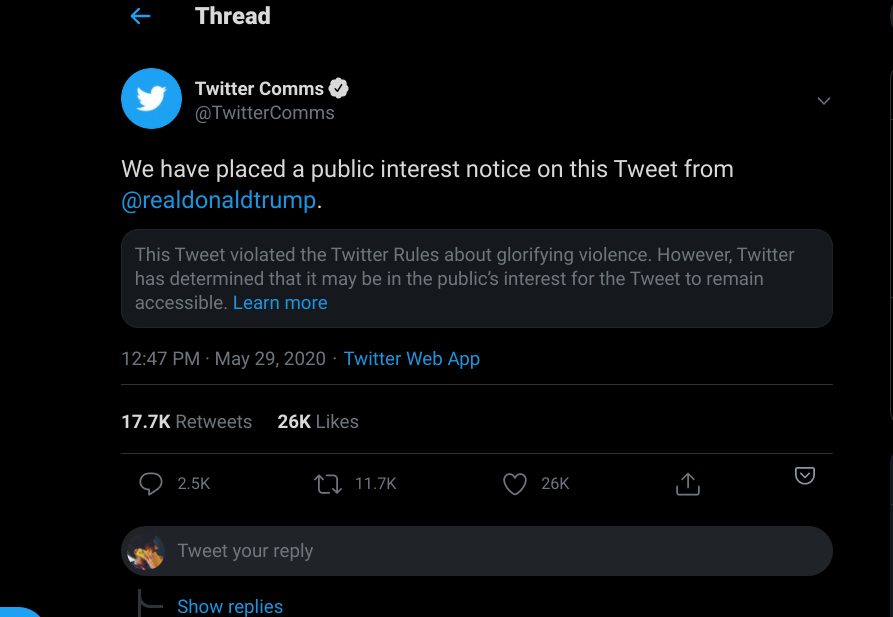
In a subsequent tweet, Twitter argued it’s not taking down Trump’s thread altogether “given its relevance to ongoing matters of public importance.” “We’ve taken action in the interest of preventing others from being inspired to commit violent acts,” added Twitter.
In addition, Twitter is limiting engagements with the tweet in question. Therefore, while people will be able to retweet it with a comment, they can’t like, reply, or retweet it directly.
Trump slammed Twitter Friday morning in a series of tweets for their warning, claiming Twitter wasn’t adding messages to his political rivals’ tweets as well.
“Twitter is doing nothing about all of the lies & propaganda being put out by China or the Radical Left Democrat Party,” he said. “They have targeted Republicans, Conservatives & the President of the United States. Section 230 should be revoked by Congress. Until then, it will be regulated!”
Trump later tried to back-pedal from his initial tweet, saying he meant to imply that looting leads to shootings amongst rioters and not the saying once infamously used by segregationist George Wallace during his failed 1968 presidential campaign.
“I don’t want this to happen, and that’s what the expression put out last night means,” Trump tweeted. He instead blamed “haters” for misinterpreting his tweet.
The warning remains on his earlier tweet.
Earlier this week, Twitter fact-checked one of Trump’s tweets for the first time. The decision landed Twitter in a public spat with the president, who accused it of becoming “an editor with a viewpoint” and yesterday signed an executive order that seeks to make social media companies more liable for the content they host.
In response, Twitter called the EO “a reactionary and politicized approach to a landmark law.” In a tweet, the company added that, “#Section230 protects American innovation and freedom of expression, and it’s underpinned by democratic values. Attempts to unilaterally erode it threaten the future of online speech and Internet freedoms.”
The executive order pushed the Federal Communications Commission to consider new standards for Section 230, which would strip protections that keep internet services from being civilly liable for the content users post on their sites. On Friday, FCC Commissioner Brendan Carr said the flagging of Trump’s tweets but not those of celebrity Kathy Griffin proved “Twitter has abandoned any attempt at a good faith application of its rules.”