There has been a strange inconsistency puzzling astronomers for two decades: Where is all the universe’s missing matter? Cosmic censuses have only observed about half the matter we’d expect to find in the universe. Now, astronomers have detected this missing matter for the first time, by making clever use of the strange phenomenon of cosmic bursts.
“We know from measurements of the Big Bang how much matter there was in the beginning of the universe,” lead author Associate Professor Jean-Pierre Macquart, from the Curtin University node of the International Centre for Radio Astronomy Research (ICRAR), said in a statement. “But when we looked out into the present universe, we couldn’t find half of what should be there. It was a bit of an embarrassment.”
This missing matter is ordinary matter, which scientists call baryons, as opposed to the dark matter which is theorized to explain the movements of galaxies. Scientists have estimates for how much ordinary matter there should be, but when they looked around us they only found about half of the matter predicted.
Searching for this matter was difficult because, to put it simply, space is so very big. “Intergalactic space is very sparse,” Macquart said. “The missing matter was equivalent to only one or two atoms in a room the size of an average office. So it was very hard to detect this matter using traditional techniques and telescopes.”
In order to search for the missing matter, the researchers turned to a phenomenon called fast radio bursts. These bright, transient radio pulses only last a few milliseconds and are of unknown origin but can be detected from Earth due to their high energy.
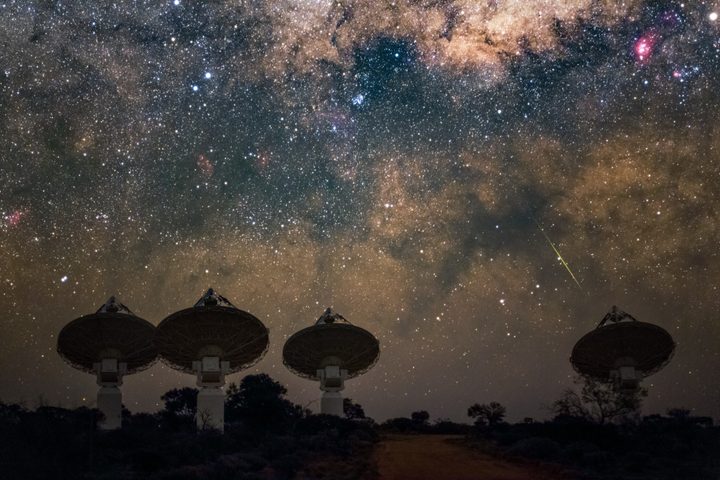
The researchers were able to pinpoint the galaxies which the bursts originated from using the highly accurate Australian Square Kilometre Array Pathfinder (ASKAP) radio telescope, allowing them to see the way these bursts smeared out over time, and. “The radiation from fast radio bursts gets spread out by the missing matter in the same way that you see the colors of sunlight being separated in a prism,” Macquart explained.
This allowed the researchers to tell how dense the universe is in an efficient way. “We’ve now been able to measure the distances to enough fast radio bursts to determine the density of the universe,” he said. “We only needed six to find this missing matter.”
The next step is for the researchers to study more fast radio bursts. They believe that with more data, they could eventually not only detect the existence of more ordinary matter, but also locate it – in particular, they want to see whether this “extra” matter is located bound to galaxies or whether it is in the vast space between galaxies, called the intergalactic medium.
The research is published in the journal Nature.