1. Home
  2. Space
  3. News

Trippy NASA video shows two black holes interacting

Add as a preferred source on Google
The Doubly Warped World of Binary Black Holes

Black holes are so dense that their gravity pulls in everything around them, even light. But that doesn’t mean that they are invisible to view. They collect clouds of dust and gas which form a structure around the black hole called an accretion disk, from which matter is pulled into the black hole over time. These accretion disks give off light and form the distinctive humped appearance made famous by movies like Interstellar.

Recommended Videos

Now, NASA has created a visualization, shared in the video above, showing what happens when two of these black holes pass one another, demonstrating how the gravity of each warps the accretion disk of the other. The larger black hole, equivalent to 200 times the mass of the sun, is shown in orange, and the smaller black hole is shown in blue. The effect of the extreme gravitational forces creates unexpected and twisted warping of the disks.
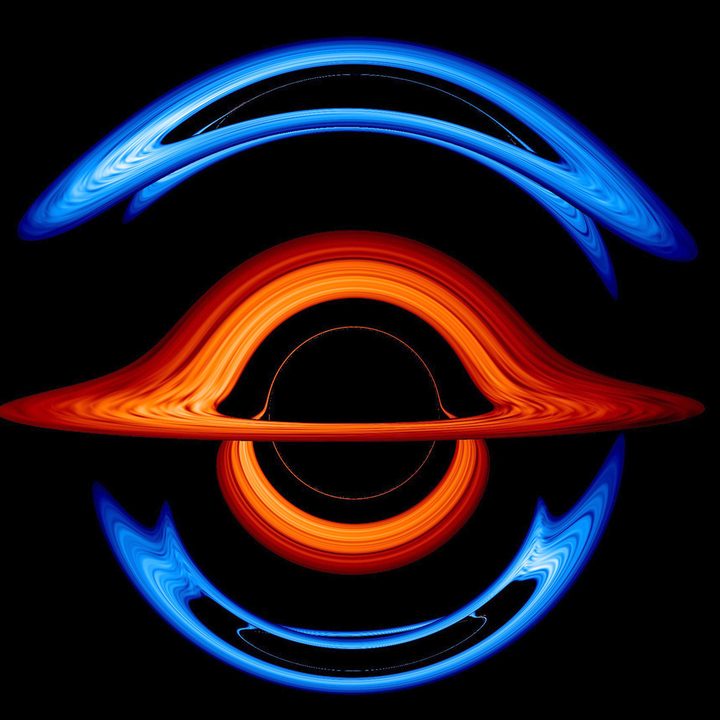
In this frame from the new visualization, a supermassive black hole weighing 200 million solar masses lies in the foreground. Its gravity distorts light from the accretion disk of a smaller companion black hole almost directly behind it, creating this surreal view. Different colors for the accretion disks make it easier to track the contributions of each one.
In this frame from the new visualization, a supermassive black hole weighing 200 million solar masses lies in the foreground. Its gravity distorts light from the accretion disk of a smaller companion black hole almost directly behind it, creating this surreal view. Different colors for the accretion disks make it easier to track the contributions of each one. NASA’s Goddard Space Flight Center/Jeremy Schnittman and Brian P. Powell

In reality, most of the light emitted in this situation would be in the ultraviolet range, rather than the visible light range. But it is accurate that material orbiting a smaller black hole would experience more intense gravitational forces, which would make it hotter. And hotter material gives off light which is shifted toward the blue end of the spectrum.

The visualization isn’t just for fun though. Simulations like this one are used to investigate what features astronomers could expect to see when observing real black holes.

“We’re seeing two supermassive black holes, a larger one with 200 million solar masses and a smaller companion weighing half as much,” said Jeremy Schnittman, an astrophysicist at NASA’s Goddard Space Flight Center in Greenbelt, Maryland, who created the visualization, in a statement. “These are the kinds of black hole binary systems where we think both members could maintain accretion disks lasting millions of years.”

This visualization shows a phenomenon called gravitational lensing, in which a massive body distorts the image of a body behind it. A similar method can be used to investigate distant stars and to identify exoplanets.

“A striking aspect of this new visualization is the self-similar nature of the images produced by gravitational lensing,” Schnittman explained. “Zooming into each black hole reveals multiple, increasingly distorted images of its partner.”

Georgina Torbet
Georgina has been the space writer at Digital Trends space writer for six years, covering human space exploration, planetary…
China’s answer to SpaceX’s reusable rockets literally catches boosters in a net
SpaceX catches boosters on legs. China just used a net.
Ammunition, Missile, Weapon

SpaceX's playbook for recovering a rocket booster generally involves legs, a precisely controlled vertical landing, and either a concrete pad or a drone ship. 

China just managed to pull off something similar, but in a slightly different way, and on July 10, it tested the method as well.

Read more
Dimming the sun sounds unhinged, but this new study on El Niño makes a surprisingly good case for it
A natural test case, Australia's worst-ever wildfire season, suggests the idea deserves serious consideration.
Nature, Outdoors, Sky

When I first saw "scientists propose dimming the sun," I rolled my eyes. It sounds like a science fiction movie cooked up after watching many climate documentaries. But a new study, published on July 8, 2026, in the journal Science Advances, seems to have a genuinely compelling argument.

A Super El Niño is currently forming in the Pacific, feared to be the most intense in decades. It could escalate floods, wildfires, and extreme heat events worldwide. However, Researchers at UC San Diego's Scripps Institution of Oceanography, led by climate scientists Kate Ricke and Jessica Wan, are now proposing one of the most interesting solutions I’ve come across.

Read more
You can now walk through space and gaze into a black hole at this VR exhibit
Smithsonian Starstruck lets you drift past dying stars and see the origin point of the universe for as little as $18 a person.
Smithsonian Starstruck featured

Most planetarium shows ask you to sit still and look up. The Smithsonian's new VR exhibit takes a different approach, letting visitors walk through the vast expanse of the universe, drifting past stars, planets, and a black hole to get a physical sense of its true scale.

A $29 ticket to the edge of the galaxy

Read more