Last week, repair experts iFixit put Apple’s Mac Studio under the knife with a full teardown video. At the time, the team also briefly examined the Studio Display, and now they’re back with a full-scale shredding of Apple’s latest monitor. And what they found inside was surprising, to say the least.
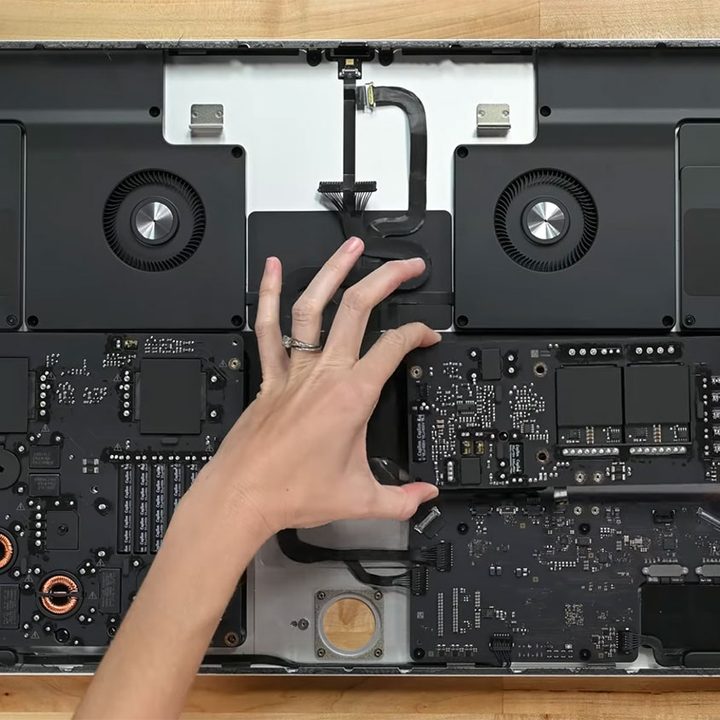
From the outside, you’d be forgiven for confusing the Studio Display with Apple’s 24-inch iMac. Yet in iFixit’s teardown video, as soon as the display’s front panel was removed, the differences became immediately apparent. For one thing, the Studio Display is far more densely packed on the inside than the largely empty 24-inch iMac.
That’s down to a number of reasons. For starters, Apple stuffed the device’s power supply inside the Studio Display’s body rather than using an external power brick as the iMac does. This required a custom design and a lot of design and engineering work, not to mention the cost. The result is incredibly thin for a power supply — barely thicker than a printed circuit board. Still, thin or not, it’s one reason the internals are so jam-packed.
The power supply’s circuit board also has a split design that comes in two parts. This is presumably to fit it into the display’s chassis effectively and is another design decision that would have required a ton of effort to make it work.
As well as that, Apple had to include two huge fans to dissipate heat from the power supply — these were not required internally in the 24-inch iMac since its power supply lurks outside the computer. The large Studio Display fans are not for its A13 Bionic chip, though, which does not generate much heat on its own.
Fixing the lackluster webcam
Once the overflowing internals were examined, iFixit got to work disassembling the Studio Display. The company started by examining the webcam, which has come in for a barrage of criticism for its poor output.
According to iFixit, the camera is almost identical to the front-facing camera in the iPhone 11. Since that camera usually produces excellent images, it suggests that the problem does not necessarily lie with the hardware and that Apple will be able to fix the quality issues with a software update. We certainly have our fingers crossed.
As for the screen, the Studio Display uses the same monitor panel as the now-extinct 5K iMac. The 60Hz LCD “isn’t much to write home about these days,” said iFixit’s Sam Goldheart, but it’s at least good to have the option of an Apple-branded 5K display without having to buy an entire computer to get it.
While the Studio Display’s speakers are not “quite as slick” as those found in the 24-inch iMac, iFixit found that they’re still “impressive for a display.” They include Apple’s force-canceling woofers to help keep vibrations in check.
On the back, there’s only one Thunderbolt 4 port, meaning you can’t daisy chain extra monitors using the Studio Display. Instead, extra monitors have to run through your Mac, which is a bit more hassle.
Rounding things up, Goldheart described the Studio Display as “an alternate universe iMac” and “an impressive testament to Apple’s ability to solve problems.” While the device wasn’t given a repairability score, iFixit optimistically suggested that if Apple can make such a slimline power supply, it should be able to make device repairs “safe and easy.” Who knows what the future holds?