1. Home
  2. Space
  3. News

Perseverance rover picks up a rock friend on Mars

Add as a preferred source on Google

It’s a lonely life for a rover on Mars, but the Perseverance rover has some company now in addition to its helicopter buddy Ingenuity. Perseverance picked up a rock hitchhiker which has been riding in the rover’s wheel for the past four months.

NASA recently shared the news in a blog post that described how a chunk of Martian rock had snuck into the rover’s front left wheel back in February this year. The rock was imaged by the rover’s front left hazard avoidance camera on February 6, and a second image taken on May 26 showed the rock still in the same wheel.
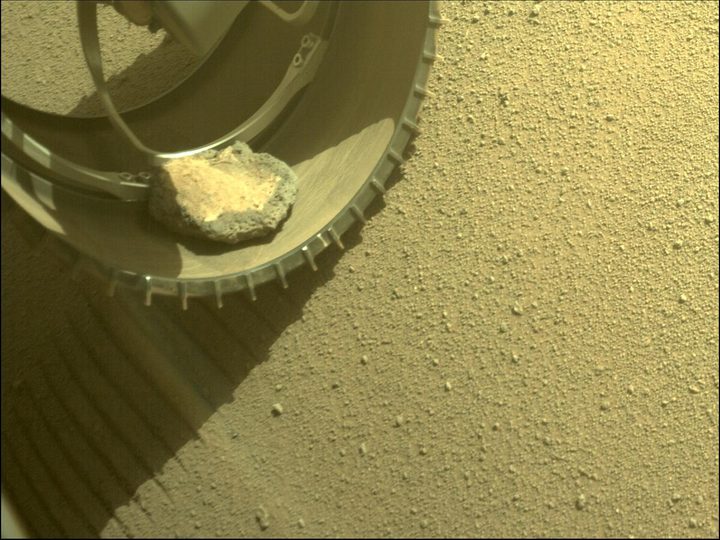
A rock in the front left wheel of Perseverance on Sol 343, image was acquired on Feb. 6, 2022 (Sol 343).
A rock in the front left wheel of Perseverance on Sol 343, image was acquired on Feb. 6, 2022 (Sol 343). NASA/JPL-Caltech

Happily, the rock doesn’t seem to be doing any harm as it bounces around inside Perseverance’s wheel, though it has stayed in place for a remarkably long time given how much it must have been jostled about — especially considering Perseverance has recently been booking it across the Martian surface and breaking records for longest drive by a martian rover in a single day.

Recommended Videos

In its time with the rover, the little rock has traveled more than 5.3 miles, leading to being charmingly dubbed Perseverance pet rock. “This rock isn’t doing any damage to the wheel, but throughout its (no doubt bumpy!) journey, it has clung on and made periodic appearances in our left Hazcam images,” writes Eleni Ravanis, a student collaborator with NASA.

Rocks inside a rover’s wheels, in this case, can be considerably less dangerous than the rocks outside the wheels. The rover Curiosity suffered damage to its wheels early in its mission when the treads were torn up by sharp rocks. Eventually, the holes and tears in the wheels lead to two of the treads of one wheel breaking off completely. To prevent further damage to Curiosity’s wheels, the rover recently changed its planned course to avoid more of these sharp rocks.

The damage to Curiosity’s wheels inspired changes to Perseverance’s design. Perseverance’s wheels are slightly different from Curiosity though the bodies of the two rovers are very similar. For Perseverance, engineers used a different tread pattern with gently curved treads placed close together, instead of Curiosity’s chevron treads which are placed further apart. This lets Perseverance have the same grip on rocky surfaces, but with a lower chance of damage from sharp rocks.

As for how long Perseverance’s rock friend will stick around, it’s impossible to say. It could fall out while Perseverance climbs the rim of the Jezero crater, or it could keep the rover company for a long time. It’s nice to travel with friends.

Georgina Torbet
Georgina has been the space writer at Digital Trends space writer for six years, covering human space exploration, planetary…
Space is becoming Bezos and Musk’s next data center site, and we have every reason to worry
The AI boom is coming for the night sky
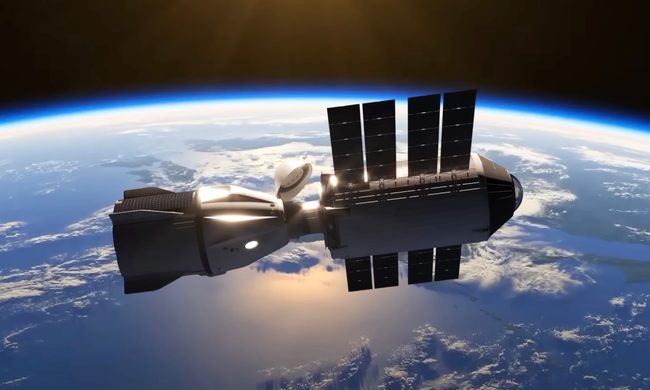
How Vast's space station will look in orbit.

AI data centers already consume vast amounts of electricity and water on Earth, so Silicon Valley has begun looking somewhere considerably more spacious... literally.

Elon Musk's SpaceX and Jeff Bezos' Blue Origin, along with several other companies, have proposed enormous constellations of satellites designed to operate as orbital data centers. However, environmental groups and former space officials are now warning that putting them into orbit at the proposed scale could have severe consequences for Earth's atmosphere and the night sky.

Read more
The first possible exomoon is here, and it makes our Moon look hilariously tiny
Scientists may have found the first exomoon, except this one is the size of Jupiter
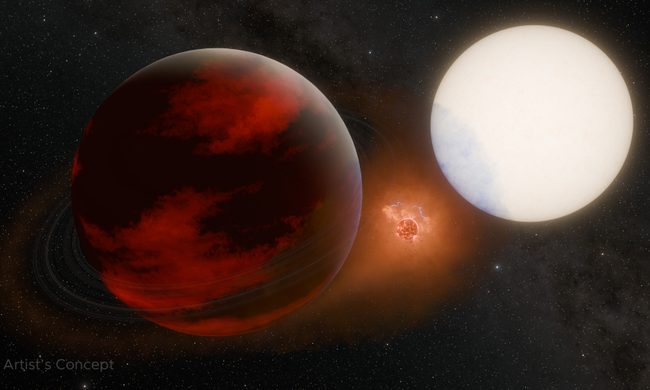
This artist’s concept depicts a potential volcanic moon between the exoplanet WASP-49 b, left, and its parent star. New evidence indicating that a massive sodium cloud observed near WASP-49 b is produced by neither the planet nor the star has prompted researchers to ask if its origin could be an exomoon.

We have already discovered more than 6,000 planets outside of our immediate neighborhood. Yet, finding a moon orbiting one of those distant worlds has proved considerably harder. Astronomers may finally have something close to the real deal, but this particular object stretches the word “moon” almost beyond recognition.

Using the European Southern Observatory’s Very Large Telescope in Chile, researchers detected strong evidence for a moon-like object in the CD-35 2722 system. Further observations are still necessary to confirm the discovery, but it could become the first confidently detected natural satellite outside our solar system. There is still one tiny complication though. This moon is apparently massive.

Read more
China’s answer to SpaceX’s reusable rockets literally catches boosters in a net
SpaceX catches boosters on legs. China just used a net.
Ammunition, Missile, Weapon

SpaceX's playbook for recovering a rocket booster generally involves legs, a precisely controlled vertical landing, and either a concrete pad or a drone ship. 

China just managed to pull off something similar, but in a slightly different way, and on July 10, it tested the method as well.

Read more