The new Nreal Air glasses have transformed my iPhone into a productivity and entertainment monster by adding a giant display that fits on my face. It sounds like something out of a sci-fi film, but that’s the reality we’re living in 2022.
At first glance, the $379 Air looks like typical virtual reality (VR) hardware. The glasses wear like a VR headset and have a cable that attaches to your mobile device. But the Air doesn’t offer an actual VR experience and instead focuses on mirroring the content of your phone, tablet, or laptop. In effect, the Air offers a giant monitor in the form factor of a pair of sunglasses.
Not VR can be a good thing
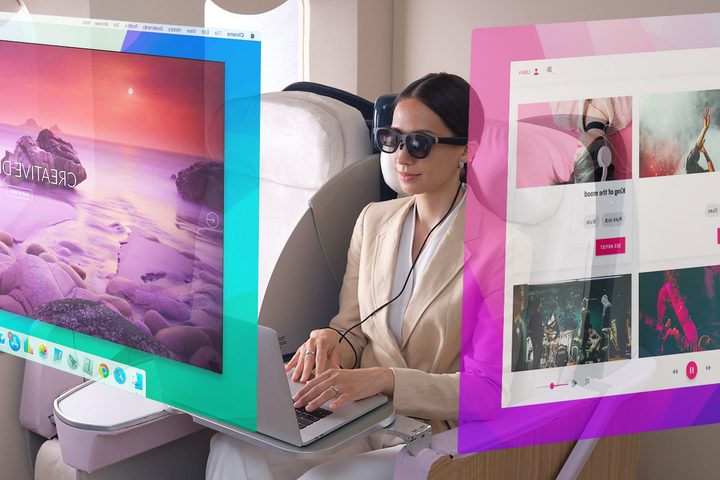
I wasn’t expecting a full VR experience with the Air, which turned out to be a good thing. Unlike the Meta Quest 2 headset, which is awkward to wear, the Air looks and feels like a pair of Raybans. In fact, they are so un-dorky looking that I have taken to wearing them in my local coffee shop and have gotten only a few strange looks.
I’ve found the Air to be a significant productivity boost when used with my iPhone or another mobile phone. Instead of lugging around a big laptop, I can slip the Air into my pocket while working on the go. They connect with a special dongle to my iPhone, and I can view and edit documents with the big screen provided by the glasses.
The sleek design makes all the difference
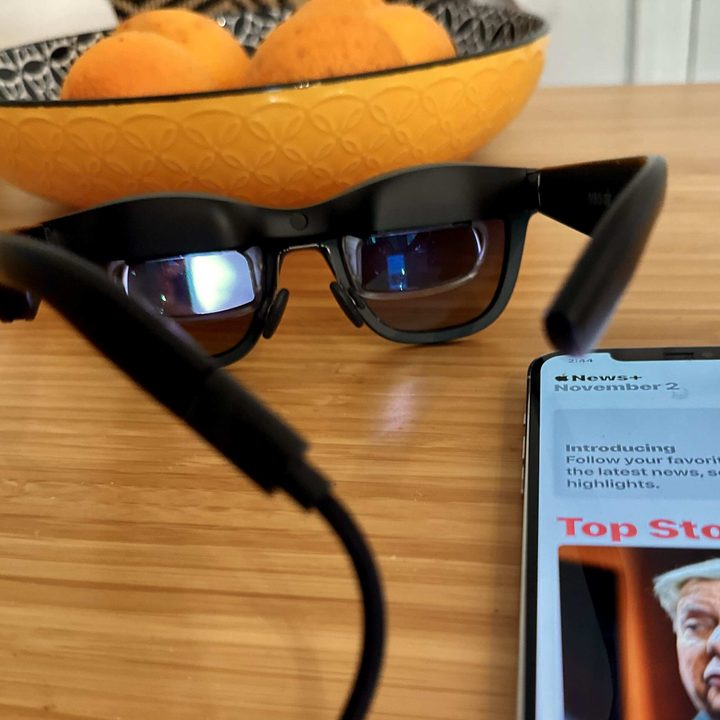
I love the look of the Air with its cyberpunk design. The glasses are light enough at 76 grams to feel more like heavy sunglasses than a full-fledged gadget you are wearing. One issue is that they are slightly too narrow for my broad face. After a few hours of use, the Air tends to pinch and become uncomfortable. On the other hand, the Air is far more comfortable to wear than my Quest 2 headset, which is much heavier.
I’ve tried working using VR headsets like the Meta Quest 2 when using apps like Spatial, which mirror your computer displays. The problem I’ve always found is that clumsy VR headsets get uncomfortable after an hour or so of use. Thanks to its lightweight design, I haven’t had the same problem with the Nreal Air.
The Air works with M1 MacBooks and specific iPhone and Android phones. To use the Air with an iPhone, you must purchase a separate adaptor, which I found to work well, although it’s annoying to lug around yet another part.
The tiny displays inside the lenses are the only giveaway that the Air are not actual sunglasses. It’s handy to see through the semi-transparent lenses, but when things get too bright outdoors, I prefer using the included shield, which blocks all light.
The Air offers virtual reality capabilities through its software. This app allows you to do things like open multiple windows and use a built-in web browser. In the end, I found the Air to be most useful simply as an external monitor.
Tiny package, great display
On paper, at least, the Air can’t match the specs of the display of my iPhone 14 Pro Max. Nreal claims the Air has a 3840 x 1080 resolution and a 60Hz refresh rate with its Micro OLED display. That compares with the iPhone 14 Pro Max’s 6.7-inch OLED display with 1290 x 2796 pixels and a refresh rate of 120Hz.
The difference in refresh rate between the two devices is noticeable and a considerable drawback to the Air. Videos and scrolling through web pages are less smooth on the Air, largely due to the lower refresh. The Air’s 60Hz refresh rate may also have contributed to the nausea I experienced after using the glasses for a couple of hours.
Great for work and play
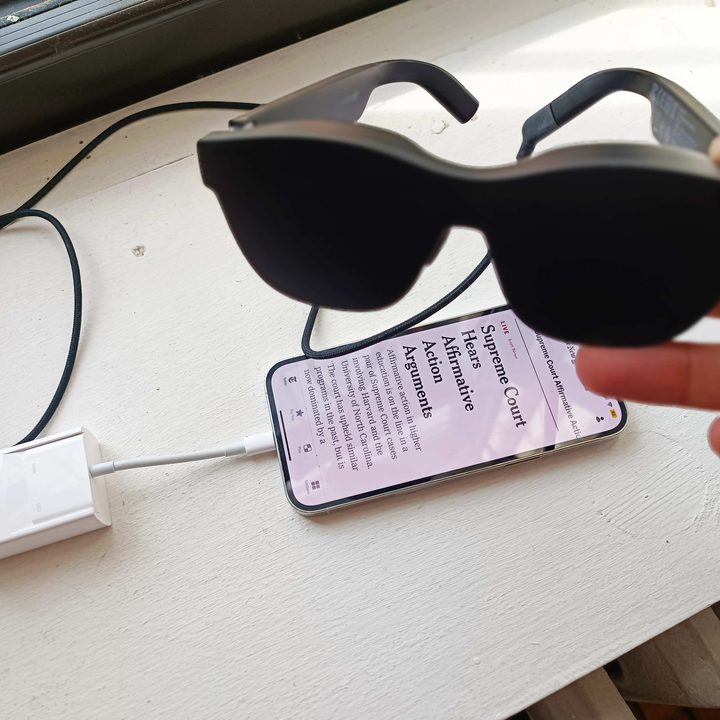
I used the Nreal Air to type this review using only my iPhone and Google Docs. I’d never normally consider using the iPhone to do word processing as the screen is too small — even on the Pro Max variant.
The screen inside the glasses appears to be the size of a large monitor when you have them adjusted correctly. I used a Bluetooth keyboard connected to my iPhone to get a near-laptop experience.
The size of the Air screen is large enough to see the text clearly when using Google Docs if you blow up the font size. However, typing is not always easy when you can’t see where your fingers hit the keyboard.
I also enjoy using the Air to watch videos in bed before going to sleep. The screen quality can’t match my iPad Pro, but not having to prop up a tablet is a killer feature that I didn’t realize I was missing before. The Air is also fun for casual web browsing.

After using the Air for several weeks, I’ve found the not-inconsiderable price tag of the Air to be money well spent, since the glasses help me get work done. I would pack the Air in my carry-on for my next trip if I needed to write while on the road. On the other hand, I’m not confident enough yet in the Air for them to replace my laptop. For that, I’ll have to hope the next version offers a higher refresh rate and more robust capabilities to work with a mouse and keyboard.