  1. Home
  2. Space
  3. News

James Webb telescope gets a view of the ‘white whale’ of exoplanet research

Add as a preferred source on Google

Studying other planets is difficult not only because they are so far away, but also because they can have properties that make taking readings much harder. Here in our solar system, we only have scant information about the surface of Venus because its thick atmosphere makes it hard to view. Being 50 light-years away, the planet GJ 1214 b has proved similarly tricky, defying 15 years of attempted observations due to its hazy nature.

But now, the James Webb Space Telescope has been able to peer into the planet’s atmosphere for the first time, revealing the secrets of this mysterious place. It’s known as a mini-Neptune because it has a thick atmosphere and layers of ice like Neptune. Only around three times the diameter of the Earth, the planet likely has lots of water, but it is located in the atmosphere, not on the surface, due to its high surface temperature.
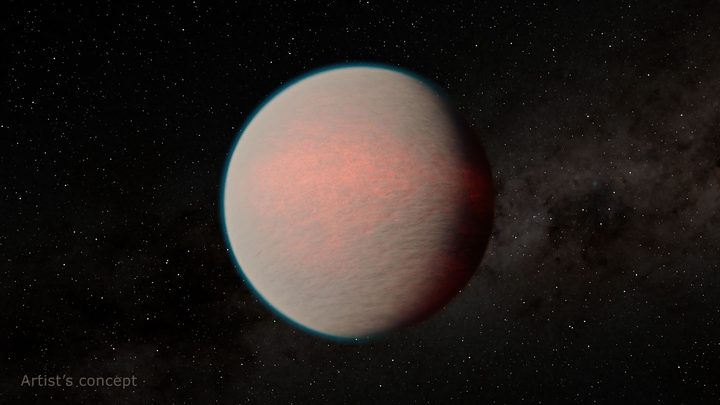
This artist’s concept depicts the planet GJ 1214 b, a “mini-Neptune” with what is likely a steamy, hazy atmosphere. A new study based on observations by NASA’s Webb telescope provides insight into this type of planet, the most common in the galaxy.
This artist’s concept depicts the planet GJ 1214 b, a “mini-Neptune” with what is likely a steamy, hazy atmosphere. A new study based on observations by NASA’s Webb telescope provides insight into this type of planet, the most common in the galaxy. Image used with permission by copyright holder

This water vapor may have contributed to the haziness of the atmosphere, which made observations difficult. However, the main culprit compound causing the reflectiveness remains unknown. “The planet is totally blanketed by some sort of haze or cloud layer,” said lead author Eliza Kempton of the University of Maryland in a statement. “The atmosphere just remained totally hidden from us until this observation.”

Recommended Videos

To observe the planet, researchers used Webb’s Mid-Infrared Instrument (MIRI), which can see temperature variations across the planet, showing the differences between the hot dayside that always faces the star and the cooler nightside that always faces out into space. As well as learning about the atmosphere’s composition, scientists were also able to determine that the planet’s average temperature is a scorching 230 degrees Celsius.

This shows how new tools are able to crack some of the tough nuts in exoplanet research, according to experts who described the planet as a “white whale of exoplanet atmosphere characterization.”

“For the last almost decade, the only thing we really knew about this planet was that the atmosphere was cloudy or hazy,” said Rob Zellem, exoplanet researcher  at NASA’s Jet Propulsion Laboratory in Southern California. “This paper has really cool implications for additional detailed climate interpretations – to look at the detailed physics happening inside this planet’s atmosphere.”

The research is published in the journal Nature.

Georgina Torbet
Georgina has been the space writer at Digital Trends space writer for six years, covering human space exploration, planetary…
Space is becoming Bezos and Musk’s next data center site, and we have every reason to worry
The AI boom is coming for the night sky
How Vast's space station will look in orbit.

AI data centers already consume vast amounts of electricity and water on Earth, so Silicon Valley has begun looking somewhere considerably more spacious... literally.

Elon Musk's SpaceX and Jeff Bezos' Blue Origin, along with several other companies, have proposed enormous constellations of satellites designed to operate as orbital data centers. However, environmental groups and former space officials are now warning that putting them into orbit at the proposed scale could have severe consequences for Earth's atmosphere and the night sky.

Read more
The first possible exomoon is here, and it makes our Moon look hilariously tiny
Scientists may have found the first exomoon, except this one is the size of Jupiter
This artist’s concept depicts a potential volcanic moon between the exoplanet WASP-49 b, left, and its parent star. New evidence indicating that a massive sodium cloud observed near WASP-49 b is produced by neither the planet nor the star has prompted researchers to ask if its origin could be an exomoon.

We have already discovered more than 6,000 planets outside of our immediate neighborhood. Yet, finding a moon orbiting one of those distant worlds has proved considerably harder. Astronomers may finally have something close to the real deal, but this particular object stretches the word “moon” almost beyond recognition.

Using the European Southern Observatory’s Very Large Telescope in Chile, researchers detected strong evidence for a moon-like object in the CD-35 2722 system. Further observations are still necessary to confirm the discovery, but it could become the first confidently detected natural satellite outside our solar system. There is still one tiny complication though. This moon is apparently massive.

Read more
China’s answer to SpaceX’s reusable rockets literally catches boosters in a net
SpaceX catches boosters on legs. China just used a net.
Ammunition, Missile, Weapon

SpaceX's playbook for recovering a rocket booster generally involves legs, a precisely controlled vertical landing, and either a concrete pad or a drone ship. 

China just managed to pull off something similar, but in a slightly different way, and on July 10, it tested the method as well.

Read more

