  1. Home
  2. Audio / Video
  3. News

Digital Trends may earn a commission when you buy through links on our site. Why trust us?

Finnish fuel company will ruin your music if you drive too fast

Add as a preferred source on Google
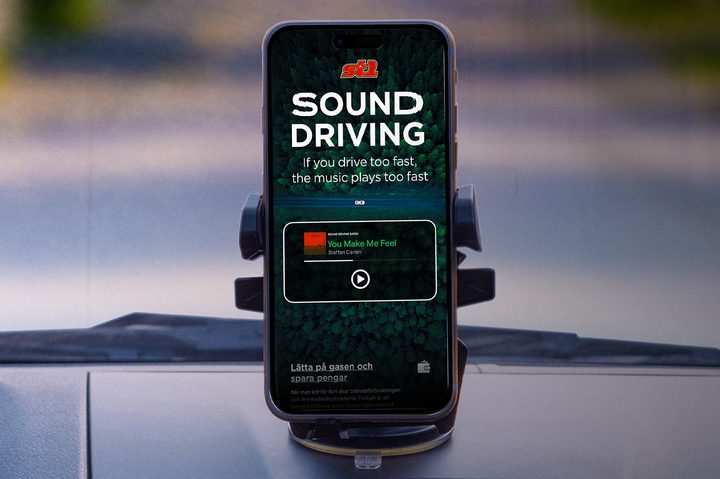
St1's Sound Driving music playlist will speed up the tempo of your music if you exceed speed limits.
St1
Promotional image for Tech For Change. Person standing on solar panel looking at sunset.
This story is part of Tech for Change: an ongoing series in which we shine a spotlight on positive uses of technology, and showcase how they're helping to make the world a better place.

There are plenty of good reasons to avoid driving too fast. You’ll likely face a fine or even jail time if you get caught. Speed is a well-known contributor to traffic fatalities. And if your vehicle runs on gas, you’ll burn more of it if you’ve got a lead foot. That costs more money. But more important: It produces more tailpipe emissions — especially the CO2 that contributes to climate change.

But if all of these reasons aren’t incentive enough to slow down, Finland-based energy company St1 has another suggestion: It will increase the tempo of your music when you exceed posted speed limits, effectively ruining your listening experience as a reminder to take your foot off the gas.

Recommended Videos

To be clear, this is a publicity stunt. St1 has no way of actually modifying your in-car music listening if you use Spotify, Apple Music, or satellite/terrestrial radio stations. Instead, the company has created its own music playback service it calls Sound Driving. And it’s not even a full-fledged music streaming service — it’s literally a single playlist powered by Epidemic Sound that you access via a website.

A driver experiencing the unpleasant change to her music tempo caused by the Sound Driving app.
A driver experiencing an unpleasant change to her music tempo caused by the Sound Driving app. St1 / Vimeo

“The initiative is born from the concept of nudging, a tool that can be used to change people’s behavior in various creative ways,” behavioral scientist and psychologist Björn Hedensjö said in an emailed press release. “It can be compared to the beep you hear if you’re not wearing your seat belt, a clear and important reminder that it’s time to ease up on the gas.”

Technically, nudges — a term popularized by Richard Thaler and Cass Sunstein in their book, Nudge — are meant to be a form of choice architecture, where the desired choice you want someone to make is presented as the more convenient or desirable option. It’s not supposed to be a form of punishment for undesirable behavior.

In order for the playlist to keep track of your speed, it needs access to your phone’s location via GPS, which you’ll have to grant when you first go to the site. Once you hit play, exceeding known speed limits will trigger an increase in the music’s tempo, transforming everything from Beyoncé to James Brown into The Chipmunks. Here’s an example video showing a driver who is clearly annoyed that her music has been altered, yet who also seems momentarily confused as to why it’s happening.

Sound Driving - If you drive too fast, the music plays too fast.

An St1 spokesperson says the company hopes to expand beyond Sound Driving’s single playlist: “We will approach bigger music services with this idea so, hopefully, we may get bigger collaborations in the future.”

Whether you like the idea of having your music altered to remind you to slow down or not, there’s a real benefit to the climate in adopting slower speeds. According to St1, the Swedish Transport Agency calculates that speed violations increase carbon dioxide emissions by 300,000 tonnes per year in Sweden.

If the same is true of American drivers and we extrapolate based purely on population sizes (America’s population is 31 times that of Sweden), speed-related carbon dioxide emissions could be as much as 9.3 million tonnes per year.

Simon Cohen
Former Contributing Editor, A/V
Simon Cohen obsesses over the latest wireless headphones, earbuds, soundbars, and all manner of related devices and…
Bose’s upcoming QuietComfort headphones appear online in six gorgeous colors
The Bose QuietComfort 2 could bring TrueSpatial audio and lossless USB-C playback
Electronics, Headphones

Bose’s standard QuietComfort headphones appear to be on the verge of their first major refresh in nearly three years, and a large collection of official-looking images has now revealed the redesign in full. HotEUDeals, in collaboration with @onLeaks, has shared 54 high-resolution press renders and six Bose marketing slides for the QuietComfort (2nd Gen).

The images show the headphones from several angles in six color options. Black and White Smoke return from the previous model, while Rosewood Mauve, DewDrop Mint, Eucalyptus Green, and Hazelnut Taupe are new additions. Their features, pricing, and expected launch plans were first detailed by Dealabs a couple of weeks ago. The new promotional slides support several parts of that earlier report, including the redesigned materials and TrueSpatial audio.

Read more
Samsung takes on Dolby Vision 2 with its new HDR format hitting Prime Video this month
Samsung's HDR10+ Advanced beats Dolby Vision 2 to Prime Video this month.
Samsung TV Settings

I didn't expect Samsung to be the one crossing the finish line first here, given how much noise Dolby Vision 2 made when it was announced (September 2025). 

The company has confirmed its next HDR format, and it’s arriving on a popular OTT platform this month, beating Dolby Vision 2 to the punch.  

Read more
CMF’s first open-ear earbuds are here with a Smart Dial charging case that lets you control music
CMF's new earbuds ditch touch controls for a rotating dial on the case.
nothing-cmf-clip-pro-earbuds

CMF just stepped into one of the most crowded corners of the earbud market, and it's doing it with a case that steals the spotlight. The Nothing sub-brand launched the Clip Pro, its first open-ear earbuds, designed to let you hear your surroundings without sacrificing sound quality.

The CMF Clip Pro arrives in the US, UK, and Japan on August 15, priced at $99, with a wider global rollout following on September 15.

Read more