1. Home
  2. Space
  3. News

Curiosity rover battles up a 23-degree slope in its exploration of Mars

Add as a preferred source on Google

The Curiosity rover is slowly making its way up Mount Sharp, a 3-mile-tall mountain on Mars. Mountains are useful to study as their steep slopes can reveal layers of material laid down over time, like a geological time capsule. But just like heaving up a mountain is a challenge for humans, it can be tricky for rovers too. Curiosity recently took on a particularly steep and slippery slope, marking its most challenging climb to date.

How difficult terrain is for a rover to pass depends on a number of factors, including how steep it is, how slippery the sand is, and what obstacles such as boulders or sharp rocks are present. This ascent, which the rover tackled through May and June, had all of the above including a 23-degree incline. “If you’ve ever tried running up a sand dune on a beach – and that’s essentially what we were doing – you know it’s hard, but there were boulders in there as well,” said Amy Hale, a Curiosity rover driver at NASA’s Jet Propulsion Laboratory (JPL), in a statement.
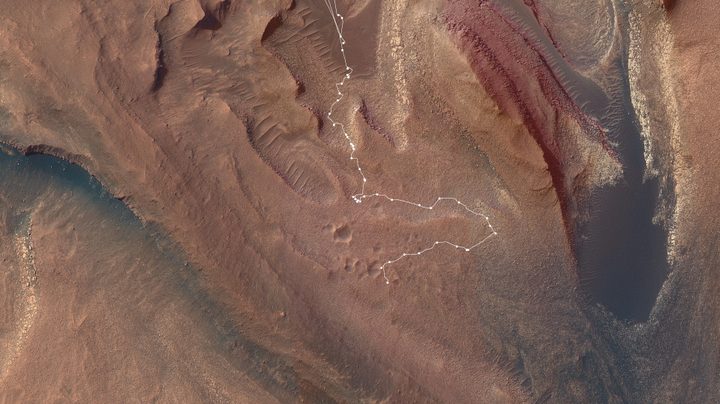
This map shows the route NASA’s Curiosity Mars rover took from May into July to complete the most difficult climb of the mission. Starting in “Marker Band Valley” (the darker area at the top center), the route is shown in white, with dots indicating each stop the rover made.
This map shows the route NASA’s Curiosity Mars rover took from May into July to complete the most difficult climb of the mission. Starting in “Marker Band Valley” (the darker area at the top center), the route is shown in white, with dots indicating each stop the rover made. NASA/JPL-Caltech/USGS-Flagstaff/University of Arizona

The rover drivers like Hale plan out the safest possible route for the rover to travel to get it where it needs to go, then send these commands on to the rover. That’s necessary because of the communications delay between Earth and Mars, which can be up to 20 minutes depending on the planets’ relative positions to each other, which would make it impossible to drive the rover in real time. It also allows for more careful forward planning to ensure no harm comes to the rover.

Recommended Videos

However, sometimes the rover has issues following the commands sent by the drivers, such as if a wheel slips or rolls across a high rock. If the rover experiences any unexpected circumstances like these, it is programmed to stop to prevent any damage — and the drivers refer to these stops as faults.

In the recent ascent, these faults were a frequent issue. “We were basically playing fault bingo,” said Dane Schoelen, Curiosity’s strategic route planning lead at JPL. “Each day when we came in, we’d find out we faulted for one reason or another.”

The drivers decided to take a slight detour which added a few weeks of travel but turned out to be easier to traverse and allowed the rover to reach the end of the climb.

“It felt great to finally get over the ridge and see that amazing vista,” Schoelen said. “I get to look at images of Mars all day long, so I really get a sense of the landscape. I often feel like I’m standing right there next to Curiosity, looking back at how far it has climbed.”

Georgina Torbet
Georgina has been the space writer at Digital Trends space writer for six years, covering human space exploration, planetary…
Space is becoming Bezos and Musk’s next data center site, and we have every reason to worry
The AI boom is coming for the night sky
How Vast's space station will look in orbit.

AI data centers already consume vast amounts of electricity and water on Earth, so Silicon Valley has begun looking somewhere considerably more spacious... literally.

Elon Musk's SpaceX and Jeff Bezos' Blue Origin, along with several other companies, have proposed enormous constellations of satellites designed to operate as orbital data centers. However, environmental groups and former space officials are now warning that putting them into orbit at the proposed scale could have severe consequences for Earth's atmosphere and the night sky.

Read more
The first possible exomoon is here, and it makes our Moon look hilariously tiny
Scientists may have found the first exomoon, except this one is the size of Jupiter
This artist’s concept depicts a potential volcanic moon between the exoplanet WASP-49 b, left, and its parent star. New evidence indicating that a massive sodium cloud observed near WASP-49 b is produced by neither the planet nor the star has prompted researchers to ask if its origin could be an exomoon.

We have already discovered more than 6,000 planets outside of our immediate neighborhood. Yet, finding a moon orbiting one of those distant worlds has proved considerably harder. Astronomers may finally have something close to the real deal, but this particular object stretches the word “moon” almost beyond recognition.

Using the European Southern Observatory’s Very Large Telescope in Chile, researchers detected strong evidence for a moon-like object in the CD-35 2722 system. Further observations are still necessary to confirm the discovery, but it could become the first confidently detected natural satellite outside our solar system. There is still one tiny complication though. This moon is apparently massive.

Read more
China’s answer to SpaceX’s reusable rockets literally catches boosters in a net
SpaceX catches boosters on legs. China just used a net.
Ammunition, Missile, Weapon

SpaceX's playbook for recovering a rocket booster generally involves legs, a precisely controlled vertical landing, and either a concrete pad or a drone ship. 

China just managed to pull off something similar, but in a slightly different way, and on July 10, it tested the method as well.

Read more