It was Wednesday night and I was sick as a dog with some mysterious virus. Waves of nausea and brain fogging left me too weak to sit up. I was on my back for the night — and that gave me the perfect opportunity to test my fancy new AR glasses.
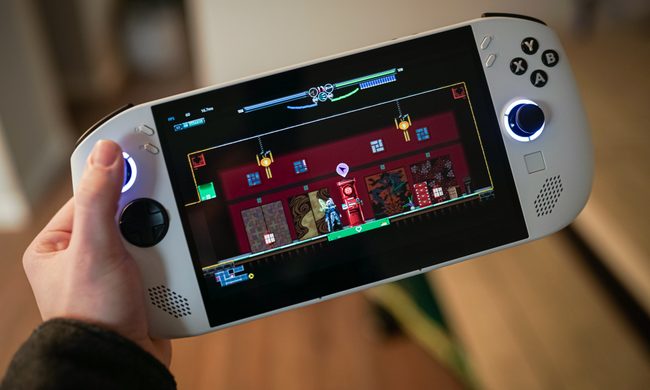
Just a few nights before, I’d gotten a pair of Lenovo’s Legion Glasses. I got the shades alongside my Legion Go and figured I’d use them to enjoy some gaming on a giant 1080p display right in front of my eyes. Since I couldn’t really get out of bed, I decided to strap them on and turn my ceiling into a screen. Maybe I’d do a few races in Forza Motorsport or a fight or two in Nickelodeon All-Stars Brawl 2 while laid up. I’d play neither of those. Instead, I was peacefully lying in the dark while a YouTuber whispered in my ears about malt liquor.
Forget gaming, movies, or web browsing. Devices like the Legion Glasses have one true killer app: ASMR.
Gaming on Legion Glasses
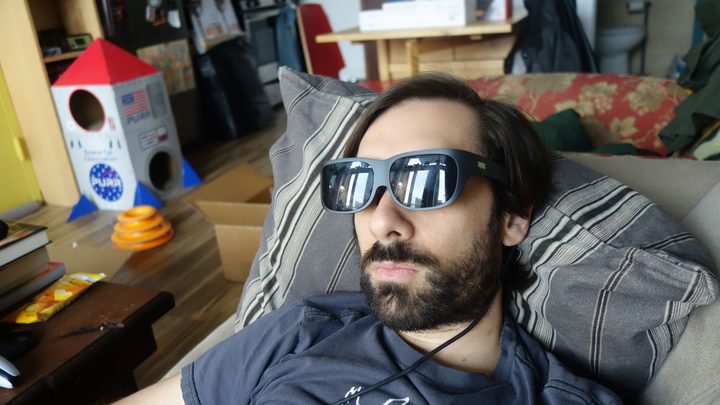
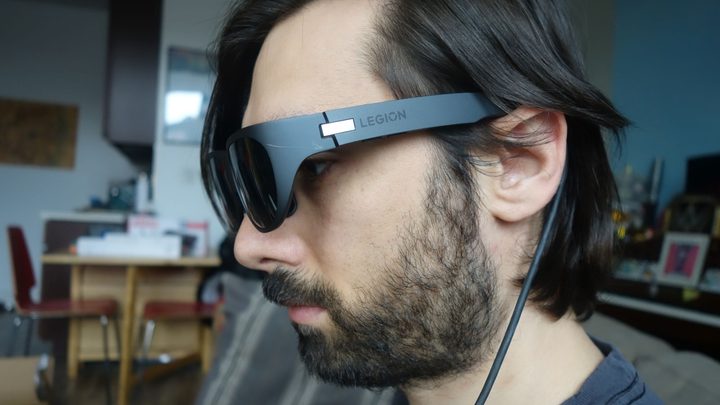
The Legion Glasses are Lenovo’s venture into the emerging AR glass market. It’s a space that’s already given us some strong devices like the XREAL Air 2 as manufacturers are innovating quickly. Lenovo’s stab at the tech is easy to grasp: It’s a pair of sunglasses with two micro-OLED displays behind the frames. You simply plug it into your device of choice via USB and they magically transform into an external monitor that sits on your face.
It’s an incredibly niche concept that has struggled to break into the mainstream wearable market for years, but devices like this indicate that tech companies are getting more serious about it. How serious? The Legion Glasses only cost $329, which is $70 less than the XREAL Air 2. That price cut does come at a slight cost, as the latter sports a 120Hz refresh rate while Lenovo’s glasses tap out at 60Hz.
The aspirational idea here is that glasses like this make it feel like you’ve got your own personal movie theater right at home, creating the illusion of an enormous screen. It’s no surprise that entertainment is the key selling point for this tech market, with gaming at the forefront especially. I’d put that idea to the test before my sudden illness, playing some games while lounging comfortably on the couch.
It didn’t take much effort to get set up. All I needed to do was strap on the glasses and plug them into my Legion Go. That’s it. The glasses themselves don’t require much fiddling either. There are no buttons to tweak focus like a VR headset, so all I really had to manage was speaker volume and brightness (both easily controlled via buttons on the temples). Granted, I quickly wished I did have more options to tweak the display. During my testing, the image always tended to be a little blurry for me, especially at the edges of the frames. If I wanted to spend the extra cash, I could get some prescription lenses slotted in, but that seems like a lot to spend for a tech gimmick.
After adjusting to that mild fuzziness, I quickly found the potential appeal of a device like this. I kicked back on my couch in a comfortable position, my neck firmly resting on a pillow while I lay down, and loaded up Forza Motorsport via my Legion Go. The racing simulator has become my go-to chill-out game in the past month, so it was the perfect game to play in that position. It’s also one that doesn’t require much reading, which I found was hard to do considering how small a lot of video game UI tends to be these days. It’s not like I could get closer to the screen to see it better, after all.
Is that an experience I think everyone needs? Absolutely not. It is the definition of luxury only reserved for those who have hundreds to spend. As I laid back, I thought about how practical a device like this could be for someone recovering from an injury or dealing with limited mobility. There’s no neck or body strain required when using them, which could really be helpful in specific situations.
And I’d experience that specificity firsthand a few days into testing.
ASM-AR
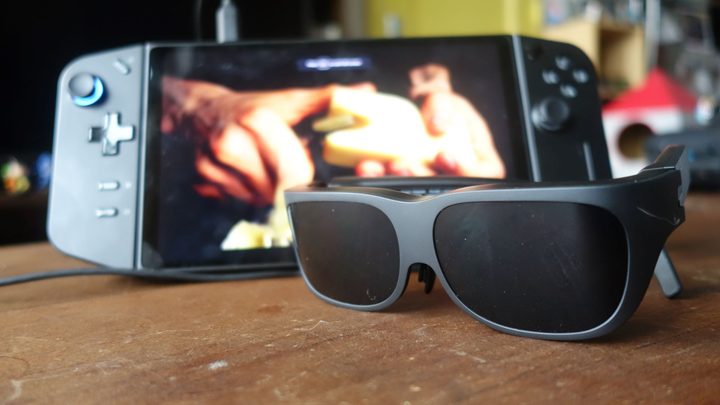
Let’s flash forward to that night I was laid up in bed with an upset stomach. Unable to sleep, I grabbed my Legion Go and Glasses. I started wondering how I could use them in a moment to calm my brain without requiring too much attention. A game would be a little too intense for my brain fog, but ASMR would be just what the doctor ordered.
For the uninitiated, ASMR (autonomous sensory meridian response) refers to a pleasant tingling sensation that some people experience when hearing certain soft noises. That’s led to a bevy of content creators over the years who’ve created an entire genre of ASMR videos. These clips, which populated YouTube in the millions, feature sound artists whispering in binaural microphones and crafting relaxing soundscapes. I’ve watched videos like this for years to help with my anxiety and calm my brain down on stressful nights.
At first, I was only goofing around when I told myself I should load up an ASMR video on my Legion Glasses. It just seemed like a ridiculous thing to do with a $329 piece of tech. It turned out that wasn’t a joke. I loaded up some old standby ASMR videos (from airplane ambiance to alcohol pouring) and quickly found they were a perfect match for the device.
That’s largely thanks to its speakers, which sit above each ear. That feature just so happens to fit neatly with the binaural audio recording used in most ASMR videos. Having glasses on my face would also keep me from looking at my phone or doing something else while listening. All I could really do was close my eyes and let the sounds sink in, giving me a more immersive experience with something that’s helped me relax over the years.
The absurdity of this is not lost on me. When you go to read hands-on impressions of a hot new tech product, you’re probably not expecting to read about how great whispered YouTube videos play on it. That speaks to what’s ultimately intriguing about devices like the Legion Glasses, though. There are a lot of creative use cases for it that go far beyond the needless luxury of playing a game on glasses instead of your TV. I don’t expect I’ll use mine for long gaming sessions anytime soon, but I’ll absolutely strap them on the next time I’m stressed out (and trust me, that’ll happen a lot). That shouldn’t convince you to drop hundreds on a pair of your own, but it should help you imagine what kind of personal routines could be enhanced with the right tech toy.