  1. Home
  2. Space
  3. News

NASA’s Juno spacecraft to pass within 1,000 miles of volcanic moon Io

Add as a preferred source on Google

NASA’s Juno spacecraft, currently in orbit around Jupiter, will soon be making a close flyby of one of the planet’s most dramatic moons, Io. On Saturday, December 30, Juno will come within 1,000 miles of Io, making it the closest spacecraft to that moon in the last 20 years.

Io is an intriguing place because it shows signs of significant volcanic activity, making it the most geologically active body in the solar system. It hosts over 400 active volcanoes, which periodically erupt due to hot magma inside the moon created by friction caused by the gravitational pull between Jupiter and its other large moons.
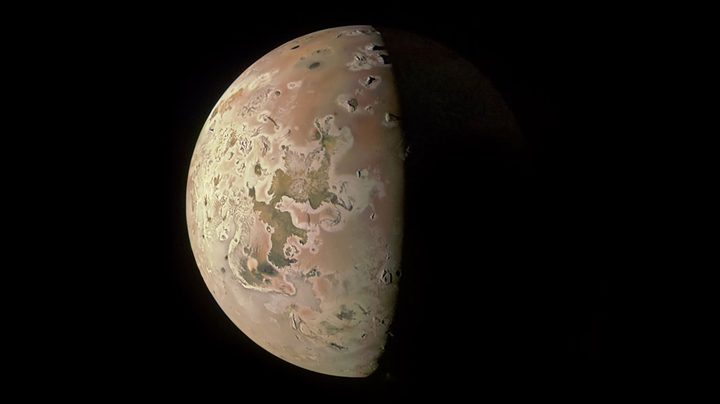
This image revealing the north polar region of the Jovian moon Io was taken on October 15 by NASA’s Juno. Three of the mountain peaks visible in the upper part of image, near the day-night dividing line, were observed here for the first time by the spacecraft’s JunoCam.
This image revealing the north polar region of the Jovian moon Io was taken on October 15 by NASA’s Juno. Three of the mountain peaks visible in the upper part of image, near the day-night dividing line, were observed here for the first time by the spacecraft’s JunoCam. NASA/JPL-Caltech/SwRI/MSSS, Image processing by Ted Stryk

Juno has previously observed Io from a distance, coming within around 7,000 miles of the moon on a previous flyby. But now, it will come much closer, allowing the mission to take more detailed readings of the moon.

Recommended Videos

“By combining data from this flyby with our previous observations, the Juno science team is studying how Io’s volcanoes vary,” said Juno’s principal investigator, Scott Bolton of the Southwest Research Institute, in a statement. “We are looking for how often they erupt, how bright and hot they are, how the shape of the lava flow changes, and how Io’s activity is connected to the flow of charged particles in Jupiter’s magnetosphere.”

The mission will make another close pass of Io in early next year, on February 3. “With our pair of close flybys in December and February, Juno will investigate the source of Io’s massive volcanic activity, whether a magma ocean exists underneath its crust, and the importance of tidal forces from Jupiter, which are relentlessly squeezing this tortured moon,” said Bolton.

The environment around Jupiter is tricky for spacecraft, however, as there is a large amount of radiation that can damage electronics. This harsh environment has begun to cause damage to one of Juno’s instruments, its beloved JunoCam imager, which has taken some spectacular images of the planet over its 12-year mission.

“The cumulative effects of all that radiation has begun to show on JunoCam over the last few orbits,” said Ed Hirst, project manager of Juno at NASA’s Jet Propulsion Laboratory. “Pictures from the last flyby show a reduction in the imager’s dynamic range and the appearance of ‘striping’ noise. Our engineering team has been working on solutions to alleviate the radiation damage and to keep the imager going.”

Georgina Torbet
Georgina has been the space writer at Digital Trends space writer for six years, covering human space exploration, planetary…
Dimming the sun sounds unhinged, but this new study on El Niño makes a surprisingly good case for it
A natural test case, Australia's worst-ever wildfire season, suggests the idea deserves serious consideration.
Nature, Outdoors, Sky

When I first saw "scientists propose dimming the sun," I rolled my eyes. It sounds like a science fiction movie cooked up after watching many climate documentaries. But a new study, published on July 8, 2026, in the journal Science Advances, seems to have a genuinely compelling argument.

A Super El Niño is currently forming in the Pacific, feared to be the most intense in decades. It could escalate floods, wildfires, and extreme heat events worldwide. However, Researchers at UC San Diego's Scripps Institution of Oceanography, led by climate scientists Kate Ricke and Jessica Wan, are now proposing one of the most interesting solutions I’ve come across.

Read more
You can now walk through space and gaze into a black hole at this VR exhibit
Smithsonian Starstruck lets you drift past dying stars and see the origin point of the universe for as little as $18 a person.
Smithsonian Starstruck featured

Most planetarium shows ask you to sit still and look up. The Smithsonian's new VR exhibit takes a different approach, letting visitors walk through the vast expanse of the universe, drifting past stars, planets, and a black hole to get a physical sense of its true scale.

A $29 ticket to the edge of the galaxy

Read more
Scientists warn Elon Musk’s orbital data centers could blind Earth’s biggest telescopes
A new ESO study suggests millions of satellites could make parts of the night sky effectively unusable for astronomy.
One hour of satellites over the northern Atacama Desert in Chile (October 2025)

The race to blanket Earth with satellite internet has unlocked faster connectivity for millions. But according to the European Southern Observatory (ESO), it could also make one of humanity's oldest hobbies, and one of its most important sciences, a whole lot harder. The organization warns that the rapid growth of satellite mega-constellations could severely disrupt observations made by some of the world's most powerful telescopes.

Astronomers say the night sky is reaching its limit

Read more