So, you’ve unlocked a new ability in a Metroidvania. You know that it could help you get to a previously inaccessible area, but you don’t quite remember exactly where that area was on the game’s expansive map. It’s a common feeling when playing the genre and an issue that games have been trying to solve for years. That frustration is what inspired the creation of the Memory Shards system in Prince of Persia: The Lost Crown, which provided a salve to this problem by enabling players to pin screenshots of certain obstacles on their map.
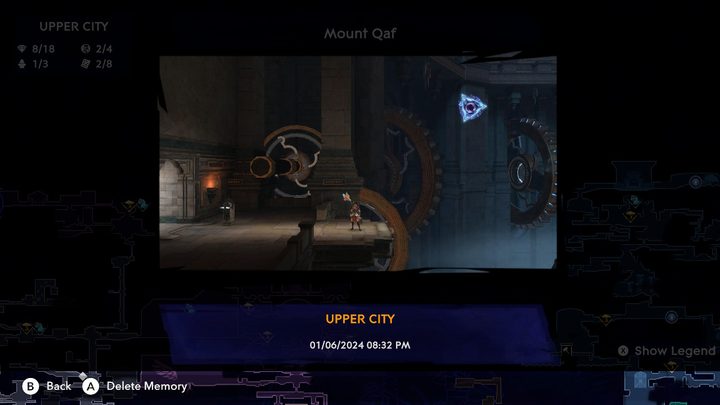
At any time while walking around Mount Qaf, players can press down on the D-pad to leave behind a Memory Shard that pins a screenshot to the map. Later, after gaining a new ability or just increasing or mastering a platforming skill, Memory Shards quickly remind players where they can use the skill they just learned. There is a finite number of Memory Shards that players can pin, but more can be found via exploration. It’s the kind of engaging Ouroboros-style game design that provides a sturdy backbone to an engrossing Metroidvania.
“The principle of taking mental notes is a key element of Metroidvania games: You encounter a blocked path, and you need to come back later with the right tool to unlock it,” Senior Game Designer Rémi Boutin tells Digital Trends in an exclusive interview about the creation of Memory Shards. “If you take a break or if you have to take too many mental notes, you forget what you were trying to achieve. As players, it happens to us a lot. At the same time, we were playing games with photo mode, and some of us were also using the screenshot features of the console to remember the blocked path. Memory shards came naturally from all these elements.”
Prince of Persia: The Lost Crown impresses as an expansive yet accessible Metroidvania when it launched earlier this month. In addition to its silky smooth platforming and combat, innovative ideas like the Memory Shard system make exploring this vast world a seamless process that never gets frustrating. To learn more about how it came to be, I spoke to Ubisoft Montpellier about a small creation that has the potential to revolutionize the Metroidvania genre going forward.
Making new memories
One of Prince of Persia: The Lost Crown’s biggest strengths is how it emphasizes approachability and accessibility. It’s a game where the platforming and combat challenges can get very tough, but Ubisoft gave players the two to toggle and customize the experience with things like a Guided Mode, platforming assist portals, and Memory Shard features. According to Boutin, the development team’s main goal with The Lost Crown was “to open the Metroidvania genre to as many players as possible,” so accessibility played a major part in the game’s development from the start.
“It took a ton of iteration to come to this simplicity.”
Each time the team designed a system, Boutin says Ubisoft analyzed if any noticeable barriers could potentially gatekeep enjoyment of it. If issues were identified, the developers behind those specific features were in charge of finding the best ways to make the system more palatable. Memory Shards are meant to solve the issue of not being able to remember a previously encountered obstacle that can now be overcome.
For the most part, Boutin believes that the core aspects of Memory Shards stayed the same from conception to release, although some small elements were tweaked for simplicity’s sake. “What took time was to refine the interactions, the moment to introduce it, and its first use,” Boutin says. “We did some tests where you had to ‘aim’ what you were taking a screenshot of, and enemies could hurt you, but as you expect, it was not really helpful or fun for the player. I think that the final version feels simple and natural, but it took a ton of iteration to come to this simplicity.”
Playtesting played a critical role in getting a feature that works this well. Boutin says that when Ubisoft didn’t tell players about it, there were “huge differences” between the experiences of those who did and those who did not find it. That’s why it’s a system clearly introduced and tutorialized to the player on the game’s main path. To help ingrain the importance of this system into players’ minds further, Ubisoft also acknowledged this mechanic within The Lost Crown’s narrative and world with the Eye of the Wanderer item.
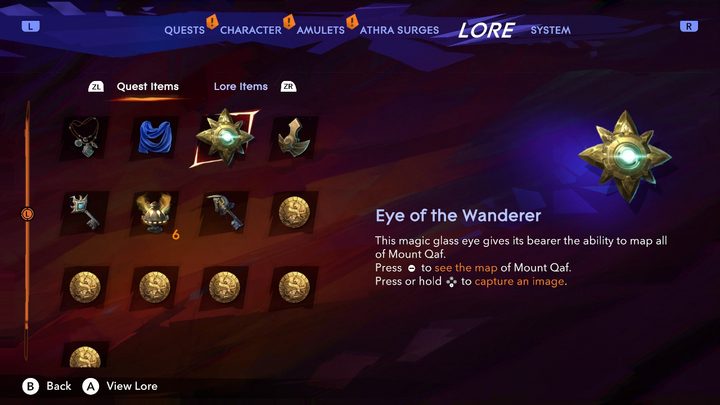
“When we playtested it and observed how much players loved it, we knew this feature was core to our game,” Boutin says. “We also wanted players to watch the world rather than only look at icons on the map. By merging it with the map in the fantasy of the game, we think it’s easier for players to link exploration, cartography, and Fariba, who can trade them her maps. At the same time, we read that one of the first eye prostheses in the world was discovered in the southeastern part of Iran.”
This approach to game design, where even more esoteric mechanics are acknowledged within the game’s wider world and lore, can make gameplay mechanics feel more cohesive and fitting for the experience. That’s why it feels so satisfying to use Memory Shards in The Lost Crown rather than just looking at icons on a map like you would in another Metroidvania like Disney Illusion Island.
A memorable system
Using Ubisoft Connect, The Lost Crown supports cross-progression and cross-saves. This means that if you’re playing the game on Nintendo Switch and take a Memory Shard screenshot, that same Memory Shard must appear on your map if you were to boot the game up on Xbox Series X and continue playing there. Although that increases the utility of Memory Shards even further, it did place limits on how many screenshots Ubisoft could let players take and pin to the map.
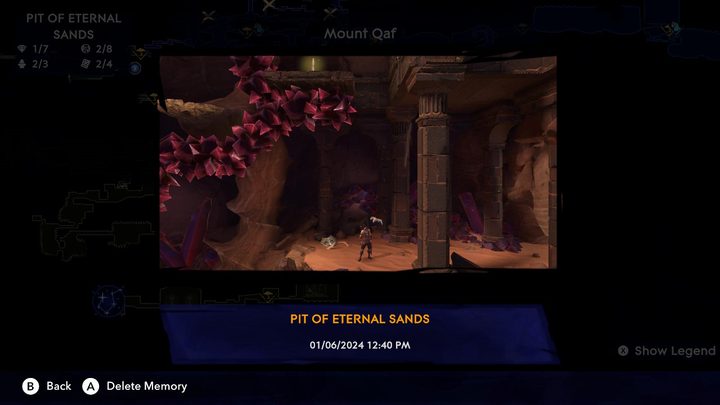
“We had to be not to have an enormous save data because of the screenshots, so we had to find the right number,” Boutin acknowledges. “You can have a total of 25 Memory Shards per save, we think it’s enough to manage your exploration. One side effect is that it also pushes the player to “clean” their Memory Shards and keep a readable map! Another interesting thing is that we don’t give all Memory Shards from the beginning so that some of them act as a reward, often in situations where you need to take screenshots, remembering the existence of the feature to the player.”
That speaks to the depth of this otherwise simple system. Memory Shards give back just as much as players put into it, and that ethos can be seen across many of The Lost Crown’s difficulty and accessibility offerings. That makes sense, as Boutin admits the development team’s approach “was to not be shy on accessibility options and trust the player.” Ubisoft designed The Lost Crown to be challenging, both in terms of combat and exploration, but systems like Memory Shards ensured that novice or struggling players could have the options to create a more enjoyable experience immediately available.
It’s possible to play through the entirety of The Lost Crown without ever using a Memory Shard, but in a way, that’s a best-case scenario for this idea. Memory Shards are a helpful tool for players whenever they need it without taking anything away. They subtly but comprehensively innovate, creating a helpful feature that many Metroidvania players — including myself — will sorely miss in future games in the genre, like Hollow Knight: Silksong, if they don’t adopt a similar system. Boutin hopes to see it in future Metroidvanias, implementing it in a way that’s “easy to use, to see on the map, and to manage.”
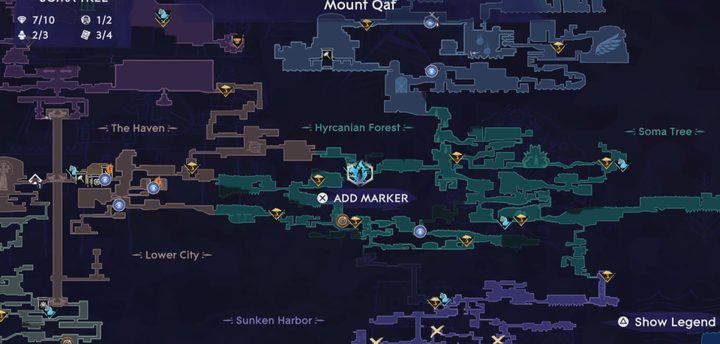
Photo modes and map markers have existed in video games for years, but by combining the two in this exploration-focused genre and grounding it within the game’s world, Ubisoft ensured The Lost Crown would be a palatable Metroidvania that encourages players to go for 100% completion, not a head-scratching adventure where backtracking is a slog. Memory Shards are an innovative feature that sets Ubisoft’s latest apart as one of the best games of January 2024 and will hopefully be something other video game developers are inspired by going forward.
Prince of Persia: The Lost Crown is available now for PC, PS4, PS5, Xbox One, Xbox Series X/S, and Nintendo Switch.