Thanks to what were clearly very accurate leaks, we already knew that Samsung was planning to release a new generation of Galaxy Buds wireless earbuds with a strong resemblance to Apple’s iconic AirPods Gen 3 and AirPods Pro. What we didn’t know at the time was just how closely Samsung had stuck to Apple’s formula.
If imitation is the sincerest form of flattery, Apple should be feeling very flattered indeed. The new Galaxy Buds are as close as it gets to Apple’s designs, right down to the price: $180 for the Galaxy Buds 3 and $250 for the Galaxy Buds 3 Pro (one dollar more expensive than Apple’s pricing). The two models are available for preorder today and will be in stores starting July 24.
The Galaxy Buds 3 and Buds 3 Pro got their official unveiling today at the Samsung Galaxy Unpacked event in Paris. Along with the new earbuds, Samsung showed off its new Galaxy Z Fold 6 and Galaxy Z Flip 6 smartphones. We got a look at the new earbuds at a private event in Toronto.


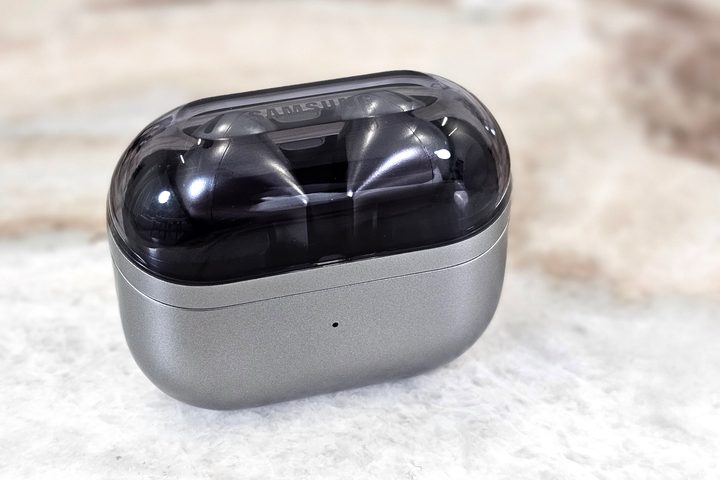
- 1. Samsung Galaxy Buds 3 (top) and Galaxy Buds 3 Pro
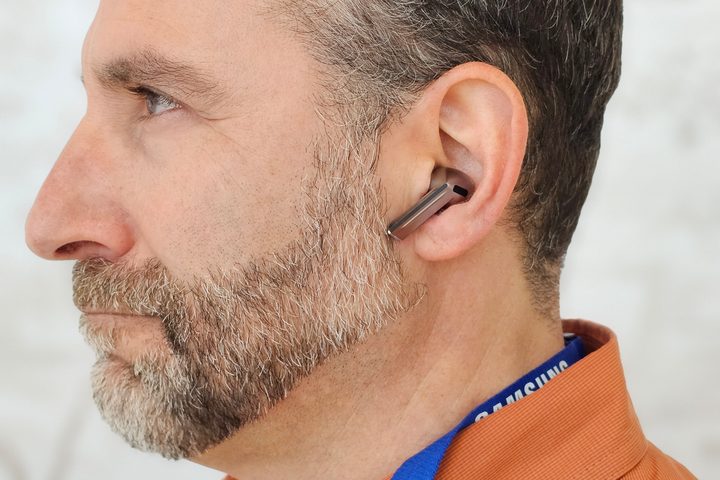
- 2. Samsung Galaxy Buds 3 (left) and Galaxy Buds 3 Pro

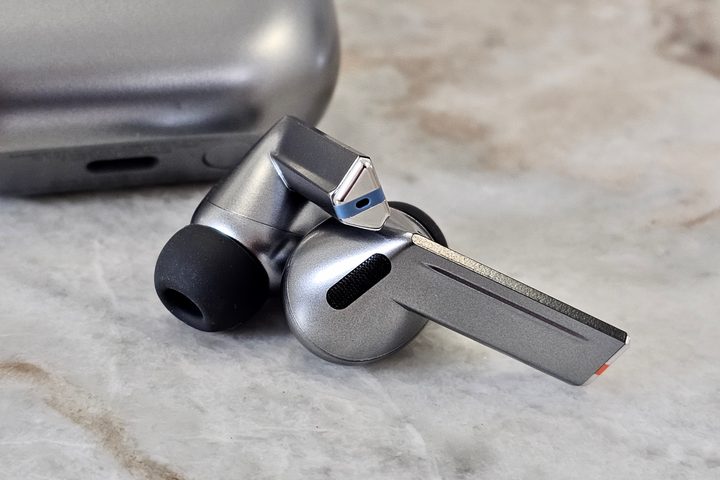
The Buds 3 are the equivalent of the AirPods Gen 3, with a semi-open design that doesn’t seal the ear canal, while the Buds 3 Pro are closer to the AirPods Pro with USB-C, as they sport silicone eartips that sit up against your ear canal’s opening. The portions of these earbuds that sit in the ear bear a striking resemblance to their respective AirPods model, but Samsung has at least found a way to differentiate the stems: they’re trapezoidal, and not round.
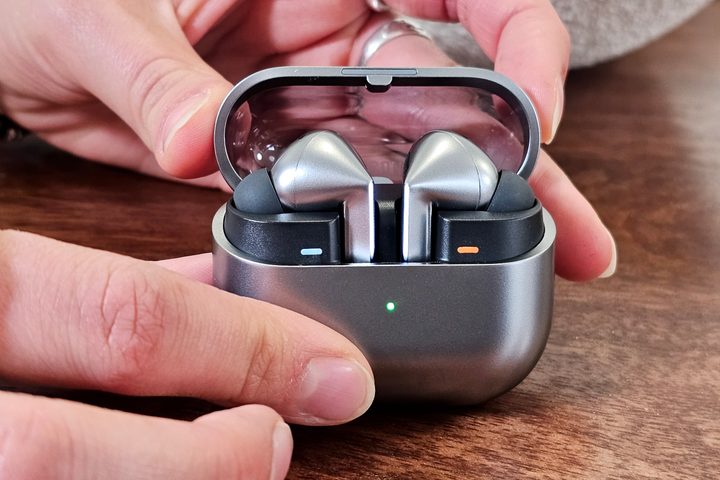
The Galaxy Buds 3 Pro further differentiate themselves with a “blade” LED strip that runs the length of the stem. Why? Supposedly, the LEDs will help you locate the buds when you use the Samsung Find feature on a Galaxy phone.
Samsung’s controls will be instantly familiar to AirPods Pro users. Pinching gestures on the stems cover all of the major functions, while volume is controlled by a vertical swiping gesture.

So those are all of the ways that the Galaxy Buds 3 and 3 Pro are like Apple’s earbuds. However, under those AirPods-like outer shells, Samsung has found a number of ways to potentially improve on Apple’s formula.
It starts with water and dust resistance: With an IP57 rating that makes them effectively waterproof anddust proof, these new earbuds aren’t just an improvement over Apple (IPX4), they’re an improvement over every previous model of Galaxy Buds.

The Galaxy Buds 3 Pro use two drivers (a 10.5mm dynamic driver combined with a 6.1mm planar driver) powered by two discrete amplifiers. PSB Speakers took a similar approach with its M4U TWM wireless earbuds, and the results were impressive. Samsung says the driver combo has a frequency response of up to 40kHz, which officially puts the earbuds in hi-res audio territory.
Both the Buds 3 and Buds 3 Pro are compatible with digital audio up to 24-bit/96kHz, but unfortunately, the only way this works is via the Samsung Seamless Codec (previously named Samsung Scalable Codec) — an exclusive feature of Samsung’s smartphones. Also, both models can transmit your voice at a very high-quality 16kHz, but again, only with a compatible Samsung phone.
The Buds 3 Pro is further enhanced with active noise cancellation (ANC) and transparency modes. The Buds 3 also get ANC — an unusual feature for semi-open earbuds (the AirPods Gen 3 don’t cancel noise) — but they lack the transparency option. Presumably the semi-open shape lets in plenty of external sound when ANC is off.
Samsung is also promoting the use of AI on its latest Galaxy devices, including the new Galaxy Buds. On the earbuds, this means new features like Interpreter, which can deliver translated versions of your voice to a Galaxy phone’s speaker and translated versions of your companion’s voice to the Galaxy 3 series earbuds.
I got a very short one-minute demo of Interpreter at my briefing. While the translations themselves appeared accurate and quick enough (we were doing English/Spanish), at times the system would repeatedly translate the same phrase. Samsung claims it will be especially useful for students who need real-time translation of a lecture.
The earbuds also get Bixby-powered hands-free voice commands — a series of two-word commands that can be used to control music playback. Both ANC and EQ functions are adaptive to your environment.
The Galaxy Buds 3 Pro also get a handy voice-sensing function that will automatically switch to transparency mode and drop the volume of your music when you begin speaking. That same monitoring feature will look for specific sounds in your environment and react accordingly: construction sounds will trigger an increase in ANC, while siren sounds will do the opposite.
Battery life looks similar to prior Galaxy Buds and to the AirPods: Samsung says the Galaxy Bud 3 get 5 hour per charge and 24 hours total when you include their charging case, and that’s with ANC on. When it’s off, the numbers go up to 6 and 30 hour respectively. For the Buds 3 Pro, it’s 6/30 ANC on and 7/30, ANC off.
Finally, Samsung says the Galaxy Buds 3 and 3 Pro will be Auracast compatible and will get 360 Audio with head tracking and object-rendering support — a move that is an expansion of the company’s existing support for these technologies in its TVs.