1. Home
  2. Space
  3. News

Europa Clipper blasts off to study whether Jupiter’s icy moon could host life

Add as a preferred source on Google
A SpaceX Falcon Heavy rocket carrying NASA’s Europa Clipper spacecraft lifts off from Launch Complex 39A at NASA’s Kennedy Space Center in Florida at 12:06 p.m. EDT on Monday, Oct. 14, 2024.
A SpaceX Falcon Heavy rocket carrying NASA’s Europa Clipper spacecraft lifts off from Launch Complex 39A at NASA’s Kennedy Space Center in Florida at 12:06 p.m. EDT on Monday, Oct. 14, 2024. NASA/Kim Shiflett

NASA has launched another deep space mission — this one to explore an icy moon of Jupiter and study whether it could potentially be habitable. The Europa Clipper mission launched using a SpaceX Falcon Heavy at 12:06 p.m. ET today, Monday October 14, from Launch Complex 39A at Kennedy Space Center in Florida, setting off on its long journey to the Jovian system.

“Liftoff, @EuropaClipper!” NASA Administrator Bill Nelson wrote on X.  “Today, we embark on a new journey across the solar system in search of the ingredients for life within Jupiter’s icy moon. Our next chapter in space exploration has begun.”
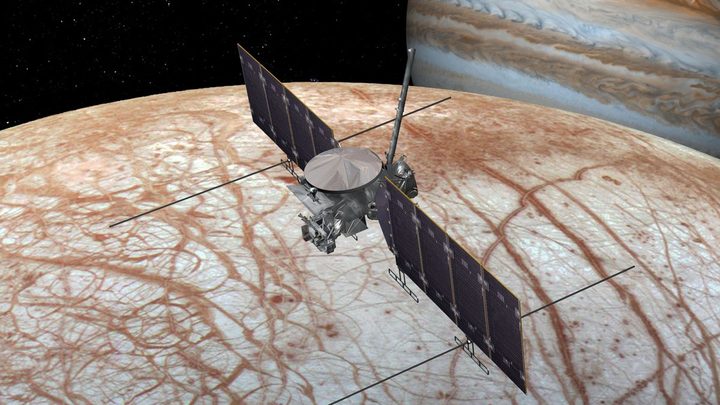
This artist's impression depicts NASA's Europa Clipper spacecraft.
This artist’s impression depicts NASA’s Europa Clipper spacecraft. NASA/JPL-Caltech

The mission aims to explore the moon of Europa, which is particularly interesting to astrobiology researchers as it has a liquid water ocean. This ocean isn’t on the moon’s surface, however — as it is so far from the sun, the ocean is hidden beneath a icy shell of around 10 to 15 miles in thickness. Missions like Galileo have orbited Europa and taken readings from it, but this effort ended in 2003. Since then, the moon has only been explored in flybys. Now, the moon will get its own dedicated mission, set to begin when Clipper arrives there in 2030.
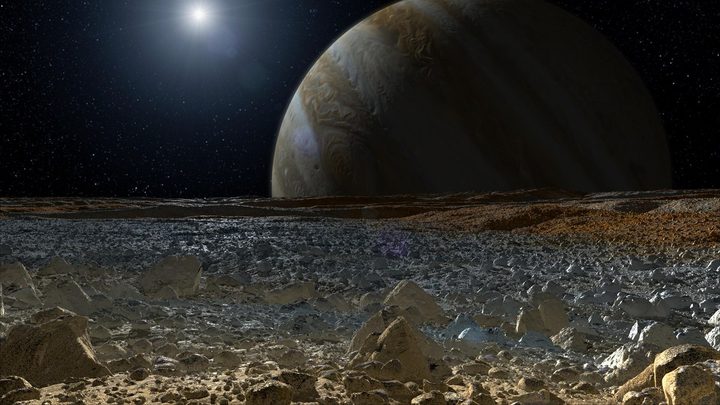
This artist's impression shows a simulated view from the frigid surface of Jupiter's moon, Europa, where temperatures drop to minus 170 degree Celsius.
This artist’s impression shows a simulated view from the frigid surface of Jupiter’s moon, Europa, where temperatures drop to minus 170 degree Celsius. NASA/JPL-Caltech

Europa Clipper will study the moon’s ice shell to determine exactly how thick it is, and will also look beneath this shell into the ocean below to see whether it hosts materials called organic compounds — the building blocks of life. While the mission is not expecting to find evidence of life there, scientists want to know it the required elements for life to form are present, as that will help them learn about what locations in our solar system and beyond could potentially host life.

Recommended Videos

“It’s important to us to paint a picture of what that alien ocean is like — the kind of chemistry or even biochemistry that could be happening there,” said Morgan Cable of NASA’s Jet Propulsion Laboratory in a statement.

Other icy moons like Enceladus are known to give off epic plumes of water vapor from their surface, in which material from the oceans below bursts through the ice and is thrown up into the air above the moon. It’s not known if Europa also has these plumes, but to study this alien environment from orbit, Clipper will fly close to the surface and take tiny samples of material being ejected.

“The spacecraft will study gas and grains coming off Europa by sticking out its tongue and tasting those grains, breathing in those gases,” said Cable.

For now, the mission has made contact with ground control and is safely on its way to Jupiter on a 1.8-billion mile journey. It will use the gravity of other planets to give it a boost on its way, making flybys of Mars and Earth before performing a slingshot maneuver onward to its destination.

Georgina Torbet
Georgina has been the space writer at Digital Trends space writer for six years, covering human space exploration, planetary…
China’s answer to SpaceX’s reusable rockets literally catches boosters in a net
SpaceX catches boosters on legs. China just used a net.
Ammunition, Missile, Weapon

SpaceX's playbook for recovering a rocket booster generally involves legs, a precisely controlled vertical landing, and either a concrete pad or a drone ship. 

China just managed to pull off something similar, but in a slightly different way, and on July 10, it tested the method as well.

Read more
Dimming the sun sounds unhinged, but this new study on El Niño makes a surprisingly good case for it
A natural test case, Australia's worst-ever wildfire season, suggests the idea deserves serious consideration.
Nature, Outdoors, Sky

When I first saw "scientists propose dimming the sun," I rolled my eyes. It sounds like a science fiction movie cooked up after watching many climate documentaries. But a new study, published on July 8, 2026, in the journal Science Advances, seems to have a genuinely compelling argument.

A Super El Niño is currently forming in the Pacific, feared to be the most intense in decades. It could escalate floods, wildfires, and extreme heat events worldwide. However, Researchers at UC San Diego's Scripps Institution of Oceanography, led by climate scientists Kate Ricke and Jessica Wan, are now proposing one of the most interesting solutions I’ve come across.

Read more
You can now walk through space and gaze into a black hole at this VR exhibit
Smithsonian Starstruck lets you drift past dying stars and see the origin point of the universe for as little as $18 a person.
Smithsonian Starstruck featured

Most planetarium shows ask you to sit still and look up. The Smithsonian's new VR exhibit takes a different approach, letting visitors walk through the vast expanse of the universe, drifting past stars, planets, and a black hole to get a physical sense of its true scale.

A $29 ticket to the edge of the galaxy

Read more