1. Home
  2. Space
  3. News

Here’s what NASA plans to do with its shiny new SpaceX spacecraft

Add as a preferred source on Google
nasa lunar landers delivery plans hls large cargo 240419 jpg
SpaceX

As SpaceX gears up for the big sixth test flight of its Starship vehicle, NASA has announced its longer term plans for the next generation of SpaceX craft. The company is in the process of developing a human lander for the moon, which NASA intends to use along with a lander from Blue Origin to potentially carry astronauts to the lunar surface as part of the Artemis program.

But NASA won’t just be carrying people in its two shiny new spacecraft. The agency announced today that it also intends to use the vehicles to carry cargo such as equipment and infrastructure to the moon.

Recommended Videos

“NASA is planning for both crewed missions and future services missions to the Moon beyond Artemis V,” said Stephen D. Creech, assistant deputy associate administrator for technical at the NASA Moon to Mars Program Office. “The Artemis campaign is a collaborative effort with international and industry partners. Having two lunar lander providers with different approaches for crew and cargo landing capability provides mission flexibility while ensuring a regular cadence of Moon landings for continued discovery and scientific opportunity.”
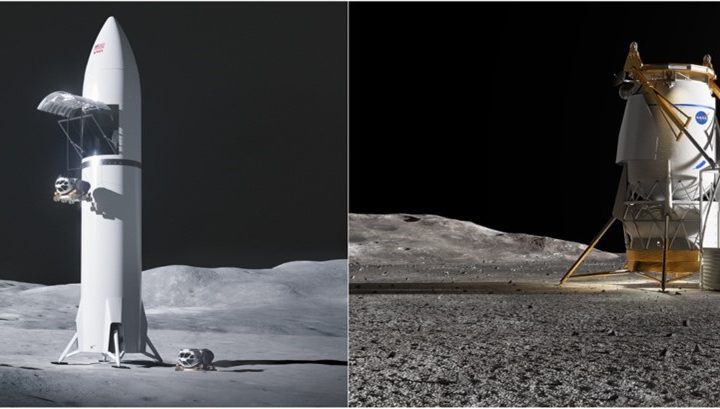
Early conceptual renderings of cargo variants of human lunar landing systems from NASA’s providers SpaceX, left, and Blue Origin, right. The large cargo landers will have the capability to land approximately 26,000 to 33,000 pounds (12-15 metric tons) of large, heavy payload on the lunar surface.
Early conceptual renderings of cargo variants of human lunar landing systems from NASA’s providers SpaceX, left, and Blue Origin, right. The large cargo landers will have the capability to land approximately 26,000 to 33,000 pounds of large, heavy payload on the lunar surface. SpaceX/Blue Origin

For NASA to succeed in its ambitious plans to create a moon base where astronauts can live for periods of weeks or even months, it will need to create a large amount of infrastructure such as habitats, water filtration systems, and scientific research laboratories on the lunar surface.

The current plan is for at least two cargo missions to drop off large pieces of equipment including a pressurized rover, carried by the SpaceX Starship cargo lander, and a habitat, carried by the Blue Origin Blue Moon lander. These cargo drop-offs can act as a kind of test for whether the landers are capable of carrying humans on future missions.

“Based on current design and development progress for both crew and cargo landers and the Artemis mission schedules for the crew lander versions, NASA assigned a pressurized rover mission for SpaceX and a lunar habitat delivery for Blue Origin,” said Lisa Watson-Morgan, NASA program manager of the Human Landing System. “These large cargo lander demonstration missions aim to optimize our NASA and industry technical expertise, resources, and funding as we prepare for the future of deep space exploration.”

Both companies are in the process of developing their landers, with SpaceX intending to use a variant of the Starship vehicle it is currently testing for this task. The current timeline puts the Starship carrying the rover to the moon in 2032, and the Blue Moon delivering the habitat in 2033.

Georgina Torbet
Georgina has been the space writer at Digital Trends space writer for six years, covering human space exploration, planetary…
China’s answer to SpaceX’s reusable rockets literally catches boosters in a net
SpaceX catches boosters on legs. China just used a net.
Ammunition, Missile, Weapon

SpaceX's playbook for recovering a rocket booster generally involves legs, a precisely controlled vertical landing, and either a concrete pad or a drone ship. 

China just managed to pull off something similar, but in a slightly different way, and on July 10, it tested the method as well.

Read more
Dimming the sun sounds unhinged, but this new study on El Niño makes a surprisingly good case for it
A natural test case, Australia's worst-ever wildfire season, suggests the idea deserves serious consideration.
Nature, Outdoors, Sky

When I first saw "scientists propose dimming the sun," I rolled my eyes. It sounds like a science fiction movie cooked up after watching many climate documentaries. But a new study, published on July 8, 2026, in the journal Science Advances, seems to have a genuinely compelling argument.

A Super El Niño is currently forming in the Pacific, feared to be the most intense in decades. It could escalate floods, wildfires, and extreme heat events worldwide. However, Researchers at UC San Diego's Scripps Institution of Oceanography, led by climate scientists Kate Ricke and Jessica Wan, are now proposing one of the most interesting solutions I’ve come across.

Read more
You can now walk through space and gaze into a black hole at this VR exhibit
Smithsonian Starstruck lets you drift past dying stars and see the origin point of the universe for as little as $18 a person.
Smithsonian Starstruck featured

Most planetarium shows ask you to sit still and look up. The Smithsonian's new VR exhibit takes a different approach, letting visitors walk through the vast expanse of the universe, drifting past stars, planets, and a black hole to get a physical sense of its true scale.

A $29 ticket to the edge of the galaxy

Read more