The RX 9070 faced off with the RTX 5070 when it launched in March, and it did a great job of it. It undercut the competition and offered not just credible performance, but impressive performance. That raises the question, can it go up against the even-more-expensive RTX 5070 Ti? Benchmarks would suggest it can.
But performance is never the whole story. Let’s see how the RX 9070 and 5070 Ti compare, head to head.
Pricing and availability
The AMD RX 9070 launched on March 6, with a suggested retail price of $549. Unfortunately, like every new component launch in 2025 so far, stock issues and tariffs from the new Trump administration mean that graphics card prices are far higher than they should be, and if you can find an RX 9070 in stock, its price is more likely to be between $650 and $750. It can go for ever more on second-hand markets.
The RTX 5070 Ti was launched at the end of February, with a suggested retail price of $750. Like the RX 9070 and other RTX 50-series cards, though, its price has skyrocketed. These cards sell for over $1,000 when they’re in stock at all, and some listings are as high as $1,300.
Specifications
| AMD RX 9070 | Nvidia RTX 5070 Ti | |
| Transistors | 53.9 billion | 45.6 billion |
| Die size | 357mm squared | 378 mm squared |
| Shader units | 3584 | 8960 CUDA cores |
| Ray accelerators | 56 | 70 |
| AI accelerators | 56 | 280 Tensor cores |
| Game clock | 2070 MHz | N/A |
| Boost clock | 2520 MHz | 2452MHz |
| Memory | 16GB GDDR6 | 16GB GDDR7 |
| Memory speed | 20 Gbps | 28 Gbps |
| Memory bus | 256-bit | 256-bit |
| Total board power | 220W | 300W |
The two cards are quite different in design, so their specifications are quite distinct, too. The RX 9070’s die packs in billions more transisitors, but the RTX 5070 Ti has many more CUDA cores than the AMD GPU’s shader units. Nvidia’s card has more tensor and RT cores, and much faster memory — but it comes at the cost of much higher power demands.
The RX 9070 can keep up in clock speed, though.
Performance
Let’s shine a light on the elephant in the room: The RTX 5070 Ti is the faster card. It has better rasterization performance, better ray tracing capabilities, and its DLSS upscaling and multi frame generation are better than the AMD alternatives. But the RX 9070 holds it own fairly well.
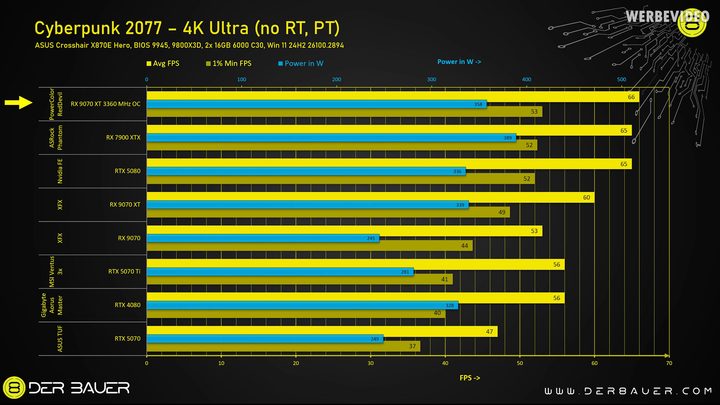
If we look at the overclocking RX 9070 XT graph from famed overclocker, der8auer, we can see that the RX 9070 is only within a few FPS of the RTX 5070 Ti in Cyberpunk 2077 at 4K, and its 1% minimums are actually better than the Nvidia card.
In Club386’s testing, the RX 9070 was less than 10% slower than the RTX 5070 Ti, despite pulling far less power. PCGamer’s testing showed the RX 9070 dominating the RTX 5070 and often only sitting a few frames per second behind the RTX 5070 Ti.
In TechPowerUp’s relative performance tables, the RX 9070 falls about 20% behind the RTX 5070 Ti and that’s probably a fair distance to put between the two cards across a super wide range of games and all factors considered. But there’s no denying that the RX 9070 is more than powerful enough to play games at 1440p and at 4K with great frame rates, and do it much cheaper than the 5070 Ti.
The RX 9070 is a great option, but it’s not better
If you’re looking for a new graphics card in 2025, you need to consider just buying whatever you can get your hands on. The market is that bare and the prices are that bad. But if we’re to look at these two cards objectively, they each have different things going for them.
The RTX 5070 Ti is the faster card. Its rasterization performance is better across most games, and its RT and AI upscaling capabilities are greater than the RX 9070s. However, the RX 9070 is often only 10-15% slower then the 5070 Ti, and its FSR frame generation and upscaling are still solid options in compatible games — there isn’t much of a difference on ray tracing, either.
As with most of the new GPUs this generation, what you can and should get comes down to price. If you can get either of these cards at MSRP, they’re worth considering. But in reality, the best you can hope for is a $700 RX 9070, or a $1,000+ RTX 5070 Ti. At least for the next couple of months.
With that in mind, the RX 9070 is the better buy. The 5070 Ti does not offer $300 (or over 42%!) additional performance or capabilities. It also uses far more power and makes you use Nvidia’s problematic power connector. The RX 9070 is good enough and could be great when its price returns to something more sensible, but for now it’s just the better value buy.