
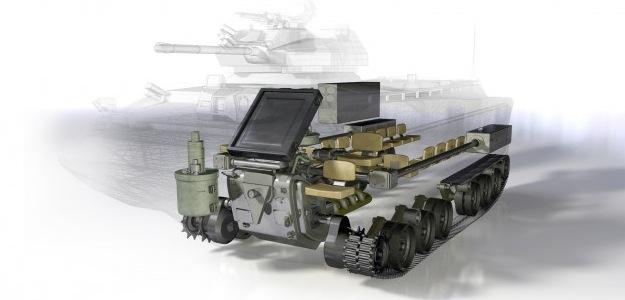
 Those looking for stories about how the Internet can bring people together and enrich their lives, here’s one that’s a bit out of the ordinary. Sure, there are long lost twins that reunite over the Web, or adopted kids searching for their biological parents. But this is a heartwarming story of how one man, his father, and their friend used the Internet to collaboratively design the drive train and control systems for an armored vehicle which won them a million dollars. You didn’t see that one coming, did you?
The trio consist of Eric Nees, father James, and friend Brian Eckerly, who responded to a request from the Defense Advanced Research Projects Agency (DARPA). As part of its Fast Adaptible Next-Generation Ground (FANG) vehicle contest – which sought to speed up the concept-to-prototype cycle through crowdsourcing and collaborative development – the three formed a team called Team Ground Systems and created a solution that garnered the highest scores for design threshold and manufacturing practicality in FANG’s first round. The win that netted the team a $1 million prize.
Each of the team members have some level of engineering background. Eric works for a defense contractor in California, while his father spent more than two decades working for the Air Force as a research engineer, and currently works as a project manager in the Air Force Research Laboratory; Eckerly graduated from Ohio State University with a bachelor’s degree in electrical and computer engineering – but only Eric had any background in automotive systems, putting him in the driver’s seat for this project. “There’s jargon that wasn’t necessarily accessible to people not familiar with automotive systems in this project,” Eric told to Ars Technica about the win.
While both Neeses worked together to design the system itself, Eckerly worked on simulations to see how successful the designs would be. “We had to run a lot of simulations and collect data from them,” he explained. “I was good at trying a lot of different combinations, collecting the data, and then providing the results back to my teammates on what was working well and what wasn’t.”
Discussing the collaborative nature of their work – and of the contest as a whole – Eric Nees said that that was a lot of value in Web design space. “It doesn’t take a lot of searching to see how this sort of crowdsourcing of design and integrated development environments have changed a lot of industries,” he said. Despite the differing amounts of work each member put in, Nees said that there was only one way that their prize haul could be fairly distributed: “A simple three-way split.”


