

Google’s keynote address at its I/O developer conference today had everything a geek could want from free laptops to new APIs. Near the end of the three and a half hour presentation, Google’s Chairman and CEO Larry Page took the stage to give his final remarks and answer questions. During this discussion, Page took the time to talk about everything from innovation to inter-operation of companies, government regulations, goals for Google as a company, and some sobering viewpoints he had on the world of technology and development for it.
Page on his childhood and the importance of innovation
Larry Page began his own address with a story form his own childhood. His voice was soft and quiet, a product of health issues related to his thyroid and a stark contrast from some other CEOs and their addresses. Page talked about how his dad took him and his family across the country to a robotic conference, fighting tooth and nail to get his son into the conference despite being below the age requirement. This was the beginning to his monologue on the importance of innovation and for a company like Google to continue building new creative ideas.
 “One of the themes I just want to talk to you about is how important it is for us – all of the developers in the room and watching – to really focus on technology and to get more people involved in it,” he said.
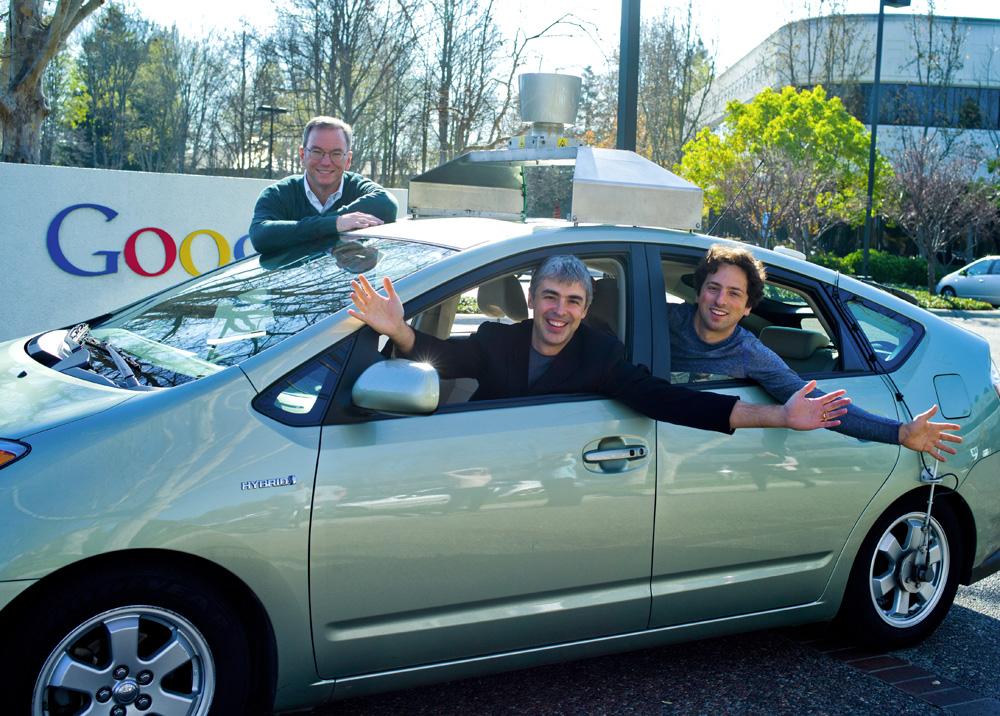
Page talked about a lot of the innovations seen in recent years from developments in both mobility and the Internet, and how we haven’t seen a rate in change like this “since the birth of the PC.” He exuded optimism and talked about all the exciting new technologies we may see just around the corner, from innovations in clean coal to self-driving cars, which he sees as the next step to “change our lives and our landscape” from adding green space, to causing fewer accidents and offering more freedom to drivers.
Page on being tired of negativity
However, this optimism came alongside sobering thoughts about how others in the industry – notably competitors and the press – viewed Google’s ambitions, “Every story I read about Google is about us versus some other company or some stupid thing that I don’t find that very interesting. We should be about building great things that don’t exist.” He talked about how Google’s endeavors are not simply measured in profit, or even with respect to what the company is already known for doing. He especially didn’t enjoy being compared to companies like Apple and Microsoft, where he sees Google as simply an innovator to make lives better, and not necessarily competition with these companies.
“Being negative is not how we make progress, and the most important things are not zero sum,” Page added. He was talking about initiatives made by Google like Google Fiber and Gmail, which were both new things way outside what the company was known for doing. Google got it’s start in search, but took its experience in building data centers and storage services to offer something like Gmail – free e-mail with tons of storage – that no one had ever done before. Now it’s offering some of the fastest internet in the country to help make the internet experience a better one for its users.
“I encourage companies to do a little more that’s outside of their comfort zone” Page told the audience, “Almost every time we do something crazy, we make progress.” These and other initiatives, including “Physical World initiatives” like the self-driving car and Android are what Page sees as new opportunities that offer a lot more than Google spent developing them, and every company should be considering such options. “As technologists, we should have some safe places where we can try out the effects of technology” Page later said, hinting that it would be great if there were actual cities or regions where large-scale technological inventions could be tested.
Page on the open Web
“As technologists, we should have some safe places where we can try out the effects of technology.”
“You need to have interoperation… We struggle with people like Microsoft. The Web is advancing too slowly. I’d like to see more open standards,” Page said. He also noted that he has also been sad with how the industry has been unable to advance the Web as quickly as it could have because of a focus on negativity and zero sum gains. He also noted other companies like Oracle and his difficulty in working with them, “Money is more important to them than collaboration.”
Page on freedom of speech
Another interesting question that came forward was regarding government regulation and internet freedom of speech. Page defended the need for freedom of speech, but also stated that “We’re [Google] protecting your private information, and ensuring security. We’re being as transparent as we can.”
Freedom of speech also came up later when talking about initiatives like Google Health, which met their demise not from the idea or the functionality, but instead from government regulations, and the fear of users placing their health records online. He noted how people feared their health records and knowledge of their health not for their safety but because of being possibly denied insurance. Page noted that there should be initiatives to offer everyone health insurance so that knowledge about health could be freely shared to help people.
Page on Google Glass
When it came to Google Glass, Larry Page made clear his own feelings on why Google is doing something like it, and why they’re currently offering the device only to developers and select members of the press. “Our main goal is to get happy users using Glass,” he said, noting that with happy users Google could work to improve the technology and eventually make it ready for the average user. “We want to make sure that we’re making user experiences that make people happy.” Again this vision was dead-set on the “Don’t be evil” mindset Google set forth back when it was founded.
Page on women in tech
One of the last questions brought forth to Page was about how few women were in the audience. “We have to start young, getting young girls interested in technology,” he noted, also talking about the many women Google interviews when looking for people to add to the team.
All in all, Larry Page offered the audiences of Google I/O an engaging conversation that was more wide-ranging and deeper than your typical press conference. While most companies look to flaunt ideas and attract press, Page took a more down-to-earth approach and covered a mixture between his own values and Google’s own vision for the coming years. The real question though is if Google will live up to these visions as the years go on.


