1. Home
  2. Computing
  3. News

OpenAI has a new website where you can check if an image is real or AI slop

OpenAI and Google are teaming up to put a stamp on every AI image.

Add as a preferred source on Google
OpenAI verification tool in action on iPad
Rachit Agarwal / Digital Trends

Spotting an AI-generated image is getting harder by the day. OpenAI wants to change that, and it is using Google as a partner to accomplish this behemoth task.

OpenAI has announced a significant update to how it handles content provenance, which is just a fancy way of saying how you can tell where an image came from and whether it was AI-generated.

Recommended Videos

The update has three key parts: C2PA conformance, a new watermarking partnership with Google, and a public tool you can use to verify images yourself.

So what is actually changing?

OpenAI has been adding metadata, called Content Credentials, to images generated by its tools since 2024. This metadata is embedded in all generated images and tells you how it was created. The company has now become a C2PA Conforming Generator, which means other platforms can reliably read and find the information when they encounter OpenAI-generated content.

The bigger news is the partnership with Google. OpenAI is now adding Google DeepMind’s SynthID watermarking to images generated through ChatGPT and the OpenAI API. Unlike metadata, which can be stripped when you screenshot or re-upload an image, SynthID embeds an invisible watermark directly into the image. It is designed to survive the transformations that can typically erase metadata-based detection.

Industry-wide collaboration on content transparency tech is key to a trusted web. 🤝
We’re accelerating the momentum started with @NVIDIA and partnering with @OpenAI, Kakao, and @ElevenLabs to bring SynthID to their generative content — helping give everyone more helpful context… pic.twitter.com/rs3tobexNX

— Google (@Google) May 19, 2026

The two systems work together. The metadata carries detailed information about the image’s origin, while the watermark acts as a backup when the metadata doesn’t make it.

How can you check if an image is AI-generated?

OpenAI is previewing a public verification tool at openai.com/verify. You can upload an image, and the tool will check for both Content Credentials and SynthID watermarks to determine if it was generated using OpenAI’s tools.

One important caveat: if the tool finds no watermark or metadata, it will not definitively say the image is not AI-generated. This is because the watermark and metadata can still be spoofed. 

Also, not all generative AI companies have partnered up with Google to include SynthID in their images. Unless SynthID or something similar is universally adopted by every generative AI model, no verification tool can tell you with 100% certainty that an image is not generated by AI. 

Still, it’s a step in the right direction. AI-generated images have become a mayhem and are widely used for nefarious purposes. A system to recognize ones is absolutely needed, and I am happy Google and OpenAI are paving the way for it.

Rachit Agarwal
Rachit is a seasoned tech journalist with over ten years of experience covering the consumer technology landscape.
Lenovo’s next ThinkCenter desktop is ready to hit the shelves, but the price will make you blink twice
The ThinkCentre X is finally heading to the US with up to 256GB RAM, dual RTX 5060 Ti GPUs, and a price tag that rivals a used car.
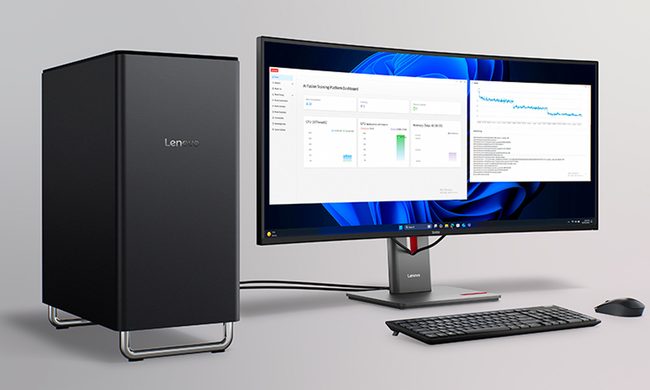
Lenovo ThinkCentre X workstation with monitor

If the phrase "future-proof desktop" means never worrying about running out of RAM again, Lenovo may have just built the ultimate machine. The company is preparing to launch its new ThinkCentre X workstation desktop in the US after making it available in several international markets. Built for AI workloads, professional content creation, and demanding enterprise applications, the desktop can be configured with up to 256GB of DDR5 memory, Intel's latest Core Ultra 9 processor, and support for dual GeForce RTX 5060 Ti 16GB GPUs.

A workstation built for serious workloads

Read more
A metallic Hall effect keyboard and a 59g mouse are Lenovo’s latest upgrades for snazzy gaming setups
The Legion R7 RT75 keyboard and Y7MG mouse bring 8K polling to both sides of your gaming setup
Computer, Computer Hardware, Computer Keyboard

Magnetic gaming keyboards and lightweight mice are hardly unusual anymore, but Lenovo is trying to push both ideas a little further with its latest Legion peripherals. The new lineup includes the Legion R7 RT75 keyboard and Legion Y7MG mouse, and both support an 8,000Hz polling rate for players who want every input delivered to their PC as quickly as possible.

Of course, Lenovo has styled these peripherals to be as bold and eye-catching as possible without getting in the way of practicality. The keyboard has a hefty metallic design with translucent keycaps and RGB lighting. Compared to that, the mouse is more tame and traditional in design, but it also has an RGB strip that appears to belong on an alien spaceship. (via NotebookCheck)

Read more
Shopping for back-to-school? These are the budget laptops I’d actually recommend
From a $359 Chromebook to the cheapest way into macOS, these are the budget picks worth your money.
Computer, Electronics, Laptop

The back-to-school season often turns into a laptop, especially the budget ones that aren't too heavy on your wallet. Due to the ongoing memory crisis, most manufacturers have already bumped up their laptop prices, including Apple. However, that doesn't mean that I won't help you get a new machine. So, for this one, I spent time digging through spec sheets, customer ratings, and price tags, finding devices that don't just look cheap in an Amazon listing, but actually hold up. 

From a flexible touchscreen Chromebook to the least expensive way into macOS, these six laptops balance price and performance well. I'd hand any one of them to a student heading back to campus this fall, depending on what they need and what their priorities are. 

Read more