  1. Home
  2. Cars
  3. Emerging Tech
  4. Photo Galleries
  5. Legacy Archives

CarVi’s dash cam doesn’t just record the road, it sends safety data to your phone

Add as a preferred source on Google

Dash cams, even those that connect to smartphones, are not uncommon these days. More rare, though, are products that can analyze video in real time and send important safety information back to the driver.

One such example is CarVi, a driver’s assistant that is currently crowdfunding on Indiegogo.

How does this hockey puck-shaped device work? CarVi uses a windshield-mounted, single-lens camera to record the road, then sends video to Android or iOS phones via on-board Wi-Fi.

The CarVi app then uses an algorithm to monitor the film, warning the driver of unsafe following distances and sudden lane changes with audio and visual alerts.

It even keeps tabs on jackrabbit starts, hard braking, and reckless motoring, providing the user with a map of previous journeys, a daily driving ‘SKOR,’ and suggestions to improve skills behind the wheel.

CarVi
Image used with permission by copyright holder

CarVi began development back in 2010 and records in 720p HD. The unit includes an embedded 3D G sensor, microphone, and Wi-Fi dongle, and supports up to a 64GB Micro SD card. The device measures 100mm in diameter and weighs 250 grams, or just over a half-pound.

CarVi’s crowdfunding campaign kicked off on February 4th, and has raised $35,961 of its $100,000 goal at the time of this writing. The company has until March 20th, 2015 to raise the full amount.

There are various rewards (Indiegogo calls them ‘perks’) associated with different levels of financial contribution. They include a branded T-shirt for $25, a CarVi pre-order for $249, and a ‘Hacker’s Choice’ development kit for $499.

Bundled with the CarVi unit itself, the ‘Hacker’s Choice’ option will allow you to customize the device to your liking depending on your level of programming savvy.

Andrew Hard
Andrew first started writing in middle school and hasn't put the pen down since. Whether it's technology, music, sports, or…
Volvo is rolling out Apple Music to over 2 million cars with a simple OTA update
Your Volvo may soon get Apple Music without needing CarPlay
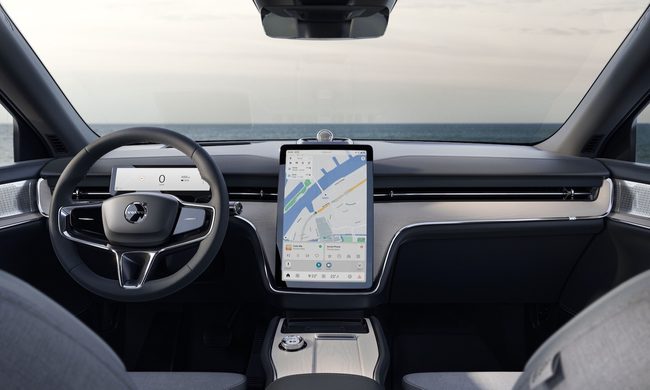
Interior view of the 2024 Volvo EX90.

The line between your smartphone and your car continues to blur. Volvo has announced that it is rolling out an over-the-air software update that brings Apple Music directly to the infotainment systems of more than 2 million vehicles worldwide. Instead of relying on Apple CarPlay or plugging in an iPhone, eligible drivers will be able to stream music natively from their car's built-in system, making Apple Music another integrated feature of Volvo's software experience.

The update is arriving for a wide range of Volvo models, including the EX90, ES90, XC90, S90, V90, XC60, S60, V60, XC40, EX40 and EC40, covering model year 2020 onwards. Availability, however, may vary depending on the vehicle.

Read more
Chery’s latest EV packs flagship tech for the price of a base Tesla, but you can’t buy it
Here's everything packed into Exeed's 2027 Exlantix ES, from its 27-sensor autonomous driving suite to its 860 km range, all starting under $31,000.
Car, Transportation, Vehicle

Chery's premium arm just dropped a sedan that makes you wonder why American EVs cost twice as much for half the tech.

Exeed's 2027 Exlantix ES ships with a driver-assist system called Falcon 700. It is built around an Nvidia Orin-Y chip and a genuinely stacked sensor suite.

Read more
A new AI model wants self-driving cars to think before they swerve
Forget guessing games, this self-driving AI actually shows its work.
Self driving car

Self-driving cars have gotten pretty good at driving. The harder problem is teaching them to drive safely in situations nobody planned for. We have heard horror stories of self-driving cars, behaving erratically in emergency situations, often times delaying first responders from reaching the scene.

A team at Seoul National University, led by professor Jun Won Choi from the Department of Electrical and Computer Engineering, thinks they have cracked part of that puzzle with a new AI model called SafeDrive. The research was recently selected as a highlight paper at CVPR 2026, a distinction that goes only to roughly 3% of all submissions.

Read more