1. Home
  2. Cars
  3. News

Garmin’s ‘nuviCam’ rolls dash cams, GPS, and driver-assist safety tech into one

Add as a preferred source on Google

Not long ago, dash cams were just that: cameras mounted on or around your vehicle’s dashboard that saved footage to an SD card.

Higher-end systems have added GPS navigation functions in recent years, giving positional context to the captured film.

Recommended Videos

A new device by Garmin takes the technology one step further by recognizing and analyzing threats that could compromise the driver’s (or anyone else’s) safety on the road.

The product in question is called the ‘nuviCam,’ and it bundles HD dash cam functionality with driver-assist features “typically found only in luxury vehicles,” the brand says.

Since the nuviCam is constantly recording, its software can detect both the home vehicle’s lane position and the distance to the car in front, offering Lane Departure Warning and Forward Collision Warning services. If an collision is unavoidable, the device recognizes it, saves the footage, and records the exact location with its onboard GPS. There’s even a feature called Snapshot that allows drivers to take still images of the damage.

Garmin nuviCam
Image used with permission by copyright holder

“The nuviCam LMTHD goes beyond helping drivers get from Point A to Point B,” said Dan Bartel, VP of Garmin worldwide sales. “The intuitive driver-assist features not only lessen the stress of getting you to your destination, but the nüviCam also provides peace of mind in knowing that your commute is being recorded and can be referenced should you need it.”

The dash cam also equips something called Garmin Real Vision, which reads and displays hard-to-read house numbers on the 6-inch pinch-to-zoom screen, while also offering directional arrow prompts. It doesn’t stop there though, as Garmin has included an Up Ahead feature that informs the driver of nearby restaurants, rest stops, gas stations, speed limit changes, school zones, and more with preloaded Foursquare data.

The nuviCam is expected to go on sale in May for a suggested retail price of $399.99.

Andrew Hard
Andrew first started writing in middle school and hasn't put the pen down since. Whether it's technology, music, sports, or…
Volvo is rolling out Apple Music to over 2 million cars with a simple OTA update
Your Volvo may soon get Apple Music without needing CarPlay
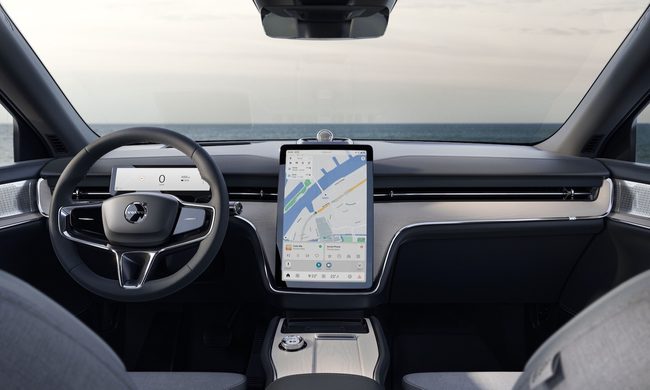
Interior view of the 2024 Volvo EX90.

The line between your smartphone and your car continues to blur. Volvo has announced that it is rolling out an over-the-air software update that brings Apple Music directly to the infotainment systems of more than 2 million vehicles worldwide. Instead of relying on Apple CarPlay or plugging in an iPhone, eligible drivers will be able to stream music natively from their car's built-in system, making Apple Music another integrated feature of Volvo's software experience.

The update is arriving for a wide range of Volvo models, including the EX90, ES90, XC90, S90, V90, XC60, S60, V60, XC40, EX40 and EC40, covering model year 2020 onwards. Availability, however, may vary depending on the vehicle.

Read more
Chery’s latest EV packs flagship tech for the price of a base Tesla, but you can’t buy it
Here's everything packed into Exeed's 2027 Exlantix ES, from its 27-sensor autonomous driving suite to its 860 km range, all starting under $31,000.
Car, Transportation, Vehicle

Chery's premium arm just dropped a sedan that makes you wonder why American EVs cost twice as much for half the tech.

Exeed's 2027 Exlantix ES ships with a driver-assist system called Falcon 700. It is built around an Nvidia Orin-Y chip and a genuinely stacked sensor suite.

Read more
A new AI model wants self-driving cars to think before they swerve
Forget guessing games, this self-driving AI actually shows its work.
Self driving car

Self-driving cars have gotten pretty good at driving. The harder problem is teaching them to drive safely in situations nobody planned for. We have heard horror stories of self-driving cars, behaving erratically in emergency situations, often times delaying first responders from reaching the scene.

A team at Seoul National University, led by professor Jun Won Choi from the Department of Electrical and Computer Engineering, thinks they have cracked part of that puzzle with a new AI model called SafeDrive. The research was recently selected as a highlight paper at CVPR 2026, a distinction that goes only to roughly 3% of all submissions.

Read more