This year, one of the biggest names in home computing is set to release the newest iteration of its proprietary operating system, an update that’s being touted as its definitive version. That company is, of course, Microsoft — but fifteen years ago, Apple was going through a very similar transition, as OS 9 was phased out in favor of OS X.
Microsoft has never been too proud to learn from its competitors, and on the surface there are a great deal of superficial similarities between Windows 10 and OS X. Looking more closely at the way Apple approached the tenth version of its operating system, we might be able to see what Microsoft’s real intentions are, as the company prepares to bring Windows 10 to as broad a swathe of users as possible.
Ashes to OSes
“Mac OS 9 was a friend to us all,” Steve Jobs quipped as he held a mock funeral for the operating system at WWDC 2002. Organ music and a coffin completed the theatrics, as Jobs signaled the end of OS 9’s reign and the dawn of OS X.
OS X built on concepts that had been forged at NeXT, specifically OPENSTEP. Jobs founded NeXT in 1985 after being fired from Apple, and sought to create computer workstations that could be used for academic and scientific applications.
However, because of its hefty price tag of nearly ten grand, the NeXT computer struggled to make as big an impact on its intended audience as Jobs and the rest of the company would have liked. That being said, it did find some success — CERN’s retelling of the birth of the web states that Tim Berners-Lee built the first ever website on an NeXT machine.
In 1997, Jobs returned to Apple as the company bought out NeXT for $427M. Work began on transforming OPENSTEP into the next generation of Mac OS. While OS 9 launched after his return to Apple, OS X was clearly a product that was personally important to Jobs. It was something of a fresh start for the OS, and crucially it was a piece of software that built on the work that Jobs did in his time away from the company.
With that in mind, the spectacle of Jobs appearing next to the operating system’s coffin has a bit more context. It’s an attention grabbing PR move, for sure; however, it’s also a pretty clear demonstration of the death of the old Apple, and the birth of something new.
The X Factor
OS X was a contributing factor to the market share growth that Mac computers have enjoyed over the past decade. Today, people are very familiar with Macs and their operating system, thanks in no small part to the popularity of Apple’s iPods, iPads and iPhones. Many of those familiar with the current state of the Mac perhaps would not claim to be an expert on OS 9 and its predecessors.
Everyone was wary [of OS X] because it was a big change, but it turned out to be a good one.
Owen Linzmayer, however, is something of an authority on the company and its products. He’s written a great deal about Macs over the past fifteen years, most notably the comprehensive Apple Confidential 2.0: The Definitive History of the World’s Most Colorful Company. I spoke to Owen for an on-the-ground take on the transition from OS 9 to OS X.
“Looking back from the comfort of today, it’s clear that Mac OS X was a huge change that threw out the old and brought in the new with the Jobs’ regime,” Owen told me. “And it was the right decision.” However, ahead of its release, it certainly wasn’t being perceived as a safe bet to carry Apple into the new millennium.
The release of a server-specific version of OS X in 1999 and a public beta labelled ‘Kodiak’ in 2000 were designed to ease consumers into the new era. This was a huge shift both functionally and superficially, and as such users were given time to adjust — not unlike the strategy being implemented with the Windows 10 Technical Preview.
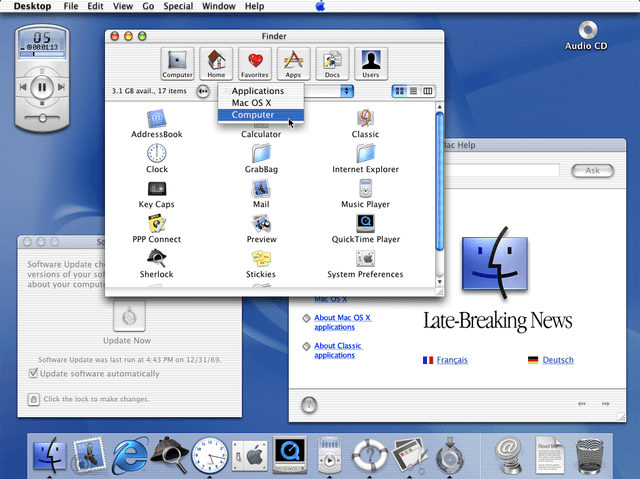
“Everyone was wary because it was a big change, but it turned out to be a good one because it disrupted the current ‘world order’ of software that had been entrenched with the older system,” Owen says when I ask about his memories of how OS X was being perceived ahead of release. “Now that the playing field had changed, a lot of new, smaller, nimble players quickly introduced software for Mac.”
Back then, Apple was competing against other operating systems to attract developers. Today, the nimbler players work on mobile platforms, and they’re being courted heavily by Microsoft via means of coding for Windows across a range of devices. More than a decade may have passed since Apple launched OS X, but the tactics the company used to popularize it are still in play today.
What Comes After Ten?
The most obvious comparison to draw between Windows 10 and Mac OS X is their attempts at longevity. Mac OS 9 was officially supported from 1999 to 2002; by comparison, OS X was launched in 2001 and continues to be iterated upon. Microsoft has already established that Windows 10 is intended as the last version of Windows, so it’s clear that they’re hoping that it enjoys as lengthy a lifespan as that of its rival.
Windows 10 will a solid foundation that lets Microsoft make risky moves.
The age of always-on Internet connections makes this kind of update schedule the most attractive option available. Consumers aren’t laden with an expensive, jarring update every couple of years, and developers can respond to the way the operating system is being used in a more immediate manner.
However, it also seems to suggest that the company’s focus is changing. Indeed, the fact that Windows 10 is being offered up for free is evidence that Microsoft doesn’t see selling the new version of Windows as its primary concern. But what’s replacing it?
For Apple, the answer was a host of other products. The iPod opened the door, but it was soon followed by the iPhone, the iPad and most recently the Apple Watch. I asked Owen about the relationship between those devices and OS X, and whether the operating system played its part in the enormous success the company has enjoyed off the back of its other interests.

“Yes,” he replied. “If for no other reason than that Mac OS X kept the company alive through the lean years, by giving the Macintosh faithful something to believe in, so that Apple had the resources to develop those other products.” It’s easy to think of Macs growing in popularity thanks to the success of Apple’s other devices, but it was the product that continued to deliver while they were still in development.
If Microsoft is angling Windows 10 to be a similar product to Mac OS X, and that seems to be the case, it seems likely that they will adopt Apple’s strategy in using it as a backbone to support development of other products to keep up with the changing face of computing. Between the Xbox and the expanding reach of Windows on non-traditional computers, there’s plenty of scope for Microsoft to explore.
Look at Microsoft’s purchase of Mojang. Look at the creation of HoloLens. These are risky maneuvers, with the possibility of huge rewards. Windows 10 will a solid foundation, from which Microsoft can make risky moves — and if it’s as successful in that role as OS X has been for Apple, the future is looking very bright indeed for Microsoft.