1. Home
  2. Phones
  3. Android
  4. Mobile
  5. Photography
  6. News

Here's how Samsung's dual pixel image sensor raises the bar for mobile photography

Add as a preferred source on Google

Samsung introduced the Galaxy S7 and S7 Edge yesterday at Mobile World Congress with a tremendous amount of fanfare. While notable improvements such as the ability to withstand water, expandable storage, and a bigger battery are sure to excite, the camera is where the real innovation lies.

After showing its camera prowess on last year’s Galaxy S6, Samsung doubled down with the Galaxy S7 and S7 Edge by improving it even more than we had imagined.

Recommended Videos

Both phones feature a dual pixel image sensor, and while we have already seen this technology in DSLRs, we have never seen it in a smartphone.

In a nutshell, dual pixel technology speeds up the autofocus by using 100 percent of the pixels, whereas traditional smartphone cameras use less than 5 percent. It almost seems absurd to have that kind of an improvement, but Samsung’s dual pixel sensor splits every single pixel into two photodiodes for phase and contrast.

So when capturing a photo on the Galaxy S7 or S7 Edge, the light from the lens is sent to two image sensors independently to adjust the focus, which is very similar to how the human eye works.
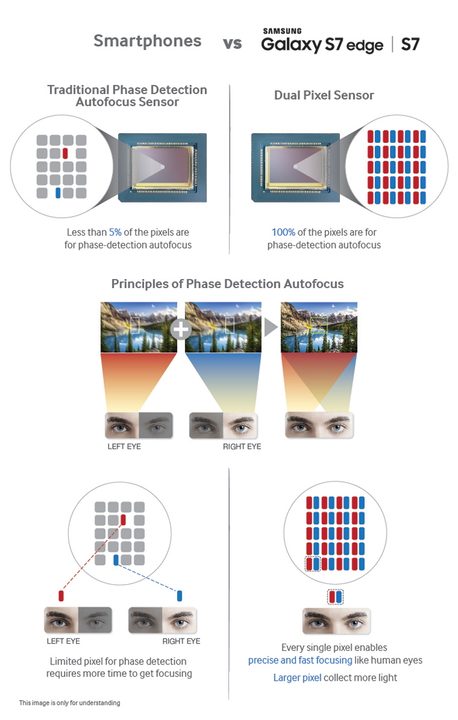
Samsung_Galaxy_S7_Dual_Pixel_Explained
Image used with permission by copyright holder

No pun intended here, but the dual pixel image sensor really outshines in low light situations. The Galaxy S6 already had fantastic low light performance, but the Galaxy S7 kicks it up more than a few notches. It captures 95 percent more light than the Galaxy S6 thanks to a 56 percent upgrade in the size of the pixels (1.44 microns) and an aperture of f/1.7.

Combine the dual pixel image sensor with the additional light, and the result is a smartphone camera that can autofocus super fast in any lighting environment.

Take a look at the two videos below to get a good idea of how much more improved the Galaxy S7 is over the Galaxy S6.

Galaxy S6 vs Galaxy S7: Camera Comparison ①
Galaxy S6 vs Galaxy S7: Camera Comparison ②

We’re looking forward to getting more hands on time with both phones to find out if they live up to the hype. Stay tuned.

Robert Nazarian
Robert Nazarian became a technology enthusiast when his parents bought him a Radio Shack TRS-80 Color. Now his biggest…
The Minimal Phone 2 looks dramatically better than the original, and I’m genuinely here for it
Plastic is out, metal is in, and Minimal Phone 2's renders suggest the digital detox phone concept finally has the hardware to match its ambition.
Electronics, Mobile Phone, Phone

I've been following the Minimal Phone since its initial crowdfunding days. The first iteration had the right idea trapped inside the wrong body, I’d say. Plastic build, no 5G, an underwhelming camera, and e-paper ghosting that frustrated early adopters; all these issues kept the phone from reaching a wider audience. 

Now, founder Armen Youssefian has posted what appears to be a 360-degree render of the Minimal Phone 2 on X, and from what I can see, the team has done its homework.

Read more
The EU says TikTok still isn’t doing enough to protect kids
Regulators say the platform's privacy settings don't go far enough under the Digital Services Act.
TikTok Creative Featured

The European Commission has accused TikTok of falling short on protecting minors, saying the platform's current account settings don't meet the child safety standards required under the Digital Services Act (DSA). The findings are preliminary, but if upheld, TikTok could face a fine of up to 6% of its global annual revenue.

Why the EU thinks TikTok isn't doing enough

Read more
Qualcomm is set to ratchet up chip prices in September, and your next gadget upgrade could bear the brunt
The price hike could touch every Snapdragon-powered device category.
The new Qualcomm Snadragon 8 Elite Gen 5

I want you to sit with this for a second. Qualcomm, the company whose Snapdragon chips sit inside your Android phone and tablet, your Windows laptop, your Meta smart glasses, your Galaxy Watch, and your wireless earbuds, reportedly sent a letter to every major customer telling them prices are going up by double digits. 

The price hike will be in effect from September 1, 2026, a recent Bloomberg report claims. Essentially, all the companies placing their chip orders after that will pay a higher price. 

Read more