  1. Home
  2. Phones
  3. Android
  4. Apple
  5. Business
  6. Mobile
  7. News

AT&T is finally getting rid of the ‘Next 24’ plan (which was actually 30 months)

Add as a preferred source on Google

AT&T is making its phone financing plans a little easier to understand, reducing the number of plans from four to two. The two new plans are called Next and Next Every Year, and these will replace the Next 12, Next 18, Next 18, and Next with Down Payment plans, starting on June 8.

AT&T has been criticized for its confusing plans — the Next 24 plan, for example, actually lasts 30 months. The new plans eliminate the ability of customers to pay in fewer installments, but they should help clear up some confusion.

Recommended Videos

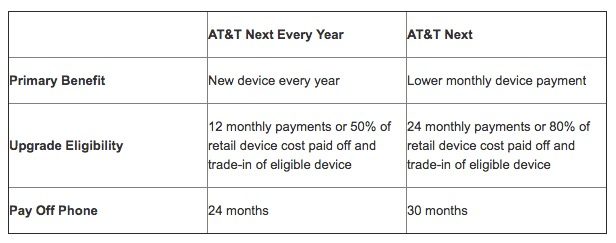
The way that the two plans work is pretty simple — the Next plan is basically a renamed version of the old Next 24 plan, allowing customers to pay for their device over 30 months in equal payments. On Next you’ll also be able to get a new phone after 24 months. The Next Every Year plan is close to the Next 18 option, however it’s a 24-month plan and allows customers to upgrade to a new phone sooner than the Next 18 plan did — you can upgrade by trading in your phone after 12 months.
att-plans
Image used with permission by copyright holder

Basically, going forward AT&T will only be offering a 30-month and a 24-month installment plan — no longer can you pay for your phone in 12 months. AT&T does say, however, that if you want to pay off your phone sooner you’ll be able to make additional payments on top of your monthly payments. Both of the plans also offer the option of a 30-percent down payment, which will help lower monthly costs, if that’s something you’re worried about.

According to AT&T, a $750 phone (such as the 16GB iPhone 6S Plus) will cost $25 per month on the Next plan, and $31.25 per month in the Next Every Year plan. You’ll also have to keep the $20 “activation fee” in mind when you get a new phone.

Christian de Looper
Christian de Looper is a long-time freelance writer who has covered every facet of the consumer tech and electric vehicle…
The Pixel 11 is almost here, and these are the 3 upgrades I’m begging Google to make
Electronics, Mobile Phone, Phone

We're only a month away from Google's next big hardware event, with the Pixel 11 series officially arriving on August 12. 

After living with the Pixel 10 Pro and the Pixel 10a over the past year, I've come to appreciate what Google's phones do well — and, more importantly, where they still fall short. With the smartphone landscape evolving faster than ever, there are three upgrades I'm hoping Google finally delivers this year. If you're a fellow Pixel user, chances are these are on your wishlist too.

Read more
5 reasons I keep coming back to Apple Reminders despite paying for premium task managers
I rely on OmniFocus for complex projects, but Apple Reminders still handles my everyday tasks better than any paid app.
Apple Reminders open on iPhone

The App Store is filled with premium task managers, and like Things 3, Todoist, and OmniFocus, despite buying and switching between several of them, I keep coming back to Apple Reminders. 

Don’t get me wrong, I still use OmniFocus to manage my projects. But when it comes to daily tasks and quick capture, Apple Reminders still remains my go-to app. In this guide, I'll walk you through the five biggest reasons why.

Read more
Google may finally ditch Samsung’s modem in the Pixel 11, and Tensor G6 could be better for it
FCC paperwork for Google’s next foldable points to MediaTek, raising hopes for lower power use and a cleaner break from Tensor’s Exynos roots
AI recreation of Pixel 11's Pixel Glow feature.

Google may be preparing its biggest Tensor hardware split yet. As spotted by Android Authority, FCC testing for an unreleased foldable Google phone includes a reference to MediaTek radio-frequency software, adding weight to reports that the Pixel 11’s Tensor G6 could leave Samsung’s Exynos modem behind.

Every previous Tensor chip has used Samsung modem hardware. Changing suppliers won’t guarantee better battery life or reception, but it gives Google a fresh path after years of leaning on the same underlying technology.

Read more