Audi took the wraps off its A3 e-tron concept, which is set to debut at the Geneva Motor Show next month. While the last e-tron was a pure electric car, this new model will be a plug-in hybrid.
Under the hood is a modified version of the stock A3 Sportback’s 1.4-liter four-cylinder engine and 75-kilowatt electric motor that is integrated into the car’s six-speed automatic transmission. Audi calls the new motor-transmission hybrid e-S tronic.
Total system output is 204 horsepower and 258 pound-feet of torque. A United States-spec 2012 A3 with the base 2.0-liter turbocharged four-cylinder makes 200 hp and 207 lb-ft, so the plug-in e-tron won’t penalize drivers on the power front.
Unlike most Audis, the A3 e-tron does without quattro all-wheel drive, going for front-wheel drive instead. Drivers can choose whether gasoline power, electric power, or a combination of both goes to those front wheels through programmable settings.
Visually, there isn’t much to distinguish the e-tron from a normal A3 Sportback, which is probably why Audi put a giant “A3 e-tron” sticker on the side.
The A3 e-tron can drive up to 31 miles on electricity, besting the Ford Fusion Energi’s 20-mile electric-only range. It can also drive at speeds up to 80 mph in electric mode, which should come in handy on Germany’s autobahns.
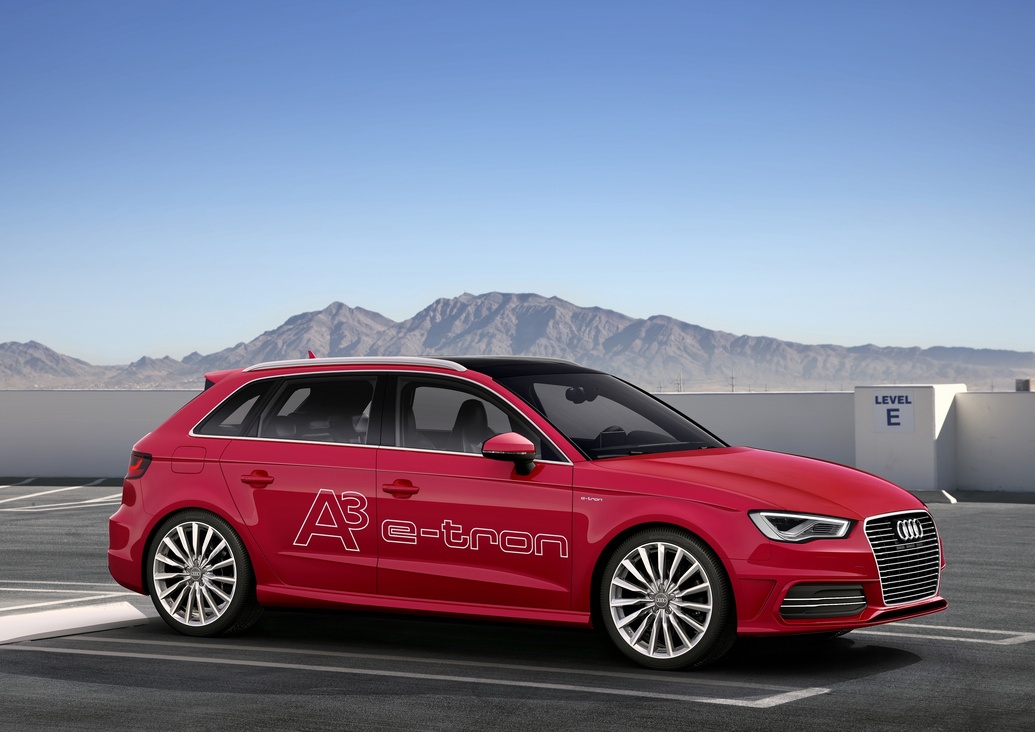 Audi says the A3 e-tron will return 156 mpg on the European cycle, if driven conservatively, while emitting just 35 grams of CO2 per kilometer.
It should also be pretty fast. Zero to 62 mph (0 to 100 kph) happens in 7.6 seconds, and the top speed is 137 mph. A Chevrolet Volt does 0 to 60 mph in 9.1 seconds, and has a top speed of 101 mph. Plug-in hybrids are mostly about fuel economy, but it’s nice to know that Audi has built one that can get out of its own way.
So far, the A3 e-tron is just a concept car, and it’s unclear what Audi has planned for it. The previous, all-electric e-tron was used as a testbed and was never put into mass production. We’ll learn more when this plug-in hybrid hatchback makes its official debut at the Geneva Motor Show during the first week of March.