  1. Home
  2. Cars
  3. News

Jeep's Grand Cherokee Hellcat is bringing all 707 HP to the U.S. in July of 2017

Add as a preferred source on Google

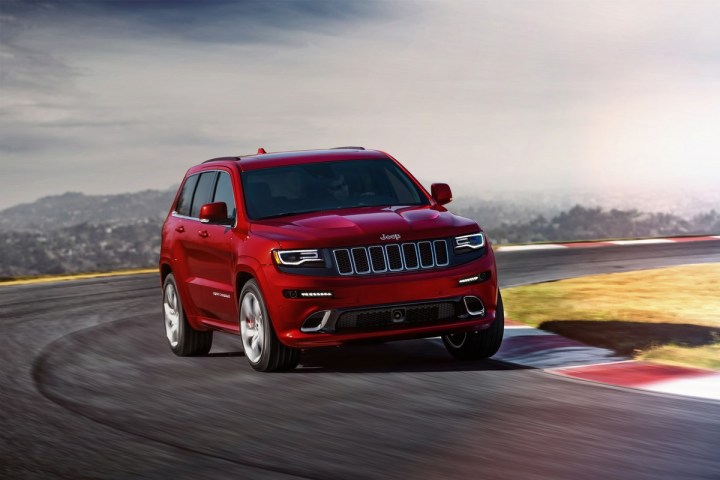
Long-rumored, confirmed, delayed, and now given an official production date, Jeep’s Grand Cherokee SRT Hellcat will make its way to the U.S. in July of 2017, according to Jeep CEO Mike Manley.

As expected, the brand’s fastest-ever model will use the supercharged 6.2-liter V8 from the Charger and Challenger SRT Hellcats with an output to match: 707 horsepower and 650 pound-feet of torque. Though those figures have yet to be confirmed, keep in mind that the Grand Cherokee SRT “only” makes 470 hp, so even getting close to that 707 figure means a massive performance increase.

Recommended Videos

As is, the regular SRT gets to 60 mph in 4.6 seconds and tops out at 157 mph. That could mean the Hellcat version will either dip below the 4.0-second mark or be just at that level while its top speed could climb beyond 175 mph. You’d best have a few sets of spare tires handy, but those kind of speeds in an SUV will be mind-bendingly fun.

Then there’s the Grand Cherokee SRT’s competition. While the SUV is currently on the low end of performance among rivals like the Porsche Cayenne Turbo, Range Rover Sport SVR, and BMW X5 M, the Hellcat tweaks could make it the fastest SUV on the market — that is if it can put the power down.

It’s not yet clear if Jeep will apply the rumored “Trackhawk” name to the Hellcat-powered Grand Cherokee, but given the Trailhawk badge has been applied to the off-road focused version, it’s a fair bet. There’s also word that the regular SRT will continue to be sold alongside the super-powered Trackhawk, likely because there will be at least a couple hundred horsepower between the two body styles. Then there’s the price. The current SRT starts at $66,490 — right around the price tag for the Charger and Challenger Hellcat, but the Trackhawk could command upwards of $75,000.

Even at that much larger figure, the Grand Cherokee Hellcat/Trackhawk will still cost thousands less than its rivals, which have much more of a luxury slant than the Jeep.

Miles Branman
Miles Branman doesn't need sustenance; he needs cars. While the gearhead gene wasn't strong in his own family, Miles…
Order an Uber and a self-driving Mustang might show up
Electronics, Phone, Mobile Phone

Ordering an Uber in London could come with a surprise today. Instead of a conventional car and driver pulling up, you might find a Ford Mustang Mach-E that can drive itself. Uber has launched London's first public robotaxi service in partnership with British autonomous driving company Wayve. The service is available through the Uber app, meaning you don't need to download anything new or book a special type of ride to try it.

There is one important caveat. Although the cars will handle the driving themselves, a trained safety operator will initially sit behind the wheel, ready to intervene if necessary. Fully driverless rides are planned for a later stage. The launch fleet consists of electric Mustang Mach-Es equipped with cameras, radar, and Wayve's AI Driver technology. These systems give the vehicle a 360-degree view of what's happening around it. And if anywhere can put that technology through its paces, London seems like a pretty good candidate.

Read more
Range Rover Electric arrives with 543hp, 600km range, and a starting price of the moon
The electric Range Rover is here, and your wallet may need CPR
Range Rover EV

The Range Rover has never been shy about luxury, size or price, and its first fully electric version is carrying that tradition into the EV era. Jaguar Land Rover’s (JLR) first battery-electric Range Rover is now open for orders, starting at £154,070, or about $208,420. That makes it one of the most expensive electric SUVs on the market.

The electric model costs almost £50,000 more than the standard combustion-engine Range Rover. It is priced in the same territory as the electric Mercedes-Benz G 580 and not far from ultra-luxury gasoline SUVs such as the Bentley Bentayga.

Read more
A solar ambulance has successfully tackled 500 miles of difficult terrain
Stella Juva

For years, solar-powered vehicles have largely lived in the world of prototypes, university projects and ambitious demonstrations. Now, one has completed the kind of test that matters far more than a flashy concept reveal: it drove hundreds of miles through difficult terrain while carrying medical equipment and generating enough electricity to operate independently.

Called Stella Juva, the vehicle was developed by Solar Team Eindhoven, a group of 23 students from Eindhoven University of Technology and two other educational institutions. According to a CNN report, the team describes it as the world's first solar ambulance. Unlike a conventional ambulance, however, Stella Juva is designed less to rush patients to hospitals and more to bring medical care to people who cannot easily reach it.

Read more