1. Home
  2. Cars
  3. Legacy Archives

Nissan teases the new Frontier pickup with a cryptic testing video

Add as a preferred source on Google

Nissan seems to be following the same strategy in promoting its newest pickup as producers did with 2014’s “Gozdilla” movie: slowly build anticipation with subtle glimpses, and then unleash the monster. 

Nissan’s campaign started earlier this week with an Instagram photo of a new pickup (we expect it to be the next-generation Frontier) cleverly disguised under some curtains.

Recommended Videos

On June 4th, Nissan continued its slow reveal with a new video, which shows Nissan’s pickup undergoing a wide variety of extreme testing.

The video details the Nissan going running an environmental gauntlet a controlled environment, as we see the truck subjected to water, snow, mud, and extremely low temperatures (-19.9 C or -3.8 F).

Nissan also put the new Frontier through the ringer outside as well; the Japanese automaker says the pickup has been tested over 600,000 miles in real-world conditions such as tarmac, rock, mud, and dirt.

Nissan purposely kept full shots of the vehicle out of the video, but the Frontier’s signature three-piece grill can be seen during the video’s short 30 seconds, as well as a  large chrome emblem and L-shaped LED running lights.

A Cummins diesel-powered Frontier “project” was unveiled by Nissan in February, so don’t be surprised if a Cummins engine, which is usually found under the hood of a Dodge, appears in the next-generation production Frontier. The Cummins-powered Frontier featured a 2.8-liter turbocharged four-cylinder that produced 200 horsepower, over 350 lb-ft of torque, and nearly 30 impressive mpg on the highway.

The new Frontier comes just at the right time for Nissan, as General Motors is just months away from releasing the 2015 Chevy Colorado and GMC Canyon, both direct competitors of the Frontier.

Thankfully, unlike Godzilla, we don’t have to wait halfway through the production until we see the new Frontier in all its glory: Nissan plans a full reveal on June 11th. 

Andrew Hard
Andrew first started writing in middle school and hasn't put the pen down since. Whether it's technology, music, sports, or…
Volvo is rolling out Apple Music to over 2 million cars with a simple OTA update
Your Volvo may soon get Apple Music without needing CarPlay
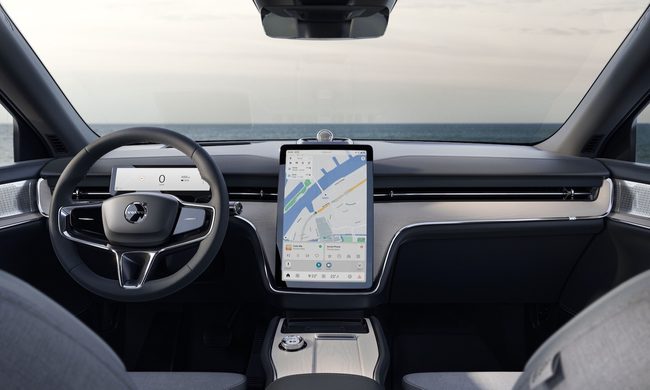
Interior view of the 2024 Volvo EX90.

The line between your smartphone and your car continues to blur. Volvo has announced that it is rolling out an over-the-air software update that brings Apple Music directly to the infotainment systems of more than 2 million vehicles worldwide. Instead of relying on Apple CarPlay or plugging in an iPhone, eligible drivers will be able to stream music natively from their car's built-in system, making Apple Music another integrated feature of Volvo's software experience.

The update is arriving for a wide range of Volvo models, including the EX90, ES90, XC90, S90, V90, XC60, S60, V60, XC40, EX40 and EC40, covering model year 2020 onwards. Availability, however, may vary depending on the vehicle.

Read more
Chery’s latest EV packs flagship tech for the price of a base Tesla, but you can’t buy it
Here's everything packed into Exeed's 2027 Exlantix ES, from its 27-sensor autonomous driving suite to its 860 km range, all starting under $31,000.
Car, Transportation, Vehicle

Chery's premium arm just dropped a sedan that makes you wonder why American EVs cost twice as much for half the tech.

Exeed's 2027 Exlantix ES ships with a driver-assist system called Falcon 700. It is built around an Nvidia Orin-Y chip and a genuinely stacked sensor suite.

Read more
A new AI model wants self-driving cars to think before they swerve
Forget guessing games, this self-driving AI actually shows its work.
Self driving car

Self-driving cars have gotten pretty good at driving. The harder problem is teaching them to drive safely in situations nobody planned for. We have heard horror stories of self-driving cars, behaving erratically in emergency situations, often times delaying first responders from reaching the scene.

A team at Seoul National University, led by professor Jun Won Choi from the Department of Electrical and Computer Engineering, thinks they have cracked part of that puzzle with a new AI model called SafeDrive. The research was recently selected as a highlight paper at CVPR 2026, a distinction that goes only to roughly 3% of all submissions.

Read more