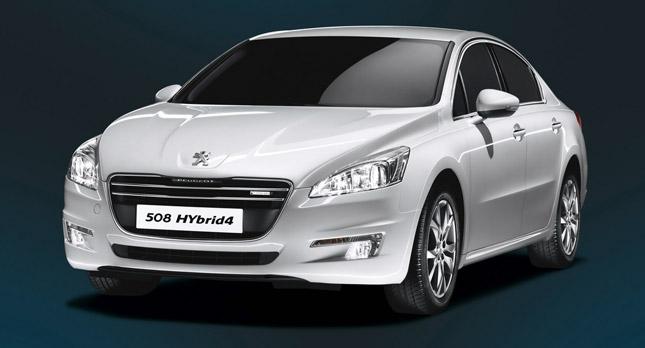
 Hybrids may have two types of propulsion, but people only care about the electric part. Electricity is what cuts emissions and trips to the gas pumps, so engineers are constantly working to design more powerful motors and more efficient batteries. The hybrid’s other engine, the one powered by explosions, is usually ignored. That’s what makes the Peugeot 508 HYbrid4 so interesting: instead of the traditional gasoline engine, it has a diesel.
The 508 HYbrid4 is powered by a 2.0-liter turbodiesel, which makes 163 horsepower, and an electric motor mounted to the rear axle that makes 37 hp. The rear-mounted motor also makes the French car four-wheel drive under certain conditions. The same powertrain was used in a hybrid version of the company’s 3008 crossover.
The combined 200 hp (and 331 lb-ft of torque) is sent to the wheels via a six-speed sequential automatic transmission, but things get complicated from there. Drivers have a choice of four modes: Auto, ZEV, Sport, and AWD. In ZEV mode, which prioritizes electric motoring, the 508 HYbrid4 can drive one to two miles on electric power only.
Peugeot says the 508 HYbrid4 can return 65.5 mpg on the European test cycle, and go from 0-100 kph (0-62 mph) in 8.6 seconds. Comparing the Peugeot’s mpg with an American-market car’s is difficult, since the European cycle is very different from the EPA’s. A Toyota Camry Hybrid (a midsize sedan like the 508) gets a combined 41 mpg on the EPA cycle, and can do 0-60 mph in 7.3 seconds.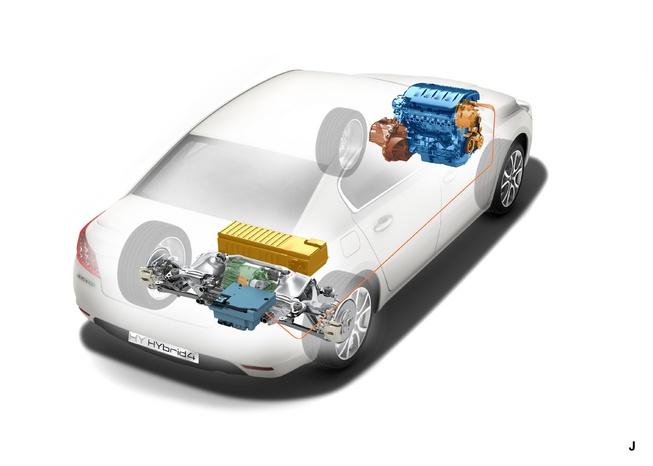
Peugeot also says the 508 HYbrid4 emits just 95 grams of CO2 per kilometer, which is about the same as a small city car. On the EPA cycle, a Camry Hybrid emits 217 grams of CO2 per mile.
The 508 HYbrid4 should be going on sale in Europe as you read this. In France, the diesel-electric hybrid will retail for 39,200 euros, or roughly $49,200.
Does a diesel engine make this Peugeot a better hybrid? Peugeot’s mpg estimate is very impressive, especially for a midsize sedan that looks like a car and not a lozenge. It is difficult to say how well the 508 HYbrid4 would do on the EPA’s test cycle, or whether the higher price of diesel in the United States would erode money saved on fuel.
Nonetheless, if diesel-electric hybrids can get 65 mpg or better, and keep emissions down, Peugeot may be onto something. The technology has potential: Audi just won Le Mans with a diesel-electric hybrid. If all hybrid drivers want is efficiency, why should it matter whether their engines have spark plugs or not?