If you’ve already decided on Toyota for their incredible reliability and safety ratings, then next is choosing which sedan will suit you best.
The smaller Corolla is a popular choice due to the lower price tag, but the Camry offers a bit more space and luxury for the focused buyer. Both are available as a hybrid option, raising the gas mileage to over 50 miles per gallon. Now that we’ve caught your attention, here’s what else they deliver.
Tech features
The Camry offers a wider range of available tech features than the Corolla, which is to be expected because it’s more expensive. It’s available with an updated version of Toyota’s Entune infotainment system, an in-car Wi-Fi hotspot, and a feature called Remote Connect which allows the driver to remotely lock or unlock the cars, keep track of maintenance, and set parameters for guest (or teen) drivers. Some of these features have trickled down to the Corolla, which is more high-tech than it has ever been, but note they’re not all available on the base model.
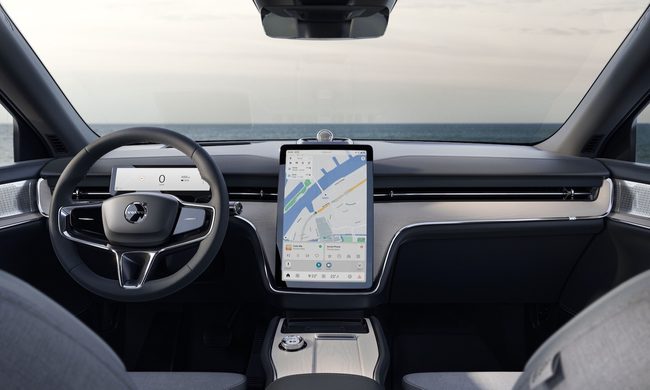
Both sedans come standard with a 7.0-inch touchscreen for the infotainment system, and the software is finally compatible with Android Auto and Apple CarPlay. Toyota rewards buyers who step up in the trim level hierarchy with an 8.0-inch touchscreen regardless of which nameplate they choose. The standard stereo is a six-speaker setup, but both cars are offered with a nine-speaker system at an extra cost. Navigation is optional, too.
Amazon Alexa compatibility, Bluetooth wireless technology, and SiriusXM radio are available, though note you’ll need to pay a monthly fee to enjoy the latter once the free, three-month trial period ends.
Performance and fuel economy
The Corolla’s entry-level engine is a 1.8-liter four-cylinder tuned to deliver 139 horsepower and 126 pound-feet of torque. SE and XSE trim levels receive a bigger, 2.0-liter four that makes 169 hp and 151 lb-ft. of torque. Front-wheel drive comes standard across the board, only Mazda and Subaru offer all-wheel drive in this segment, but transmission options vary depending on displacement. The smaller engine is offered with either a six-speed manual transmission or a continuously variable transmission (CVT). The bigger engine is CVT-only.
With the 1.8-liter, the Corolla returns up to 31 mpg in the city, 40 mpg on the highway, and 34 mpg in a combined cycle, which are stellar figures. With the 2.0-liter, those figures drop slightly to 30, 38, and 33, respectively.
If that’s not efficient enough, the Corolla is available with a 121-horsepower gasoline-electric hybrid powertrain that consists of a 1.8-liter four-cylinder and an electric motor. Fuel economy skyrockets to 53, 52, and 52, respectively.
Base models of the Corolla and Camry get a 1.8-liter and 2.5-liter four-cylinder engine, respectively.
The larger, pricier Camry comes standard with a 2.5-liter four-cylinder engine rated at 203 hp and 184 lb-ft. of torque, though those figures go up ever so slightly to 206 and 186, respectively, in the XSE model. Buyers seeking more power can select a 3.5-liter V6 with 301 hp and 266 lb-ft. of torque on tap. Front-wheel drive and an eight-speed automatic transmission come standard regardless of how many cylinders are under the hood, but the four-cylinder engine can be paired with a winter-taming all-wheel-drive system at an extra cost.
Fuel economy checks in at 21 mpg in the city, 41 mpg on the highway, and 34 mpg in a combined cycle for the four-cylinder engine. Select the six, and those figures drop to 22, 33, and 26, respectively.
The Camry has a hybrid option, too; it’s a Toyota, after all. Its gasoline-electric drivetrain is made up of a 2.5-liter four-cylinder engine and a small motor. The two power sources come together to deliver 208 horsepower while boosting city, highway, and combined fuel economy figures to 51, 52, and 53, respectively.
Interior and exterior design
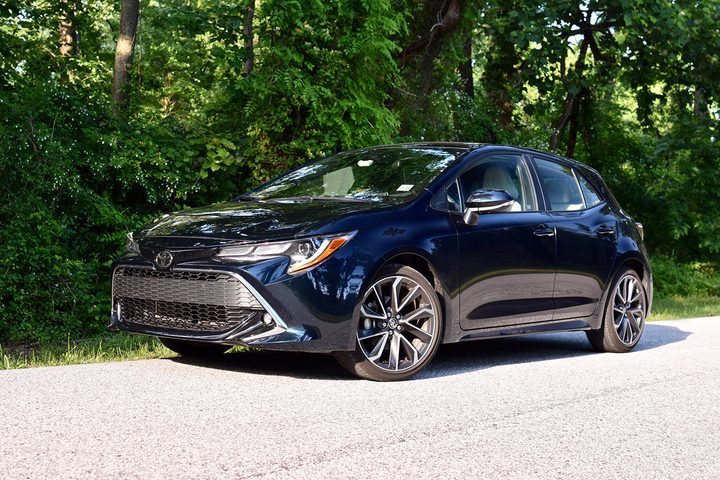
Both nameplates suffered from a reputation for extraordinary blandness, so designers worked hard to make the current-generation models more exciting than ever before. They may have gone a bit too far; we find the exterior design is a bit overwrought, but the final call is yours to make. The Camry’s interior is just as extroverted as its exterior; its dashboard is characterized by an S-shaped line that divides the center console in two sections. Stylists took the Corolla in a tamer direction with horizontal lines and a screen propped up on the dashboard.


- 1. 2020 Toyota Camry
- 2. 2020 Toyota Corolla
Both cars seat five, but the difference in exterior dimensions is reflected on the inside.
Using a measuring tape highlights the difference between the compact and midsize segments. The compact Corolla measures 182.3 inches long, 70.1 inches wide, 56.5 inches tall, and it rides on a 106.3-inch wheelbase. Note those figures apply to the sedan detailed here; there’s also a hatchback model. The midsize Camry stretches to 192.7 inches in SE and XSE trims (192.1 inches in other trims), 72.4 inches wide, 56.9 inches tall, and rides on a 111.2-inch wheelbase. Simply put, the longer wheelbase clears up more space for people and gear in the cabin.
Both cars seat five passengers in relative comfort, but the Corolla has 88.6 cubic feet of interior volume, while the Camry has 100.4 cubic feet (99.3 cubic feet with a moon roof). The Camry also has 15.1 cubic feet of trunk space, compared to the Corolla’s 13.1 cubic feet. Oddly, both are considered midsize cars by the EPA.
Safety
In addition to basic safety features like anti-lock brakes and traction control, both cars come standard with Toyota Safety Sense P, which bundles a pre-collision system that mitigates accidents, lane departure warning, automatic high beams, and adaptive cruise control. The Corolla offers eight standard airbags, while the Camry has 10.
Pricing
When it comes to pricing, the Corolla wins the budget award. The entry-level Corolla L starts at $19,600. At the other end of the spectrum, the flagship XSE model enters the market at $25,550. That’s more than a Camry L, which carries a base price of $24,425. The fully-loaded XSE V6 rings in at $35,130, which pushes it into luxury car territory. As a side note, Audi’s most affordable model, the A3, starts at $33,300.
Adding options beyond the base models means spending more, of course. If it’s a hybrid powertrain you’re after, plan on shelling out at least $23,100 for the Corolla and $28,430 for the Camry; electrification remains relatively expensive. Whether improved fuel economy is worth a few thousand extra dollars depends on how you drive, where you drive, and how much you’re currently paying for fuel. It may help to sketch out a few scenarios before springing for either Toyota sedan’s pricier hybrid model.
Key rivals
Toyota Camrys and Toyota Corollas each have an extensive set of worthy contenders, with many other car manufacturers producing similar caliber sedans.
The biggest competitors to Corolla come from either Asia or Europe. There isn’t an American car manufacturer that directly challenges the Corolla vehicle, and that absence is a willing choice from the biggest car manufacturers in Detroit. That said, there are a host of foreign Corolla competitors to choose from: The Honda Civic, the Subaru Impreza, the Volkswagen Jetta, the Mazda3, the Nissan Sentra, the Hyundai Elantra, and the Kia Forte.
For the Camry, there are several rivals you could opt for instead. An American challenger exists in the form of the Ford Fusion. If you prefer a foreign automaker, you have several choices to sift through. The Honda Accord, the Subaru Legacy, the Volkswagen Passat, the Mazda 6, the Nissan Altima, the Hyundai Sonata, and the Kia Optima are all viable options.
Corollas and Camrys are particularly popular, thanks to the dependable reputation of Toyota vehicles. The company produces cars that are incredibly user-friendly and reliable. Their overall mileage and quality are tough to compete with. These Toyota sedans live up to that reputation; They’ll likely outlast your average vehicle and prove to be a worthy investment. It’s up to you to determine which of the two cars is the best fit for you. We recommend comparing their exclusive features to see which fit your driving style and preferences best.