Porsche envisions a future where people can commute in the sky, but you’re on the wrong track if you’re thinking of the flying DeLorean DMC-12 from Back to the Future. The German automaker joined forces with Seattle-based Boeing to explore an entry into the burgeoning urban air mobility segment that could be worth trillions in the coming decades.
The newly-minted partnership is a way for both companies to explore whether there’s a market for premium flying taxis. Porsche’s road cars are luxurious, and it wants to maintain this high level of opulence in the sky — and, presumably, in the water, if it ever develops a submersible taxi. One of the team’s first tasks will be to define what luxury looks like in this new dimension of the transportation infrastructure.
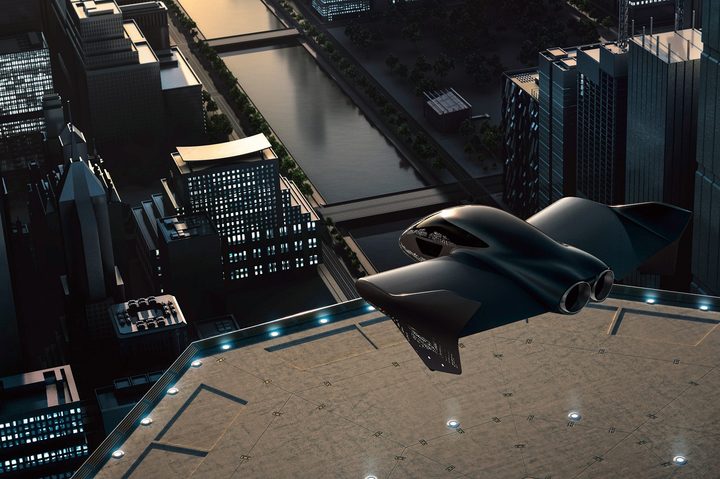
An international team of engineers from Porsche and Boeing have started fine-tuning a concept previewed by a sketch of a sleek, winged vehicle with a wrap-around windshield. The project is still at the embryonic stage, so the final design could very well change, but the firms imagine a vertical takeoff and landing vehicle that’s fully electric, stylish, and innovative. They’re working on a prototype that will be tested as soon as its ready, Digital Trends learned.
“Porsche sees its responsibility as presenting products only when they are fully developed and the market is ready for them. Product development is therefore a long-term process with intensive testing. We can only show a concrete product concept when a certain level of maturity has been achieved. At the moment, a first flight of a full scale prototype is planned for 2020, a Porsche spokesperson told Digital Trends via email.
Porsche, like every company in the race to build flying taxis, sees the sector developing almost exponentially during the second half of the 2020s. The firm’s research shows the market will pick up speed after 2025, and it concludes the vehicles developed with Boeing will be capable of taking passengers from point A to point B quicker than conventional taxis or trains, while costing less and offering more flexibility. Whether it moves forward with the project depends on what it learns from testing prototypes.
The partners will need to fend off a growing list of competitors. Porsche sister company Audi is designing similar flying taxis with Airbus, Boeing’s arch enemy. Hyundai recently hired an ex-NASA employee to develop the technology in-house, and it pegged the market’s value at $1.5 trillion by 2039. Aston Martin wants in, as does Rolls-Royce (the engine maker, not the car manufacturer), and Uber is working with NASA to beat everyone to the punch. Google co-founder Larry Page is throwing buckets of money at a start-up named Kitty Hawk that also operates a partnership with Boeing. You’ll have no shortage of options if you dream of commuting like Luke Skywalker, though you’ll need to show Yoda-like patience before you take a ride.