1. Home
  2. Cars
  3. News

Tesla Model S occupants survive landslide and fallen tree

Add as a preferred source on Google

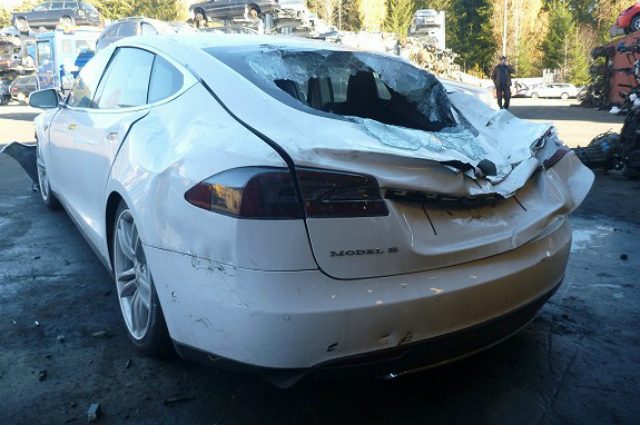
Tesla Motors got some real-world publicity for its touted car safety back in August. The Norwegian newspaper site Bergensavisen reported that a Tesla Model S was caught in a landslide outside of Bergen, Norway. The car was pushed close to the edge of a cliff and crushed by a large tree. The woman and child occupants survived uninjured — a testament to the strength of the car’s construction. In fact, the Model S did get an overall five-star rating by the NHTSA, and Tesla itself claimed it broke the crushing machine used in one of the tests. Whether this is true or not, it certainly proved itself when a tree landed on top of it.

Last week, the crushed Model S 60 was put up for sale on a Norwegian classified ads site, though it’s being sold as a parts car.
Recommended Videos

The car is indeed a write-off. The front truck (or frunk) appears to have sustained the most damage, and the hood is unsalvageable. The bumper cover is hanging on by a thread. The rear end of the car was also crushed, so it’s a good thing nobody was in the rear-facing seats. The interior seems mostly intact, if you can look past the broken glass and rearview mirror hanging by its wires. The windshield was smashed, but it did not shatter.

The latest safety reports for Tesla focus on its new Autopilot system, which was released as a software update earlier this month. The Autopilot allows the Model S to steer within a lane, change lanes by tapping a turn signal, and manage speed by using active, traffic-aware cruise control. The system can also control the indivudal motors, brakes and steering to help avoid collisions and keep the cars on the road. It can even scan for parking and then do the job itself.

The Autopilot system is only available in North America, so don’t go blaming it for the tree incident. However, American Tesla owners are reporting malfunctions with the system, which is currently in a beta stage.

Albert Khoury
Former Weekend Editor
Al started his career at a downtown Manhattan publisher, and has since worked with digital and print publications. He's…
Volvo is rolling out Apple Music to over 2 million cars with a simple OTA update
Your Volvo may soon get Apple Music without needing CarPlay
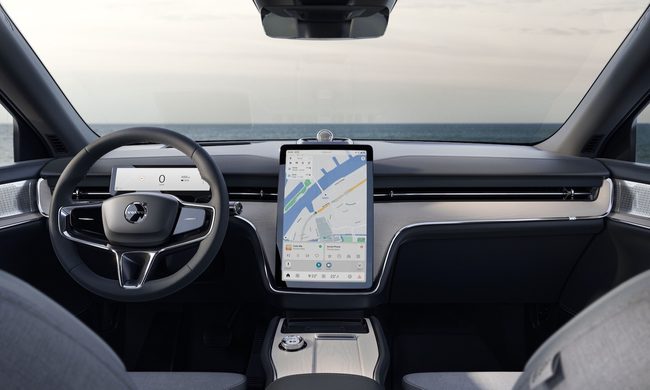
Interior view of the 2024 Volvo EX90.

The line between your smartphone and your car continues to blur. Volvo has announced that it is rolling out an over-the-air software update that brings Apple Music directly to the infotainment systems of more than 2 million vehicles worldwide. Instead of relying on Apple CarPlay or plugging in an iPhone, eligible drivers will be able to stream music natively from their car's built-in system, making Apple Music another integrated feature of Volvo's software experience.

The update is arriving for a wide range of Volvo models, including the EX90, ES90, XC90, S90, V90, XC60, S60, V60, XC40, EX40 and EC40, covering model year 2020 onwards. Availability, however, may vary depending on the vehicle.

Read more
Chery’s latest EV packs flagship tech for the price of a base Tesla, but you can’t buy it
Here's everything packed into Exeed's 2027 Exlantix ES, from its 27-sensor autonomous driving suite to its 860 km range, all starting under $31,000.
Car, Transportation, Vehicle

Chery's premium arm just dropped a sedan that makes you wonder why American EVs cost twice as much for half the tech.

Exeed's 2027 Exlantix ES ships with a driver-assist system called Falcon 700. It is built around an Nvidia Orin-Y chip and a genuinely stacked sensor suite.

Read more
A new AI model wants self-driving cars to think before they swerve
Forget guessing games, this self-driving AI actually shows its work.
Self driving car

Self-driving cars have gotten pretty good at driving. The harder problem is teaching them to drive safely in situations nobody planned for. We have heard horror stories of self-driving cars, behaving erratically in emergency situations, often times delaying first responders from reaching the scene.

A team at Seoul National University, led by professor Jun Won Choi from the Department of Electrical and Computer Engineering, thinks they have cracked part of that puzzle with a new AI model called SafeDrive. The research was recently selected as a highlight paper at CVPR 2026, a distinction that goes only to roughly 3% of all submissions.

Read more