Check out our review of the Asus M70 desktop PC.
Here at CES 2014, one of the trends we’ve noticed is the ever-increasing convergence between traditional PCs and mobile devices. Asus continues this theme with its M70 desktop PC. On the outside, it simply looks like a swanky desktop fit for a PC gamer. However, there are some pretty nifty features here that you won’t find on the average rig. We got to spend a few minutes with the M70 at CES 2014, and here’s what we learned.
First thing’s first: Asus claims that the M70 is the world’s first desktop PC that includes NFC, tech that’s usually associated with smartphones and tablets. Any mobile device that’s also equipped with NFC can be used share content with the M70 and log into Windows from with their smartphone or tablet. On top of that, any mobile tech that subscribes the Qi wireless standard can be charged wirelessly simply by placing it on the top of the M70’s case. Pretty cool, huh? Oh, but there’s more.
The M70 also includes an uninterruptable power supply, or UPS. In the event that you lose power to the M70, the M70 won’t power down and your unsaved data won’t burn up. Instead, the UPS will kick in and provide you with 15 minutes of emergency battery life. That’s more than enough time to save your work and/or gaming progress and shut down, and it’s a great feature that we wish we’d see more often in desktops. We imagine that people living in areas that commonly get hit by major storms (not to mention tornadoes and hurricanes) would love the M70’s UPS.
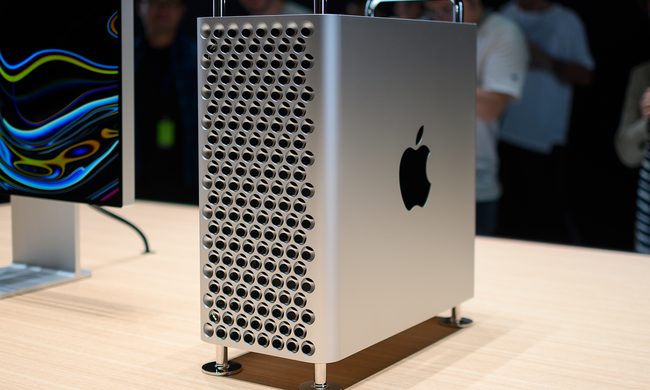
Now for a specs rundown. The M70’s case is engulfed in brushed aluminum painted in silver, and sports some sharp corners, giving it a bit of aesthetic pizazz. When we pulled down on the top of the M70’s front panel, we found a foursome of USB ports, two of which were USB 3.0, with the other being USB 2.0. The front panel also stores a media card reader, an audio/mic combo jack as well as the M70’s optical drive. Around back, we found another four USB ports, VGA and HDMI ports, Ethernet, and a multitude of audio jacks. There’s also an ancient PS/2 port in the rear, but we doubt it’ll ever get much use.
The M70 will consist of two models: the M70AD-US005S and the M70AD-US003S. The former includes an Intel Core i5-4440 quad core CPU clocked at 3.1 GHz, 1TB of hard drive space, 8GB of RAM, Nvidia GeForce GT 640 graphics with 4GB of RAM, and a DVD burner. The latter is packed with a more powerful Intel Core i7-4770 quad-core processor running at 4.7 GHz, 16GB of RAM, a 1TB/8GB hybrid mechanical-SSD hard drive, Nvidia GeForce GTX 650 graphics with 1GB of RAM, and a Blu-ray combo drive. The US005S model will cost $1,199, while the US003S version will run you $799.
Both units are currently available for pre-order from Newegg and will begin shipping on January 16, roughly over a week from now.
What do you think of the ASUS M70? Sound off in the comments below.