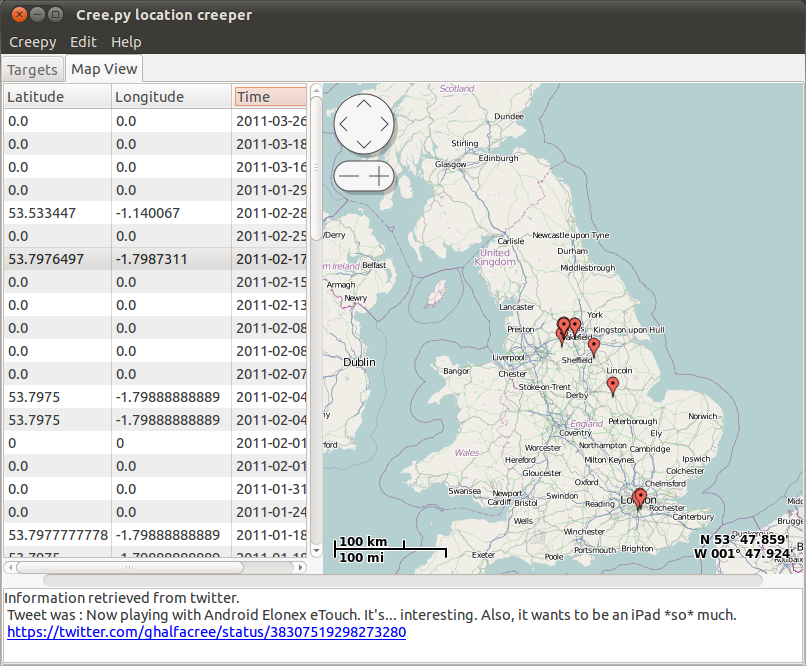
 A new app fittingly called Creepy is making waves in privacy circles for its creative use of social networks to achieve an unsettling result. The app, actually a software package for Windows and Linux, hooks into social networks like Twitter and Flickr to glean information about a targeted user’s location. It’s surprisingly effective, even in its early stages, according to the UK-based blog Tinq.
Would-be stalkers need only to enter a Twitter, Foursquare or Flickr username and Creepy will use the service’s APIs to access whatever photos or tweets have been published to the targeted account. Creepy then analyzes the information and delivers a report to the user.
While Twitter’s geo-tagging feature is turned off by default, photos taken with a smartphone and uploaded through services like Twitpic and YFrog contain geographical information embedded in EXIF data. Social network users often aren’t aware that the geographical data is contained in their shared images, and even if they are aware, they probably don’t expect an app like Creepy to come along and extract it without their consent.
After Creepy has finished its analysis, it reveals a map that pinpoints the location where the targeted user posted every geo-tagged tweet and every shared image. Clusters would logically indicate a person’s residence or workplace — vital information to a stalker.
Yiannis Kakavas, the 26 year old creator of Creepy, acknowledges the program’s high level of, er, creepiness, but insists that it is meant to raise awareness about the privacy issues surrounding geo-location aware social networking sites.
“Users should be educated and warned about the risks before they choose to use any location aware service,” Kakavas said in an interview with Tinq. “It’s a constant fight between our right to be ‘left alone’ and our need for exhibitionism. Let’s see which one wins.”
Creepy is currently available to download for Windows and Linux operating systems and a version for Mac OS X is in the works.