1. Home
  2. Computing
  3. News

Upgrading your PC just got a lot easier

Add as a preferred source on Google
A new Asus X870 motherboard.
der8auer

Asus and MSI revealed a slew of new motherboards at Gamescom 2024, and some of them seem to take convenience in PC building to the next level. A few of the motherboard models introduced during the event come with quick-release mechanisms, and not just for the SSD but also for the graphics card. Seeing as some of the top GPUs are now massive and unwieldy, easier installation is going to be a welcome change.

The two hardware manufacturers presented motherboards for the latest processors, including AMD 800-series boards for Ryzen 9000 from Asus, and Intel Arrow Lake-S 800-series chipsets from MSI. Der8auer, a well-known overclocker and YouTuber, got to see the new Asus boards up close and personal, including the ROG X870E Hero.

Recommended Videos

The Asus’ ROG X870E Hero comes with a quick-release mechanism for the M.2 slot — and it’s easy enough to handle with just one hand. As for the GPU, Asus dubbed the feature PCIe Q-Release Slim, and seeing it on video underscores how simple it appears to be.

ASUS shows their new X870 AM5 Lineup at Gamescom 2024

The PCIe Q-Release Slim feature gets rid of the release button that we know from most motherboards. With the bulky graphics cards we deal with today, pulling the PCIe retention mechanism to mount the card is a difficult endeavor, especially for new builders. Meanwhile, the new retention mechanism that Asus is introducing makes it so that you can easily slot the GPU in, and it will stay put even if you try to remove it from the center or from the right side. You’ll need to pull it right from the front, and to Asus’ credit, it seems like it pops right out when approached the right way. We’ll have to test it ourselves to find out how much of an improvement it is.

Moving on to MSI, the company held a two-hour live stream to show off some of its new products, and that includes the upcoming Z890 MPG Edge motherboard. It might be a while before we see that one hit the shelves, as it’s made for Intel’s 15th-gen CPUs, but once it’s there, installing the GPU should be a breeze. MSI equipped the motherboard with a feature called “EZ PCIe Release.” It’s slightly different from Asus’ take on the mechanism, as it comes with a switch above the GPU.
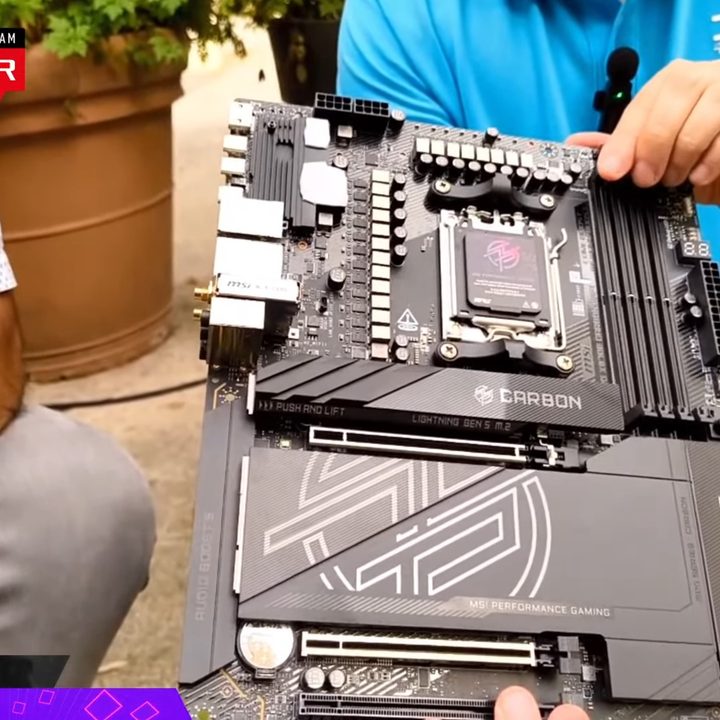
An upcoming MSI Z890 motherboard.
MSI

Installing a GPU only gets harder as the years go by. These days, graphics cards like the RTX 4090 take up to four slots, and slotting them in and out is a real challenge. In this generation alone, we’ve heard of things such as melting connectors (often caused by bending the power connector) and cracked PCBs, likely due to the weight of the GPU. We’ll have to wait and see if one day this becomes a standard outside of high-end motherboards made by select manufacturers.

Monica J. White
Monica is a computing writer at Digital Trends, focusing on PC hardware. Since joining the team in 2021, Monica has written…
Look, the MacBook Neo is a fine machine for building apps. And yes, I am utterly surprised
I am talking about apps with a generous dose of AI wizardry happening in the background.
MacBook Neo in yellow.

In a span of just one week, I have built a full-fledged Android app for my Galaxy Z Fold 8 foldable phone, three Mac apps, and an iPhone app. And here's the fun part. The entire journey of creating these apps actually started on a phone, jumped to my MacBook Neo, compiled just fine, and ran flawlessly, without making me want to tear my hair off. The latest example? 

It built my calendar-clipboard hybrid app in Terminal within 20 seconds, and an on-device transcription app with a retro look in roughly 15 seconds. I used to think building desktop software would have me burning the midnight oil. The MacBook Neo did it in less time than I can pour myself a can of soda and take the first sip. 

Read more
AI could be doing to our tolerance for hard work what social media did to our patience
Even brief AI use may make unaided work feel more frustrating once the help disappears.
ChatGPT on iPhone

It is no secret that social media, and especially the rise of short-form content, has played a major role in the declining patience many of us have for anything that takes too long to get to the point. A few seconds without something interesting happening is enough to make us swipe away and look for the next thing. AI appears to be doing something similar to the way we approach work.

A new peer-reviewed study found that people who used AI for around 10 to 15 minutes were more likely to struggle and give up once the AI was taken away. The researchers ran three randomized experiments with 1,222 participants who were given math and reading-comprehension tasks. AI helped them perform better at first, but their performance tanked once they had to solve the problems on their own.

Read more
Microsoft wants Copilot Notebooks to handle the work that comes after an AI answer
Built-in Office editing gives users somewhere to revise what Copilot produces
Copilot graphics

Microsoft is bringing Office editing into Copilot Notebooks through its Frontier preview. Users can work on Word, Excel and PowerPoint files alongside their project references, making changes themselves or asking Copilot to handle them.

Generating a report or presentation with AI still leaves someone responsible for getting it ready to share. The October update puts editing tools where that work begins, though having a document neatly formatted doesn’t make its contents correct.

Read more