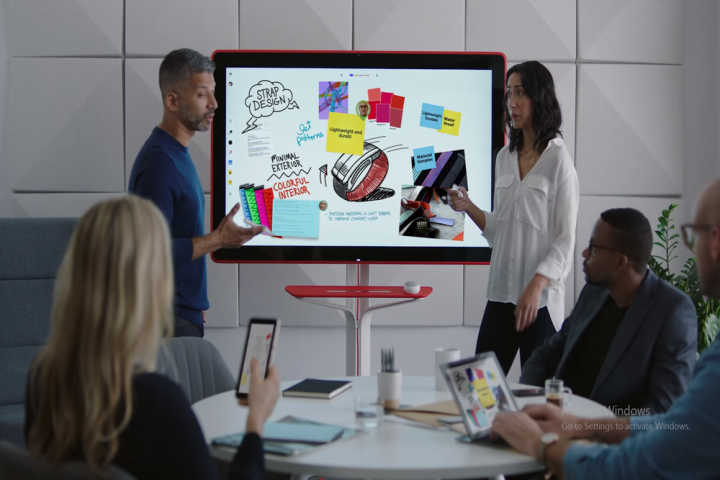
The Jamboard, which Google designed in-house, is about the size of an average wall-mounted, non-connected whiteboard at 55 inches diagonally. It packs a 4K (4,096 x 2,160 pixels) pressure-sensitive, soft-touch plastic display that recognizes up to 16 simultaneous touches — presumably for especially collaborative sessions — and taps from a Bluetooth-enabled stylus and eraser accessory. (The included styli are optional, it’s important to note — any rubber-tipped stylus will work in lieu of the official accessories, and you can use your hands to erase things.) The Jamboard features HDMI inputs, too, plus a built-in camera, speakers, and a wheeled custom stand for offices which choose not to mount it. And it packs built-in support for Chromecast, Google’s streaming platform that lets you mirror your device’s screen or stream content from YouTube, Netflix, or thousands of other supported services.
Software is the arguable draw of a device like the Jamboard, and it doesn’t disappoint. It’s running Android, Google’s mobile operating system, tweaked nearly beyond the point of recognition. You work within what Google calls “jam” sessions, whiteboard spaces on which you can sketch, draw, type, scribble with or without handwriting being recognition enabled, and you can import images. There’s a miniature web browser, and you can connect to other Jamboards over the internet to, say, work on the same project simultaneously — sketches on one are instantly synced to all others.
But that’s just the tip of the collaborative iceberg. You can launch a chat with co-workers with Google’s Hangouts app or upload your team’s creations to Google Drive. And even those without Jamboards can participate in sessions: a companion app for iOS and Android devices allows onlookers to view passively, or, if they so choose, add photos, drawings, and digital sticky notes to the board in real time.
The Jamboard isn’t perfect. Desktop and laptop users are essentially flat out of luck: they can watch a stream of ongoing whiteboard meetings, but they can’t contribute drawings, images, or text. And the hardware isn’t available in larger configurations like, say, Microsoft’s line of Surface Hub digital whiteboards, which include an 84-inch model. And then there’s the price: the Jamboard starts at $6,000 for “early adopters” who register to reserve a unit ahead of wider availability next year.
But the Jamboard’s shortcomings are almost beside the point. This is Google’s hardware complement to its software suite of productivity apps, a sector to which it has devoted increasing attention. In September, Google re-branded its Google Apps for Work program — which comprises Docs, Sheets, and Slides, among other apps — G Suite. And in October, it rolled out Slack integration, robust voice dictation, and artificial intelligence features that suggest action items you can assign to co-workers and generate potential answers to survey questions, among other labor-saving tasks.
Why the big focus on enterprise? Its potential for growth, mostly. Worldwide spending on cloud services is expected to grow 19.4 percent annually, rising from $70 billion in 2015 to $141 billion in 2019. And Google expects cloud and services revenue to surpass the revenue it makes from web advertising, which currently represents 90 percent of its revenue, as soon as 2020.
The Jamboard also figures into Google’s effort to build a hardware ecosystem. The Mountain View, California-based search giant launched the Pixel, its first branded smartphone, in October. Later this year, the Pixel and the Jamboard will be joined by Google Home, a voice assistant intended to compete with online retailer Amazon’s Echo; Google Wi-Fi, a mesh-networked wireless router; and Daydream View, a virtual reality headset.
Time will tell whether Google’s enterprise and hardware efforts pay off. But one thing’s for certain: it’s forging ahead.
Editors' Recommendations
- This Google Pixel 8a leak just spoiled everything about the phone
- Google’s Pixel phones are in trouble
- Google’s future Pixel phones just got hit with bad news
- You can now collaborate on emails directly in Google Docs
- Should you buy the Google Pixel 6 or get an older model instead?