Hewlett-Packard is the world’s top PC maker, and apparently the company has elbowed its way to the top of the pack in part by the sheer number of computer models it offers. The company has taken the wraps off an update to its consumer notebook lines that encompasses seven new systems in the Envy, Pavilion, and MIni lines…and that’s leaving aside the nine new business notebooks and enterprise-oriented ProBooks and (sometimes scattered amongst these offerings) more than a dozen notebooks powered by AMD processor and graphics solutions. Add it all up, that’s (we think) more than 20 new notebooks…and if that’s not confusing to potential customers, we don’t know what is.
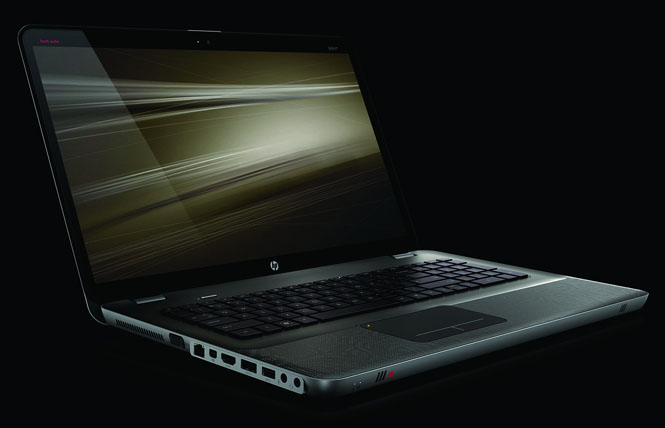
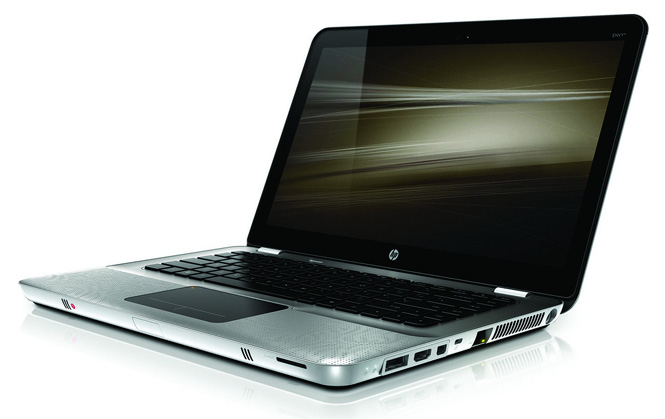
On the consumer-oriented side of the fence, HP’s new offerings are slightly less befuddling: HP is introducing 14-inch and 17-inch entries in its stylish Envy line. Both the new Envy systems will feature Intel processors and ATI Mobility Radeon HD 5830 graphics, a backlit keyboard, a mini DisplayPort output, and high-performance audio technology “developed by HP and Beats by Dr. Dre.” The Envy 14 will pack a 14.5-inch display, Intel Core i5 processor, and the ability to switch between dedicated ATI graphics and battery-sipping integrated graphics—HP says the unit can get up to 8 hours of battery life. The Envy 17 ramps up to handle up to 2 TB of onboard storage, multiple display technology via ATI Eyefinity, and packs in a special subwoofer: it will be available with Intel Core i5 or Core i7 processors. The Envy 14 should start with pricing under $1,000, with the Envy 17 starting under $1,400; both should be available mid-month.
Moving toward the mainstream, HP has revamped its Pavilion line with the Pavilion dm4, Pavilion dv5, Pavilion dv6, and Pavilion dv7. The new Pavilions ditch their previous glossy cases for aluminum, but also feature etched patterns and some color options for the design-conscious. The Pavilion dm4 measures just 1 inch thick and sports a 14.-inch HD LED display, internal optical drive, and an estimated battery life over six hours: it should ship with a variety of Intel Core i5 and ATI discrete graphics options with prices starting at $729. Stepping up, the Pavilion dv5 has a 14.5-inch display and a choice of champagne, red, or black imprinted covers. The dm5 doesn’t have discrete graphics options and steps down to a Core i3 processor or AMD Turion II, but they will have starting prices under $650.

Configuration options expand again with the Pavilion dv6, which sports a 15.6-inch display, a choice of Intel or AMD processors, and the 17.3-inch Pavilion dv7 will offer a range of quad-core processor options from Intel and AMD, along with ATI discrete graphics. Pricing on the Pavilion dv6s should start at $530 for the AMD versions and about $650 for the Intel versions, with the dv7s starting at about $800. All should be available in mid-May.
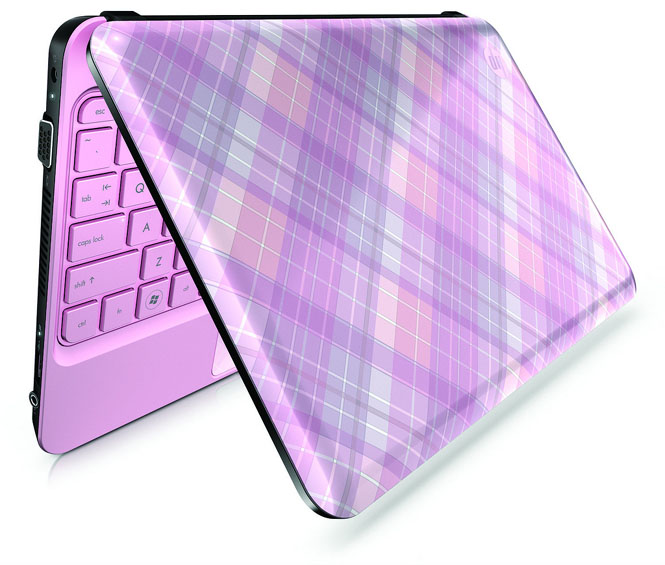
For folks who want something smaller, HP is also updating its Mini 210 line with two new designs: “preppy pink” and “white crystal,” with the pink version featuring the kind of nifty 3D surface technology that lets elements in the case design seem like they’re floating and casting shadows. The new Mini 210’s have the same specs as previous models (1.66 GHz Intel Atom N450 CPU, 2 GB of RAM, up to 320 GB of hard drive storage, and 10.1-inch LED-backlight widescreen display) and should be available in June at prices starting at $355.