
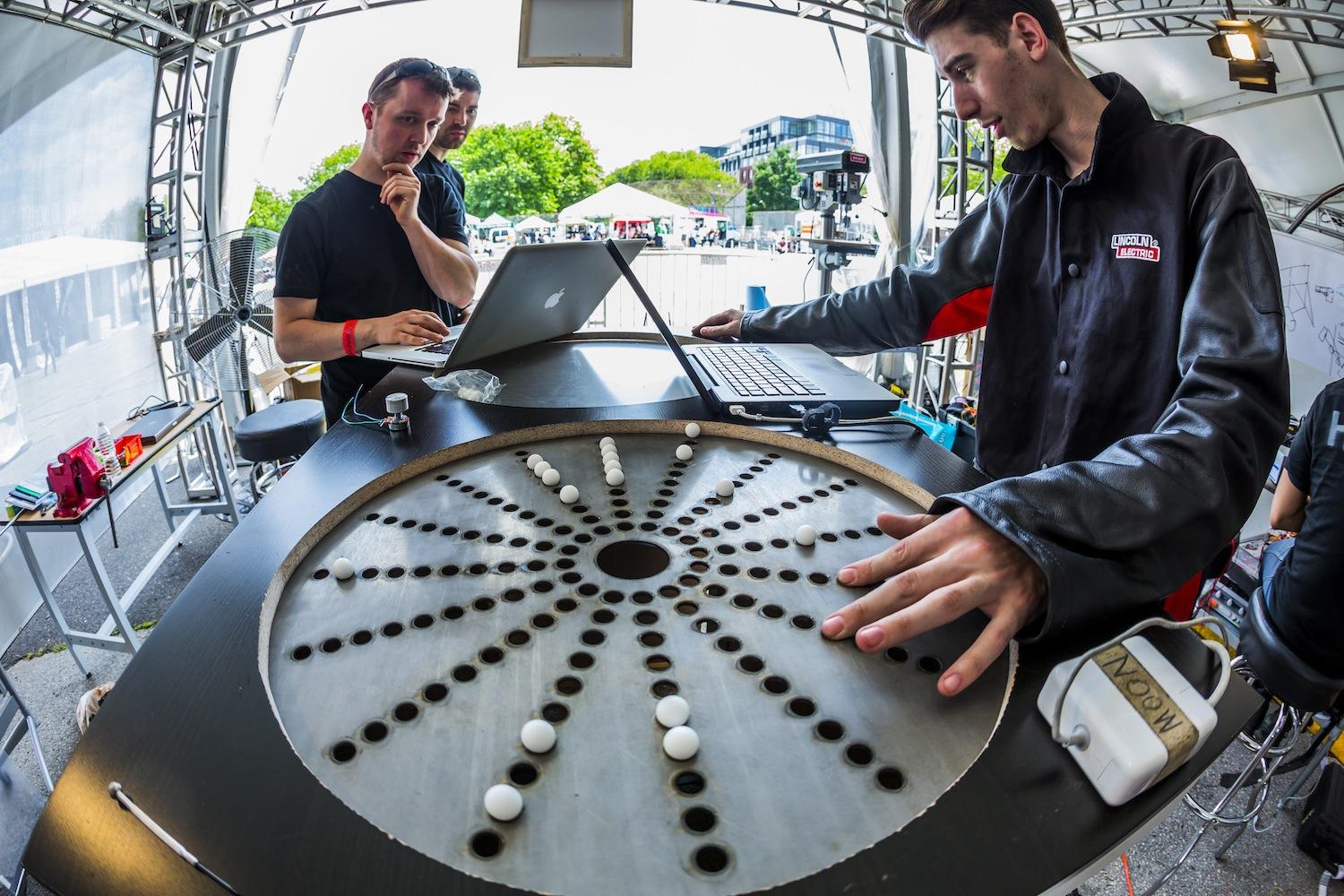
Six teams gathered on a rooftop bar in Brooklyn last Wednesday night to toast to the launch of the third annual Red Bull Creation competition. With 72 hours on the clock, teams made up of makers, builders, and hackers from all over the country began the live build – all with the grand prize of $10,000 in sight. The topic, “Signal to Noise,” was announced Wednesday night; building began Thursday morning; and one team was crowned the winner today.
Teaming up with Brooklyn’s annual Northside music festival (think the Brooklyn equivalent of Austin’s South by Southwest), Red Bull Creation challenged the six teams to design and build a new musical instrument. With practically no restrictions, the teams were given the opportunity to create whatever they wanted. Nearly every tool imaginable, including 3D printers, laser and plasma cutters, and welding and cutting machines were made available to the teams, as well any materials they brought or could conjure up in New York City – some teams even overnighted parts from afar.
Running on little sleep and a whole lot of Red Bull, the teams worked non-stop from Thursday morning to Saturday evening, at which point the clock hit zero and the teams put down their tools – whether they were ready to or not. Some teams, like MB Labs from Chicago, finished with time to spare, walking over to grab a beer and watch the concert taking place in the same venue as the build. Other teams scrambled down to the wire.
And the winner is…
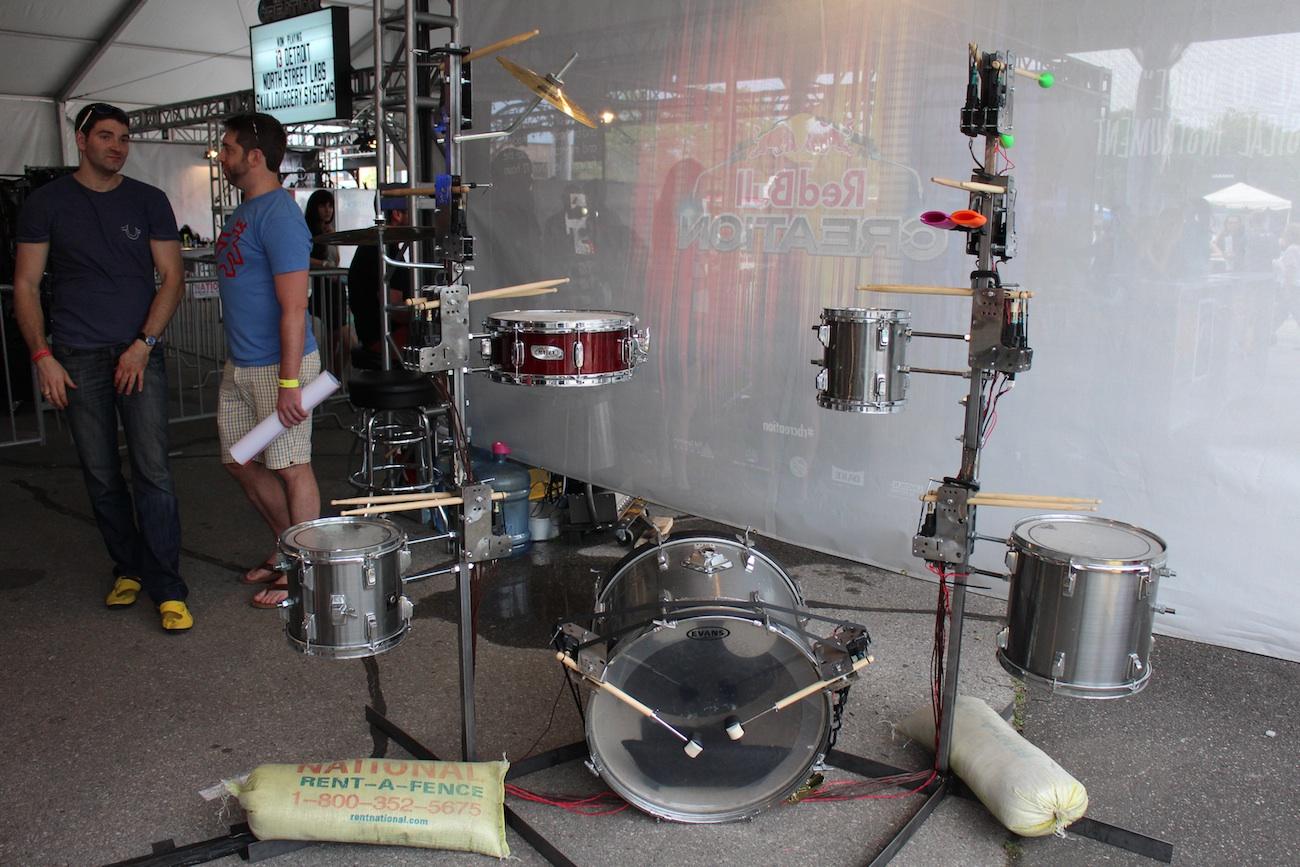 The winner of the 72-hour build was announced today in between bands. MB Labs took the grand prize for its Autoloop project. The project lets users control drums via a separate table that uses sensors to determine the rhythm, which varies depending on where on the table you place objects.
“The judges were blown away by the complete re-imagination of what a synthesizer and musical output device can be,” former Red Bull Creation participant and 2013 Head Judge Greg Needel said in a press release. “The possibilities of where they can go with this in the future is endless.”
The six teams also voted for who they thought was the coolest team in the competition. That award went to i3 Detroit. Though they didn’t win $10,000 like MB Labs, i3 Detroit is walking away with a $3,000 laser cutter from Full Spectrum Laser.
Concertgoers were also able to vote for their favorite project at Sunday’s festivities. That award went to 1.21 Jigawatts and their Erte-tronic Deco Decoder, which allows users to draw something on a large sheet of paper, press a button, and watch their drawing move through sensors, which then translates it into sounds coming form steel tubes. The People’s Choice prize is a 3D printer.
Digital Trends got to spend a few days at the Red Bull Creation site, so stay tuned for more on the unique event.
[Top photo courtesy of Aaron Rogosin/Red Bull Content Pool]


