1. Home
  2. Computing
  3. News

Avoid reality everywhere you go with MSI’s VR One backpack

Add as a preferred source on Google

The Tokyo Game Show will kick off later this week, and MSI will be on hand to showcase its VR backpack called the VR One. It’s a computer that can be worn like a backpack and optimized for the HTC Vive headset, allowing users to walk around freely in their virtual worlds without the leashed constraints of cables. Of course, cables are still involved, but with the VR One, the computer is no longer the anchor.

But don’t get your hopes up of running around with a computer on your back all day. The VR One comes with two rechargeable, hot-swappable battery packs, one inserted on each side of the unit, that provides up to 90 minutes of pure VR gameplay combined. Granted, that’s not a lot of time, but keep in mind that this device doesn’t seem to be a strapped notebook, but rather a compact, high-end desktop that must power a VR headset and its controllers in the process.

Recommended Videos

As for the system specs, MSI hasn’t exactly been forthcoming before the show, stating that it’s powered by an overclocked, high-end Intel Core i7 processor and a Nvidia GeForce GTX 1070 graphics chip. Device connectivity includes four USB 3.0 ports, one HDMI port, one Mini DisplayPort, one USB Type-C port supporting Thunderbolt 3, a microphone jack, and a headphone jack. It’s overall weight with the batteries intact is just under 8 pounds.

Because this is a PC users wear on their back, cooling is a priority given the heat generated between human and machine. The unit’s cooling system relies on two 90mm fans and nine heat pipes, producing less than 41dBA of noise. Again, MSI doesn’t provide any details just yet, but images show what appears to be two air intakes on the front, two air intakes on the back, and an air vent on each side of the device.
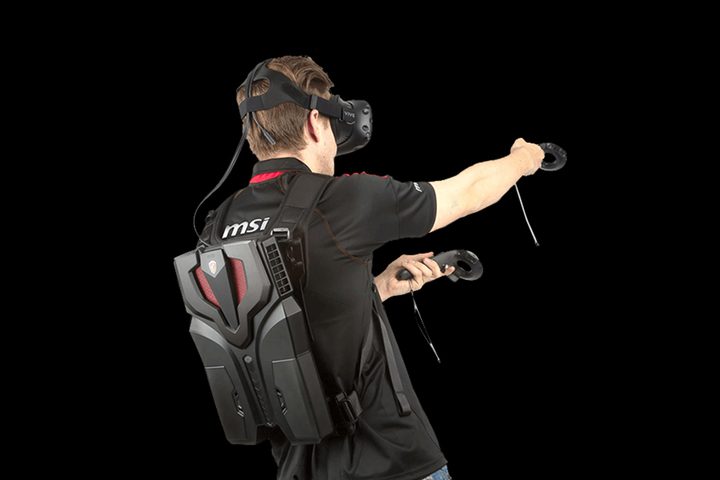
MSI VR One
Image used with permission by copyright holder

On the battery front, the unit provides four white LEDs next to each of the battery mounts. When all four LEDs are illuminated, the associated battery is at 75 to 100 percent capacity. When there is only one LED lit, the battery is below 25 percent. This LED will blink when the battery is about to give out, and will require the user to plug in a power adapter to swap it out. In turn, this power adapter allows the unit to serve as an ultra-slim PC gaming desktop, not just a VR backpack.

Of course, we’re not exactly sure how users will be able to see the battery status lights with a VR headset strapped to their face. That’s likely where the MSI Dragon Center software comes in, which is accessible with a single click of a VR key. This platform includes a hardware performance monitor, a system tuner, an LED wizard, an app portal, and a mobile center, allowing users to make adjustments by way of a smartphone.

MSI is expected to launch the VR One here in the United States sometime in October, and we expect to hear the hardware details later this week. That also goes for pricing, which wasn’t revealed in the company’s tease distributed on Monday. Expect to hear more sometime around Thursday.

Kevin Parrish
Kevin started taking PCs apart in the 90s when Quake was on the way and his PC lacked the required components. Since then…
I found five desk organization gadgets I’d happily recommend for Back-to-School
Because a cluttered desk is not the productivity aesthetic you think it is.
Computer, Electronics, Laptop

I have seen my desk go from a pristine, organized workplace to something out of a horror movie within a week. One day it's just your laptop and a coffee mug, and a month later it's a scrapyard of tangled cables, chargers, books, and the one key that's been missing since move-in day. If your setup has slowly turned into that mess, this list is for you.

I picked five products that fix different pieces of the same problem: not enough charging, not enough storage, and not enough ways actually to keep track of the stuff you need. None of these will magically make you a tidy person, but they'll take away most of your excuses.

Read more
Lenovo’s next ThinkCenter desktop is ready to hit the shelves, but the price will make you blink twice
The ThinkCentre X is finally heading to the US with up to 256GB RAM, dual RTX 5060 Ti GPUs, and a price tag that rivals a used car.
Lenovo ThinkCentre X workstation with monitor

If the phrase "future-proof desktop" means never worrying about running out of RAM again, Lenovo may have just built the ultimate machine. The company is preparing to launch its new ThinkCentre X workstation desktop in the US after making it available in several international markets. Built for AI workloads, professional content creation, and demanding enterprise applications, the desktop can be configured with up to 256GB of DDR5 memory, Intel's latest Core Ultra 9 processor, and support for dual GeForce RTX 5060 Ti 16GB GPUs.

A workstation built for serious workloads

Read more
A metallic Hall effect keyboard and a 59g mouse are Lenovo’s latest upgrades for snazzy gaming setups
The Legion R7 RT75 keyboard and Y7MG mouse bring 8K polling to both sides of your gaming setup
Computer, Computer Hardware, Computer Keyboard

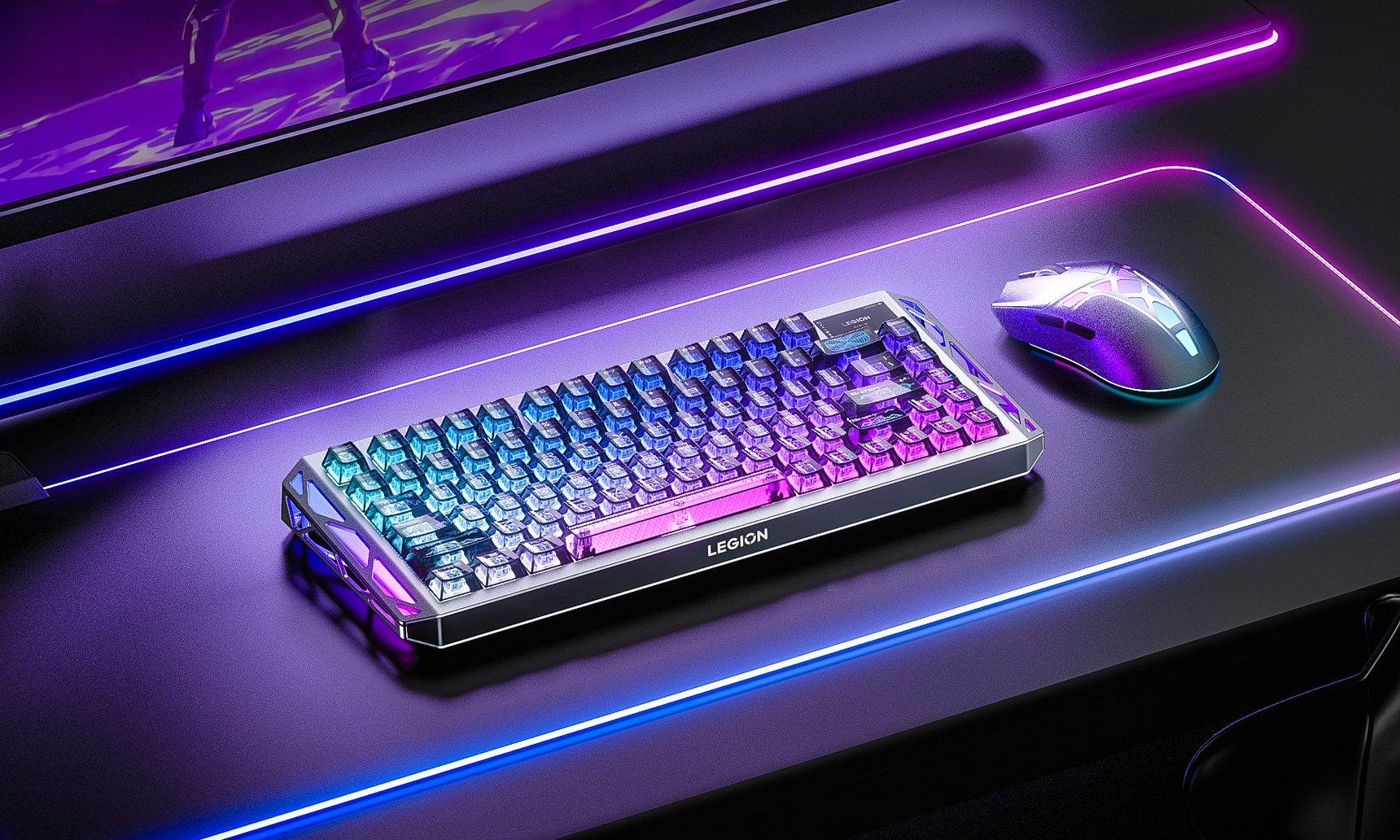
Magnetic gaming keyboards and lightweight mice are hardly unusual anymore, but Lenovo is trying to push both ideas a little further with its latest Legion peripherals. The new lineup includes the Legion R7 RT75 keyboard and Legion Y7MG mouse, and both support an 8,000Hz polling rate for players who want every input delivered to their PC as quickly as possible.

Of course, Lenovo has styled these peripherals to be as bold and eye-catching as possible without getting in the way of practicality. The keyboard has a hefty metallic design with translucent keycaps and RGB lighting. Compared to that, the mouse is more tame and traditional in design, but it also has an RGB strip that appears to belong on an alien spaceship. (via NotebookCheck)

Read more