1. Home
  2. Computing
  3. News

Razer’s new Kiyo Pro webcam uses surveillance camera tech to improve lighting

Add as a preferred source on Google

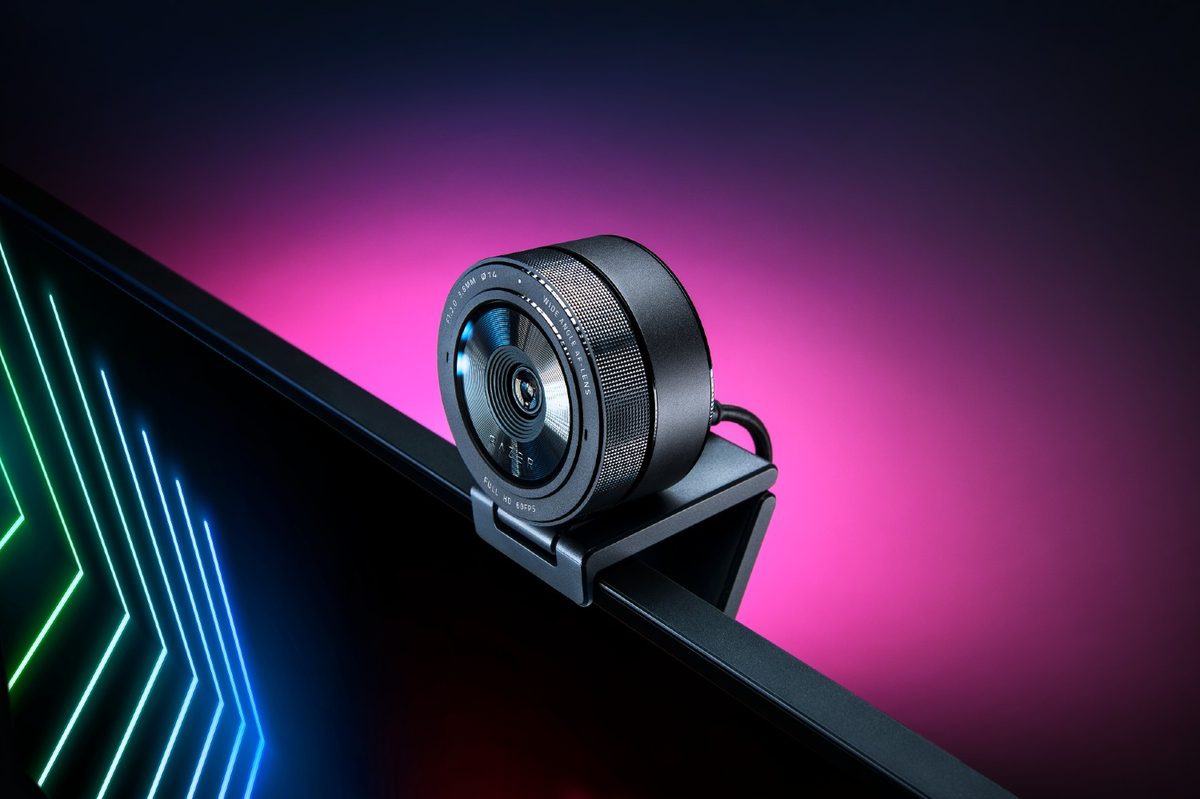
Webcams have never been more important, and Razer has a new option that’s geared toward both streamers and remote workers. The Kiyo Pro, which costs $199, is a spruced-up version of the company’s popular Kiyo webcam, though some significant changes have been made to earn the “Pro” designation.

Most notably, the Kiyo Pro doesn’t include a built-in ring light like the Kiyo does. Instead, it uses a new “adaptive light sensor” technology, which Razer says negates the need for a direct light to brighten up your face during video calls.
Razer
The image sensor, called the Sony IMX327 CMOS with Starvis Technology, is the star of the show. It is currently used in security and surveillance cameras for the purpose of operating in extreme lowlight scenarios. It’s not hard to see how that could benefit the makeshift offices your co-workers occupy these days.
Recommended Videos

Razer showed off comparison photos between the Kiyo Pro and competitors like the Logitech Brio and Logitech StreamCam. Across the board, the Kiyo Pro appears to give a more nuanced and balanced picture, rather than blowing out whites.

Razer representatives also made special note of the more accurate and lifelike colors represented in the Kiyo Pro’s camera. In some of the comparisons, such as the one below, the Logitech StreamCam (bottom right), provides a brighter image that Razer admitted some might prefer. Fortunately, the lighting is adjustable in Razer’s Synapse software, so you can save profiles and select between different presets.

Image used with permission by copyright holder

The Kiyo Pro shoots in 1080p at 60 frames per second (fps), compared to the 30 fps of the original Kiyo. The Logitech Brio costs the same amount, though it can also shoot in 4K at 30 fps. The $170 Logitech StreamCam, meanwhile, matches the Kiyo Pro in resolution and frame rate.

The Kiyo Pro also features an adjustable field of view, ranging from 80 degrees to 100 degrees. This can be adjusted within Razer Synapse.

Razer says the Kiyo Pro has some unique tuning and customization for streamers as well. The camera better handles harsh background lights often found in streamer setups. And, of course, the emphasis is always on making sure faces and skin tones appear crisp and bright in the frame.


Luke Larsen
Former Senior Editor, Computing
Luke Larsen is the Senior Editor of Computing, managing all content covering laptops, monitors, PC hardware, Macs, and more.
Getting health advice from AI chatbots comes with a problem doctors may never see
Researchers say AI companies should face the same liability as doctors for bad health advice
ChatGPT and pills on the same canvas.

AI chatbots have quietly become a go-to source for medical advice the extent that some are dangerously skipping real doctors. But when AI's health advice goes wrong, doctors may never see the exchange behind it.

Researchers from Binghamton University, Stanford, Texas A&M, and Indiana University published a paper in Nature Health examining what happens after a chatbot gives you bad health information. Their biggest concern is not just that chatbots can be wrong. It is that those mistakes often leave no trace for doctors, researchers, or regulators to catch.

Read more
AI companies expect a catastrophic AI incident and are reportedly preparing for the aftermath
A major AI cyberattack could disrupt essential services, damage public trust, and spark a political fight over regulations.
openai-anthropic-logo-on-screen

Leaders at OpenAI, Anthropic, and other AI companies are reportedly preparing for a potential AI disaster that could turn the public against artificial intelligence. According to an Axios report, industry leaders are privately running through possible scenarios for what happens after a catastrophic AI incident.

What kind of AI disaster are companies preparing for?

Read more
Elon Musk’s SpaceX just made a big move to become a mobile carrier heavyweight in the US
SpaceX moves closer to becoming a major US mobile carrier with $8 billion deal
spacex

Elon Musk’s SpaceX is moving past satellite internet, and it’s making a big move into the US wireless market. The company has agreed to buy cellular spectrum licences from investment firm Grain Management in a deal reportedly worth about $8 billion, its biggest move yet to compete with established mobile carriers such as AT&T, Verizon and T-Mobile, according to a WSJ report.

The deal is for spectrum in the 800MHz band, which is for mobile services delivered via terrestrial infrastructure such as cell towers, not satellites. If the acquisition is approved, SpaceX could combine those airwaves with its growing Starlink satellite network to create a more comprehensive wireless service.

Read more