

Covered by CNN recently, a development team at Chaotic Moon has created a new type of bicycle helmet that utilizes several cameras in order to capture identifying information during an accident. Using a built-in accelerometer, the helmet can detect when a cyclist has been struck by a car or another vehicle on the road. At the moment of impact, the seven camera built into the helmet immediately start recording video and capture footage for the next two hours. There are two cameras mounted at the front of the helmet, four cameras mounted at the rear of the helmet and one camera mounted at the top of the helmet in case the cyclist falls to the ground.
 The idea for the ‘Helmet of Justice’ spawned after Chaotic Moon employee Jason Poindexter (labeled John Poindexter by CNN) was hit by a car that sped away from the scene of the accident. An injured Poindexter later woke up covered in blood in an ambulance and had no identifying information that could lead to the arrest of the driver.
With the ‘Helmet of Justice’ in operation, the video cameras could have picked up the color and make of the vehicle as well as the license plate and a still image of the person driving the car. After an accident, the video footage can be recovered from the helmet using a USB cable and a computer.
The entire project to build the helmet took about one week to complete and the total cost of creating the helmet was around $300. Hypothetically, future versions of the helmet could include GPS-logging to track the location of the cyclist. In theory, that data could be passed along to emergency services after a devastating impact. However, that would require a paired smartphone over low-power Bluetooth and regional text-to-911 service. Within that text message, emergency medical services could be dispatched to the rider’s exact location and the police could be informed of the existence of the helmet video immediately in order to quickly track down the driver that fled the scene.
 Chaotic Moon hasn’t announced any plans to manufacture the ‘Helmet of Justice’ in the United States, but it’s possible that the organization could license the design to companies that manufacture and sell bicycle helmets like Schwinn, Giro or Bell.
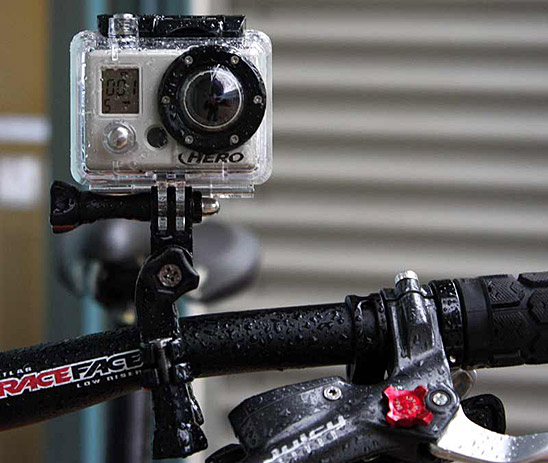
At the moment, the most popular video protection solution used by cyclists are small, inexpensive 1080p video cameras created by companies like GoPro and Contour. These cameras are usually mounted to the top of a helmet or on the frame of a bicycle.
For instance, 33-year-old Evan Wilder was able to capture footage of a driver that sideswiped his bike according to the New York Times. After passing along the footage to Washington police, the license plate and make of the car was identified and the driver, John W. Diehl, was charged with leaving the scene of an accident. When asked about the incident and the video footage, Wilder said “I know my actions before and after some event are going to be recorded if I’m the one being a jerk. It makes me want to be careful…Most cyclists don’t use cameras so Mr. Diehl may have assumed he could assault and drive away anonymously.“


