  1. Home
  2. Emerging Tech
  3. Outdoors
  4. News

If Apple designed a scooter, it would probably look a lot like The Eagle

Add as a preferred source on Google

Apple’s Jony Ive doesn’t design scooters, but if he did we’re imagining they may well be along the lines of The Eagle, a forthcoming ultra-thin carbon fiber electric scooter created by Swiss and Lithuanian startup Citybirds. Recently shown off at the ISPO trade expo in Munich, Germany, The Eagle promises to join the ranks of best escooters when it finally hits the streets.

The scooter is described by its creators as the thinnest and lightest electric scooter concept on Earth, with a folded thickness of just 30mm. This makes it perfect for both storing in your home and office, and any commute that requires you to fold it up for space saving. It features a 36-volt motor that will grant you a top speed of around 25 kilometers per hour (approximately 16 mph) and a battery that will give you a range of 15 kilometers (nine miles) or double that with an extra battery.

Recommended Videos

In addition to this, it will boast both plug-in and inductive charging, and a pop-up display in the handlebars, which will offer turn-by-turn directions, as well as the possibility of acting as another external display for information like media notifications.
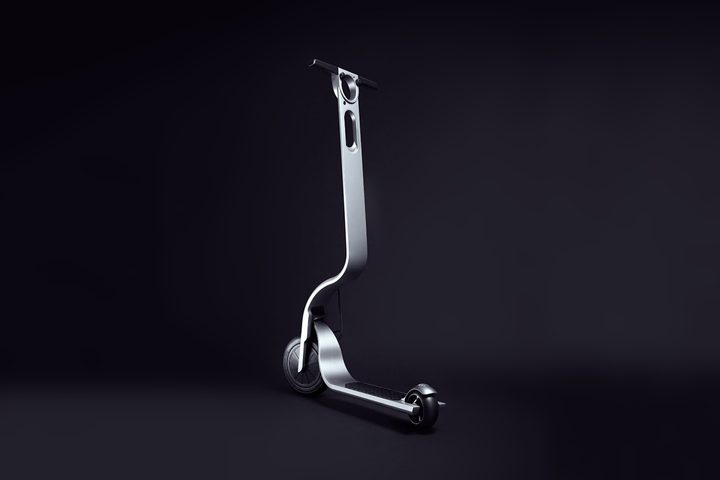
Image used with permission by copyright holder

“We started designing Citybirds scooters in 2014, when the first iconic non-electric Pigeon scooter design appeared on Kickstarter,” CEO and designer Ignas Survila told Digital Trends. This was followed by the newer Raven scooter before the team turned its attention to creating the sleekly impressive Eagle e-scooter.

Don’t expect it to be here in time for this summer, though. “We present it not as a finished product, but as a concept that will only appear on the market in 2020,” Survila said. There are no more details at present about the exact availability of the scooter, nor its planned market price. However, Survila said it won’t be prohibitively expensive. “For sure it won’t be more than 1,500 euros,” he said.

While the equivalent of $1,840 isn’t exactly cheap, it’s also not in the upper echelons of escooter prices. Given the chic design and promise of some nifty smart features, it seems a pretty fair price. Now we guess we should better get saving some extra cash.

Luke Dormehl
I'm a UK-based tech writer covering Cool Tech at Digital Trends. I've also written for Fast Company, Wired, the Guardian…
Anker just exposed a big problem with portable power stations
Appliance, Device, Electrical Device

When you're shopping for a portable power station, there's one number that's almost impossible to ignore: battery capacity. A 2 kWh battery should give you roughly 2 kWh of usable power, right? Unfortunately, things aren't quite that simple. Anker SOLIX has published new efficiency data for its S Series portable power stations, and it's putting the spotlight on something that doesn't get nearly as much attention as capacity: how much of the energy stored inside the battery actually makes it to your devices.

According to Anker, portable power stations are commonly advertised with efficiency figures measured under relatively heavy loads, where they can reach roughly 89% to 92% efficiency. But that's not necessarily how most people use one during an outage. Think about what you'd actually plug in. A Wi-Fi router might sip power continuously, a refrigerator switches its compressor on and off throughout the day, and a CPAP machine could run overnight. Together, those devices may draw just a fraction of what a large power station is capable of supplying. And that's where efficiency can start slipping.

Read more
OpenAI’s first gadget sounds like a tiny expressive AI companion
The device will have a doughnut-shaped body, built-in cameras, and moving parts
OpenAI press image

For months, reports have suggested that OpenAI’s first hardware product would be a screen-free smart speaker designed to act more like an AI companion. We already knew it could understand its surroundings, be carried around the home, and proactively help users. A new Bloomberg report now gives us a clearer picture of what the device may actually look like.

As per the report, OpenAI’s first gadget will be shaped like a doughnut and measure about the same size as a hockey puck. You will be able to carry it between rooms or leave it nearby on whatever surface is convenient. The device is expected to be on the expensive side, as the company has pondered pricing it around $300 to $400. A release is currently planned for 2027.

Read more
Google Antigravity just built an AI translator that works without the internet
Electrical Device, Switch, Robot

Google has shown off a new AI project that could make language barriers a little less intimidating, and it doesn't need an internet connection to do it. The company has introduced the Gemma Translator, a compact prototype built in collaboration with Antigravity. Unlike most AI translation tools that rely on cloud processing, this device runs entirely offline using Gemma 4 E2B, Google's lightweight open model. Everything happens locally on the device, making it both portable and independent of an internet connection. The prototype is powered by a Raspberry Pi 5 and includes a microphone and speaker inside a custom 3D-printed enclosure, creating a self-contained translator you can carry almost anywhere.

AI translation, without the cloud

Read more