Peter Aralic, who should now add “protester” to his resume, took to his 3D printer in response to a recent State Department law proposal which would make the online distribution of gun blueprints illegal. Aralic claims this proposal — which itself is hidden among an update to the International Traffic in Arms (ITAR) regulation — has the ability to arbitrarily ban some weapon designs over others, and will put unnecessary constraints on freedom of speech.
To prove this, Aralic posted a short video to his YouTube channel (posted below) calling out the proposed law and exploiting one of its inherent loopholes. In the video, Aralic first points out the fact air guns aren’t considered firearms under federal law, which mean’s that even if the proposed law were put into effect, it would still be completely legal to distribute air gun blueprints online.
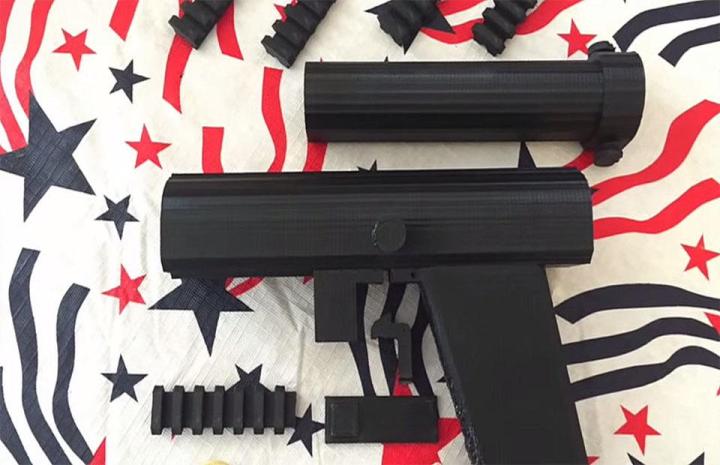
Instead of getting caught up in the political debate, Aralic decides to show off his own design of a .40-caliber poison dart gun because, well, he can. The design, comprised of a 3D-printed gun body, a 3D-printed piston, and several rubber bands, looks awfully similar to a real gun, but remains unaddressed by the recent proposed law due to its “air gun” status. After a brief explanation about the construction of the dart gun, Aralic displays the firing power of his creation by obliterating a balloon with a .40-caliber dart. Needless to say, Aralic’s creation toes a very fine line between being a simple air gun, and being what federal law deems to be a full-fledged firearm.
Those against the publication of weapon schematics online say these blueprints actually classify as operational objects — as opposed to free speech — which make them eligible for regulation. As it stands currently, the State Department intends to require approval for the online publication and distribution of data pertaining to the construction of any weapon. It also put forth the notion that publishing documents related to the construction of such armaments would be equivalent to illegally exporting weapons, and that these actions would not fall under the protective umbrella of free speech.
However, a recently filed lawsuit — from famed 3D-printed weapon maker Cody Wilson and his company Defense Distributed — aims to challenge the stance of the State Department on these matters, claiming it violates its first amendment rights. The lawsuit, which effectively pits advocates for free speech against those in favor of gun control, won’t likely reach a conclusion soon, but a decision on the matter should serve as the definitive ruling on whether 3D-printed weapon schematics are indeed free speech or subject to censorship.
Considering few issues rile people up like free speech and gun control, expect a lengthy — and very heated — debate until the judge’s ruling comes down.
Editors' Recommendations
- 3D printed cheesecake? Inside the culinary quest to make a Star Trek food replicator
- AMD’s revolutionary 3D V-Cache chip could launch very soon
- Fighting football injuries with 3D-printed, hyper-personalized pads
- Need a last-minute Halloween costume? Check out these 3D-printable getups
- NASA is testing a 3D printer that uses moon dust to print in space