  1. Home
  2. Emerging Tech
  3. Health & Fitness
  4. News

Researchers build the world's smallest hammer to smash brain cells

Add as a preferred source on Google

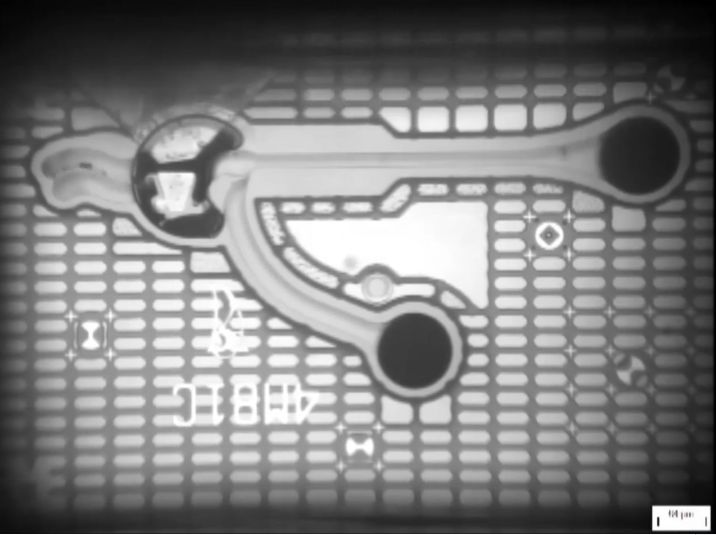
The world’s smallest hammer has been created to study what happens to brain cells when we hit our head. The goal for the University of California, Santa Barbara researchers behind the project is to uncover the physical underpinnings of traumatic brain injuries (TBI) in order to develop better treatment methods.

“This is new territory,” Kimberly Foster, one of the principal investigators leading the project, told Digital Trends. “We are not yet sure of what we will find! This is what makes this science so interesting and exciting.”

Recommended Videos

Along with Megan Valentine, Adele Doyle, and research student Luke Patterson, Foster will study how impact affects neural stem cells. But cells are small and the researchers needed a cellular-scale device to test and measure the damage, so they developed a tiny hammer.

“The microhammer is a silicon micromechanical device, known as MEMS,” Foster explained. “The hammer is deployed using a magnetic force. It was fabricated in a cleanroom utilizing tools similar to those used to make microprocessor chips.”

Foster and her team’s microhammer was designed by modifying a cell-sorting technology developed by Owl Biomedical, a biotech company that will collaborate with the researchers in the study.

“With the microhammer device we not only provide TBI-relevant forces to cells, we can collect the cells after impact and assess their biochemical and structural changes over time,” Valentine told Digital Trends.

Though the project is still in its infancy it shows promise to illuminate the mechanisms at work beneath our skulls by impacting and precisely measuring physical, chemical, and biological effects.

“There is so much we don’t understand about the brain, and in particular how forces are sensed and processed,” Valentine said. “We hope the tools we develop will allow us to understand the complex interactions between force inputs and biological outputs, including changes in cell composition, function, and viability.”

The project is part of the federal Brain Research through Advancing Innovative Neurotechnologies (BRAIN) Initiative.

Dyllan Furness
Former Contributor
Dyllan Furness is a freelance writer from Florida. He covers strange science and emerging tech for Digital Trends, focusing…
The Apple Car may be dead, but it became the foundation of Apple Intelligence
A decade of work on a canceled car project reportedly laid the groundwork for Apple Intelligence.
Apple Intelligence in Apple Car

The Apple Car may have never left the garage, but it apparently gave birth to Apple's AI ambitions. According to Bloomberg's Mark Gurman, Apple's canceled autonomous vehicle project, one that consumed more than a decade of work and over $10 billion before being scrapped in 2024, ended up laying the technological foundation for Apple Intelligence. In a rather ironic twist, one of Apple's most expensive failures may also become one of its most important long-term investments.

The Apple Car forced Apple to think like an AI company

Read more
Researchers hid a prompt injection inside a PNG, and AI fell for it
Hacker

AI coding assistants like Claude are becoming every developer's favorite coworker. They can review code, explain confusing functions, and even write entire features with a single prompt. But new research suggests that this growing trust could also become their biggest weakness.

A team of security researchers (professor Sudipta Chattopadhyay and researcher Murali Ediga) has demonstrated an unusual attack that doesn't target the AI model directly. Instead, it targets what the AI doesn't pay enough attention to during code reviews. Rather than hiding malicious instructions in lines of code, the researchers tucked them inside an image file. Since many AI review tools treat images as decorative assets rather than as something worth inspecting, the pull request can appear perfectly harmless and sail through the review.

Read more
AI has already fallen into the wrong hands and they’re using it to make bombs
Logo, Text

Artificial intelligence has quickly become the go-to tool for everything from writing emails and summarizing meetings to helping students study or developers debug code. But the same technology that saves people time can also be misused, and a new report suggests that terrorist organizations are finding ways to do exactly that.

According to a research paper shared with The New York Times ahead of its publication, researchers found evidence that members of Boko Haram have been using popular AI chatbots to support both day-to-day activities and combat-related tasks. Interviews with 27 former members conducted in Nigeria over the past two years suggest that tools such as ChatGPT, Gemini, Claude, Grok, Meta AI, and DeepSeek were used to gather technical information, troubleshoot weapons, and even assist with planning attacks.

Read more