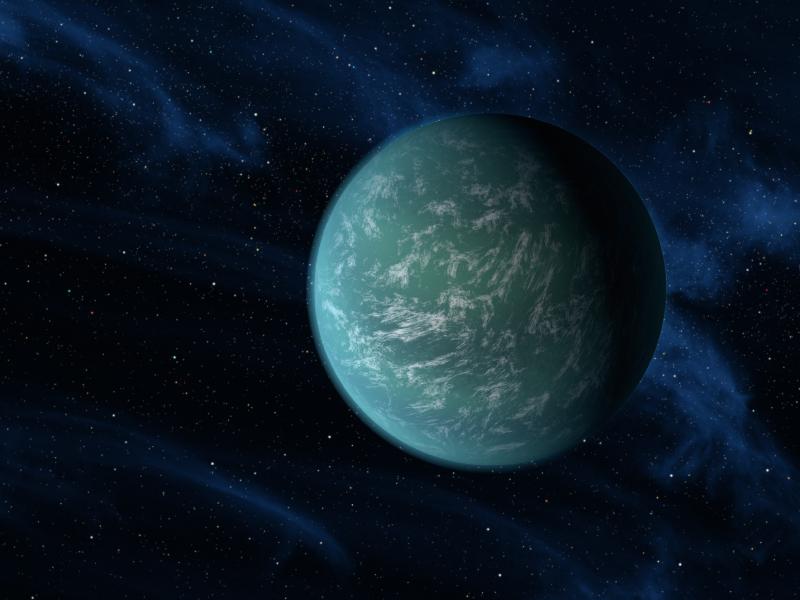
We don’t usually get too in-depth with science coverage here at Digital Trends, but this breakthrough certainly deserves mention: NASA announced today that it has confirmed the discovery of the first known planet that could have liquid water on its surface, thus making it potentially habitable for alien life. The planet, dubbed Kepler-22b, is one of more than 1,000 new planet candidates discovered during the Kepler mission.
The reason Kepler-22b is particularly notable is that it orbits in the middle of the so-called “habitable zone” of its star, which NASA calls “sun-like,” but is slightly smaller and cooler than our sun. (Earth orbits in a similar location to our sun.) Two other planets have been found in the habitable zones of their stars, but they orbit on the outer edges of what could be classified as habitable.
“This is a major milestone on the road to finding Earth’s twin,” said Douglas Hudgins, Kepler program scientist. “Kepler’s results continue to demonstrate the importance of NASA’s science missions, which aim to answer some of the biggest questions about our place in the universe.”

Kepler-22b measures roughly 2.4 times the radius of Earth, and is located approximately 600 light-years away. It’s year — the amount of time it takes a planet to orbit its sun — is nearly the same as Earth’s, taking 290 Earth-days to make a full orbit. The planet, along with 48 other planets that may also lie in a habitable zone, was discovered using a number of ground-based telescopes, which monitor the Cygnus and Lyra constellations, which are home to more than 150,000 stars.
To confirm that a heavenly body is, in fact, a planet, Kepler scientists watch to see if a planet candidate crosses in front of a particular star, something known as “transit.” In order for a planet candidate to be confirmed as a planet, it must transit a minimum of three times. It was through this scrutiny that Kepler-22b achieve full planet status.
Now that Kepler-22b has been confirmed, Kepler scientist will begin to examine it more closely to find out what it is made of (solid, liquid or gas), and whether or not it has an atmosphere that could actually support life as we know it.
[Images via NASA/Ames/JPL-Caltech]
Editors' Recommendations
- What comes after Webb? NASA’s next-generation planet-hunting telescope
- Planet hunter TESS finds more potentially habitable worlds