  1. Home
  2. Emerging Tech
  3. Legacy Archives

NASA rovers carried World Trade Center aluminum to Mars

Add as a preferred source on Google
Image used with permission by copyright holder

The offices of Honeybee Robotics were located less than a mile from the World Trade Center in 2001. In September of that year, the company was building grinding tools for NASA’s Mars Exploration Rovers Spirit and Opportunity.

Following the terrorist attacks of September 11, the employees of Honeybee struggled to find a way to offer help or a tribute as they were weighed down by the necessarily-firm NASA deadlines required for equipment testing. But eventually Honeybee found the perfect opportunity.

Recommended Videos

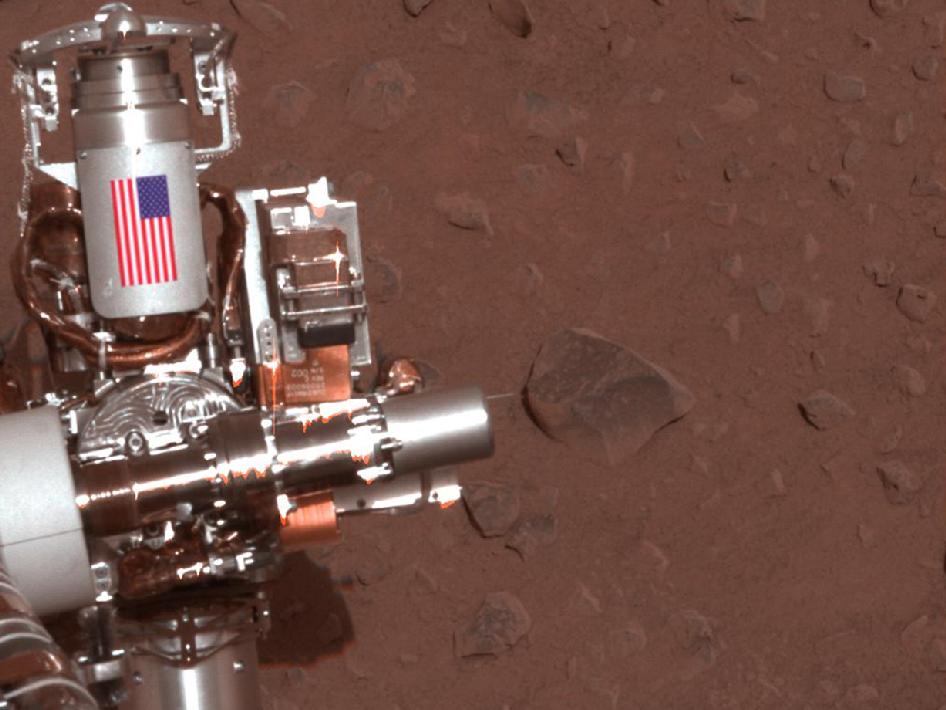
The design of the grinders called for a plain aluminum shield to cover the tool’s control cables. Working with New York City mayor’s office, a metal-working shop in Texas and NASA’s Jet Propulsion Laboratory in California, Honeybee decided to fabricate the shields out of aluminum recovered from the World Trade Center towers. With images of American flags attached, both shields now serve as a permanent tribute on Mars. On the photo of Spirit above, the shield is the dull metal piece at top left.

The Spirit rover was launched all the way back in June 2003, with Opportunity launched that July. By January of 2004 they’d both landed safely on Mars. Their primary missions were both completed three months later. The grinders designed by Honeybee were used initially in rock sampling; they allowed both rovers to cut through the crust on Martian rocks to analyze their contents.

Interestingly, it wasn’t until the end of 2004 that anyone from Honeybee spoke publicly about where the shields’ aluminum had come from. That November, in a profile of Honeybee by the New York Times, Honeybee CEO Stephen Gorevan spoke of the shields.

“It was intended to be a quiet tribute,” he said. “Enough time has passed. We want the families to know.”

The rovers continued their work long after that. Opportunity is actually still active, while Spirit quit communications in spring of last year. During that span both rovers have used their penchant for geological study to vastly increase our knowledge about ancient Mars’ wet environments and their potential for supporting life.

After Opportunity goes silent, both rovers will remain in good condition for years to come thanks to Mars’ dry, cold environment. Even when they’re nonoperational, the rovers will continue carrying out their mission as the only interplanetary tribute to September 11.

Lead photo via NASA/JPL-Caltech/Cornell University

Derek Mead
Former Digital Trends Contributor
Scammers are teaching AI to sound like you, and research says our brains are falling for it
Has your accent just become a security vulnerability? AI scammers are getting too good at sounding local
Scammers are turning trusted news brands into investment traps

The next scam call you receive may not sound like a robot, a call center, or even someone pretending to be your relative. AI voice generators have become capable of reproducing regional accents and dialects that sound convincing enough that researchers are warning they could become a potent social-engineering tool.

For example, a scammer could use an accent familiar to a targeted community to make a suspicious call sound considerably more trustworthy.

Read more
Scientists found a way to turn plastic bottles into cookies you can actually eat
hand holding a cookie

Plastic bottles and cookies rarely show up in the same sentence, but a team of researchers just gave us a reason to talk about both together. According to Science Daily, scientists at Southern Illinois University Carbondale have engineered yeast that can turn waste from plastic bottles and old crop leftovers into real food ingredients and create cookies.

The work began as part of a NASA program exploring how astronauts might produce their own food during deep space missions, since resupply runs from Earth aren't exactly realistic that far out. The researchers' big insight was simple: plastic bottles are packed with carbon, and so, as it turns out, is food. That single connection became the foundation for everything that followed.

Read more
Students who use AI every day may be falling behind, while moderate users pull ahead
New global testing data suggests more AI in the classroom isn't automatically better.
Logo, Text

I assumed more AI access might help students learn faster. However, a new OECD study dispels that misconception for me and everyone else who gave their children a paid version of AI chatbots, thinking it would help them through their educational journey. 

According to PISA 2025 data from 760,000 students in 91 countries, students who use AI daily score meaningfully worse on standardized tests than their peers. The full picture is more complicated than a simple ban would fix.

Read more