  1. Home
  2. Emerging Tech
  3. Health & Fitness
  4. News

Massive air-purifying vacuum cleaner sucks up particles, blows out clean air

Add as a preferred source on Google

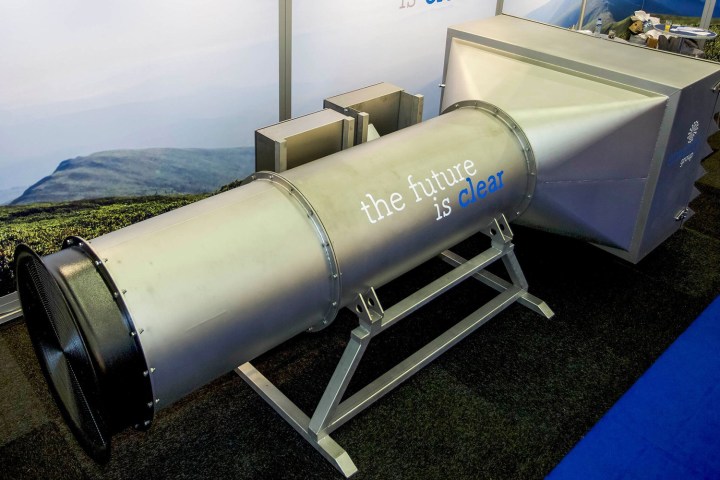
A giant outdoor air-cleaning vacuum cleaner was unveiled in Amsterdam yesterday. Its inventors at the Envinity Group claim the air purification system is the first of its kind and may soon help filter toxic particles from the atmosphere.

The 26-foot-long steel vacuum cleaner has enough suction to intake air from a 300-meter radius and up to over four miles above the machine, according to studies conducted by the Energy Research Center of the Netherlands, with the capacity to filter 100 percent of fine particles and 95 percent of ultra-fine particles from nearly 800,000 cubic meters of air per hour.

Recommended Videos

“A large column of air will pass through the filter and come out clear,” Envinity spokesperson Henk Boersen told the Agence France Presse (AFP).

Particle pollution is a big part of big city life. Fine particles of dust, dirt, and smoke from burning fuels fill the air we breathe, irritate our eyes, get into our lungs, and cause health problems. Ultra-fine particles from vehicle emissions have even more damaging effects. Envinity is already in talks with governments, businesses, and airports to install its vacuum cleaner to filter these particles from problem areas, according to Boersen.

RelatedBeijing’s silver-plated ‘Smog Free Tower’ turns pollution into carbon cubes

Just last month, another Dutch-designed air purifier was powered on in Beijing, China, one of the world’s most polluted cities. The 23-foot-tall Smog Free Tower was billed as the “the largest electronic vacuum cleaner in the world” by its designer, Dan Roosegaarde.

While Envinity Group is intended both as an environmental and commercial product, the tower was primarily an art installation intended to raise awareness about air pollution. It is said to filter roughly 30,000 cubic feet of air per hour and remove about 75 percent of harmful particles.

For every 1,000 cubic meters of air filtered through the tower, Roosegaarde and his team will create a carbon cube, which will serve as a reward for the project’s Kickstarter campaign participants.

Dyllan Furness
Former Contributor
Dyllan Furness is a freelance writer from Florida. He covers strange science and emerging tech for Digital Trends, focusing…
Students who use AI every day may be falling behind, while moderate users pull ahead
New global testing data suggests more AI in the classroom isn't automatically better.
Logo, Text

I assumed more AI access might help students learn faster. However, a new OECD study dispels that misconception for me and everyone else who gave their children a paid version of AI chatbots, thinking it would help them through their educational journey. 

According to PISA 2025 data from 760,000 students in 91 countries, students who use AI daily score meaningfully worse on standardized tests than their peers. The full picture is more complicated than a simple ban would fix.

Read more
XPENG just put its humanoid robot on the production line, and it walked itself out
IRON clocks in for its first shift
XPENG Iron

XPENG’s humanoid robot has officially joined the workforce, and it even got an employee badge. The Chinese automaker announced on September 8 that its next-generation IRON had completed assembly and autonomously walked off its newly commissioned humanoid robot production line in Guangzhou.

CEO He Xiaopeng then pinned a staff badge onto the robot, symbolically welcoming it to the XPENG team. It is a charming little ceremony for a machine that the company hopes will eventually become a regular part of everyday life. XPENG is moving IRON beyond R&D prototypes toward production-line manufacturing, applying the quality-control systems and manufacturing experience it has developed through its electric vehicle business.

Read more
An AI-designed drug might help slow aging, but we’re not there yet
The results hint at a possible anti-aging effect, but there’s still a long way to go before we know what it means.
medical test tubes

Rentosertib, a drug Insilico Medicine designed almost entirely using AI, was created to treat idiopathic pulmonary fibrosis, a disease that scars and stiffens the lungs over time. But fighting lung disease was only half the plan from the start.

According to a new study published in Nature Biotechnology, the drug's target was chosen specifically because it overlaps heavily with the biology of aging, and the whole trial was designed to test whether treating the lungs could also mean turning back the body's biological clock.

Read more