  1. Home
  2. Emerging Tech
  3. Business
  4. News

Siemens is at it again with a hybrid train capable of 125 mph

Add as a preferred source on Google

Siemens is no stranger to hybrid-transportation technology, and has announced its intention to create a hybrid electric plane long before NASA. However, the engineering firm is also working on more earthbound transportation in the form of a passenger train — and a fast one at that.

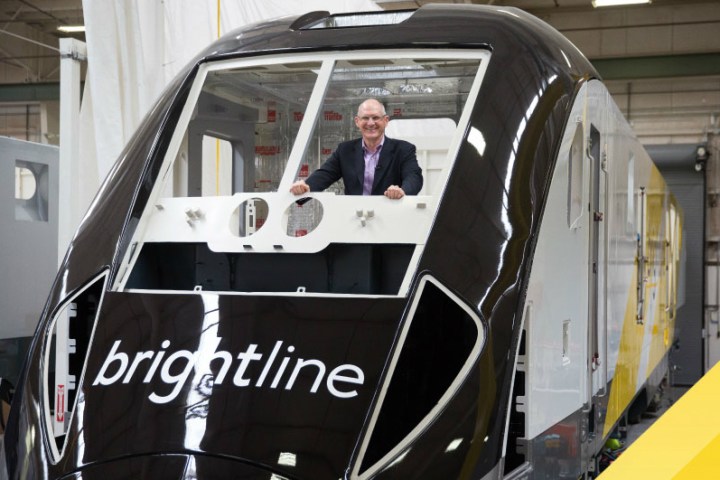
In a privately funded venture, Siemens will build hybrid diesel electric trains for Brightline, according to Business Insider. Initial plans for the train will connect Miami, Fort Lauderdale, and West Palm Beach. Brightline indicates that the train will cut travel between downtown Miami and Fort Lauderdale to 30 minutes, allowing commuters and tourists a quicker, greener option to travel that route.

Recommended Videos

Florida’s east coast will be a starter market for the high-speed hybrid train, but Siemens indicates that it is also manufacturing 69 more diesel-electric trains for California, Illinois, Maryland, Michigan, Missouri, and Washington Departments of Transportation. Siemens manufactures the trains at its 600,000 square foot factory in Sacramento, California, and then transports the trains to the service markets.

Rail service from Miami to West Palm Beach is scheduled to begin in mid-2017, though no implementation time frame was immediately available for the markets outside of Florida.

In the mean time, Florida is preparing the infrastructure necessary to incorporate this game-changer and to extend its reach. Fort Lauderdale began construction on its 60,000 square foot Brightline station in May. Outside of Fort Lauderdale, rail construction is expected to be complete by the end of 2017, and will add Orlando to the list of Florida rail destinations.

While the 125 mph Brightline is not as fast as some found overseas, it is much faster than Amtrack’s 80 mph trains, and provides a quicker alternative for travel between the popular destinations on Florida’s east coast.

A 4,000 horsepower Cummins diesel-electric engine powers the Brightline train, and a 42,000-pound 16-cylinder electric generator keeps electricity flowing. 42 miles of cable runs throughout the train to meet train and passenger electrical demands. The hybrid design allows the train to meet Federal Railroad Administration Tier IV clean air standards.


Dave Palmer
Dave’s technology geek-fest began with the classic Commodore 64 computer, which started a lifelong passion for all things…
Anker just exposed a big problem with portable power stations
Appliance, Device, Electrical Device

When you're shopping for a portable power station, there's one number that's almost impossible to ignore: battery capacity. A 2 kWh battery should give you roughly 2 kWh of usable power, right? Unfortunately, things aren't quite that simple. Anker SOLIX has published new efficiency data for its S Series portable power stations, and it's putting the spotlight on something that doesn't get nearly as much attention as capacity: how much of the energy stored inside the battery actually makes it to your devices.

According to Anker, portable power stations are commonly advertised with efficiency figures measured under relatively heavy loads, where they can reach roughly 89% to 92% efficiency. But that's not necessarily how most people use one during an outage. Think about what you'd actually plug in. A Wi-Fi router might sip power continuously, a refrigerator switches its compressor on and off throughout the day, and a CPAP machine could run overnight. Together, those devices may draw just a fraction of what a large power station is capable of supplying. And that's where efficiency can start slipping.

Read more
OpenAI’s first gadget sounds like a tiny expressive AI companion
The device will have a doughnut-shaped body, built-in cameras, and moving parts
OpenAI press image

For months, reports have suggested that OpenAI’s first hardware product would be a screen-free smart speaker designed to act more like an AI companion. We already knew it could understand its surroundings, be carried around the home, and proactively help users. A new Bloomberg report now gives us a clearer picture of what the device may actually look like.

As per the report, OpenAI’s first gadget will be shaped like a doughnut and measure about the same size as a hockey puck. You will be able to carry it between rooms or leave it nearby on whatever surface is convenient. The device is expected to be on the expensive side, as the company has pondered pricing it around $300 to $400. A release is currently planned for 2027.

Read more
Google Antigravity just built an AI translator that works without the internet
Electrical Device, Switch, Robot

Google has shown off a new AI project that could make language barriers a little less intimidating, and it doesn't need an internet connection to do it. The company has introduced the Gemma Translator, a compact prototype built in collaboration with Antigravity. Unlike most AI translation tools that rely on cloud processing, this device runs entirely offline using Gemma 4 E2B, Google's lightweight open model. Everything happens locally on the device, making it both portable and independent of an internet connection. The prototype is powered by a Raspberry Pi 5 and includes a microphone and speaker inside a custom 3D-printed enclosure, creating a self-contained translator you can carry almost anywhere.

AI translation, without the cloud

Read more