  1. Home
  2. Emerging Tech
  3. Legacy Archives

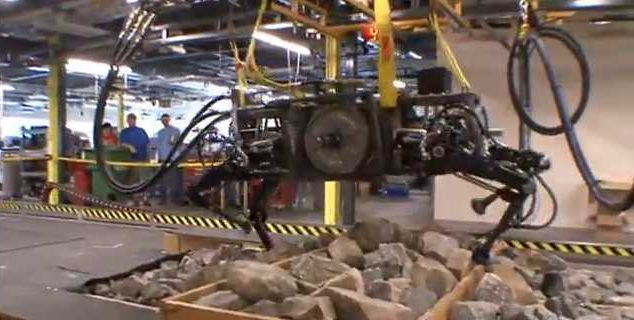
Watch four-legged AlphaDog robot go for a walk and roll over

Add as a preferred source on Google

Move over, BigDog, there’s a new headless, quadrupedic robot in town — and its name is AlphaDog.

Robots manufacturer Boston Dynamics recently debuted some video of the next-generation robotic “mule” it’s developing as a method for transporting military equipment around uneven terrain. The company has been working on a four-legged machine for hauling gear since 2005, and its videos featuring the “BigDog” robots have been an online (and on-air) hit, showing off the robots ability to handle all manner of environment and external obstacles (including soldiers trying to knock it down).

Recommended Videos

The AlphaDog video shows that the robot has learned a few new tricks since we last saw it — such as the ability to right itself after being knocked over. The AlphaDog can also carry up to 400 pounds (60 more than its BigDog predecessor), and can walk for 20 miles without needing recalibration or refueling.

Officially titled the Legged Squad Support System (L3), AlphaDog and BigDog are being developed through funding by DARPA, though it will still be a little while before they’re in active use. The military is expected to begin testing the robots in 2012.


Rick Marshall
Former Contributing Editor, Entertainment
A veteran journalist with more than two decades of experience covering local and national news, arts and entertainment, and…
Robots can now ‘see’ touch thanks to a new color-changing tactile sensor
Researchers have developed a color-changing tactile sensor that turns pressure into visible information.
Robot Touch Human Finger

Most robots are pretty good at seeing, but touching? That's been a much tougher problem. While humans instinctively know how hard they're gripping a coffee mug or pressing a button, robots have traditionally relied on complex arrays of tiny sensors to estimate the same thing. Now, researchers at Queen Mary University of London believe they've found a much simpler solution: make touch visible.

A sensor that turns touch into color

Read more
Chrome is getting better at understanding the breaks and punctations you never say out loud
Voice typing in Chrome is about to feel much more natural
Google Chrome on Android Featured

Google is quietly making voice dictation in Chrome feel a lot more natural. With the latest Chrome 151 Beta, the company is introducing a new capability that allows the browser's speech recognition engine to automatically infer punctuation based on the way people speak, eliminating the need to explicitly say commands like "comma" or "full stop."

The update may sound minor at first glance, but it addresses one of the biggest frustrations with voice typing: speaking naturally often produces text that lacks punctuation unless users consciously dictate every punctuation mark. By teaching Chrome to understand pauses, rhythm, and speech patterns, Google is taking another step toward making conversations with computers feel more human.

Read more
Horror films play music to warn about danger. These headphones use the same trick to save you from robots
Spherephones replaces factory alarms with music that tells you what is coming and from where.
spherephones-georgia-tech

The ear has always processed what is coming before the eye does. In horror movies, the music always tells you something bad is coming. Now researchers at Georgia Tech are using the same idea in real life to keep factory workers safe around robots.

They have built a wearable headset called Spherephones that converts nearby robot movement into spatial music, giving you a warning before a machine gets too close. It helps the user stay aware without breaking their attention.

Read more