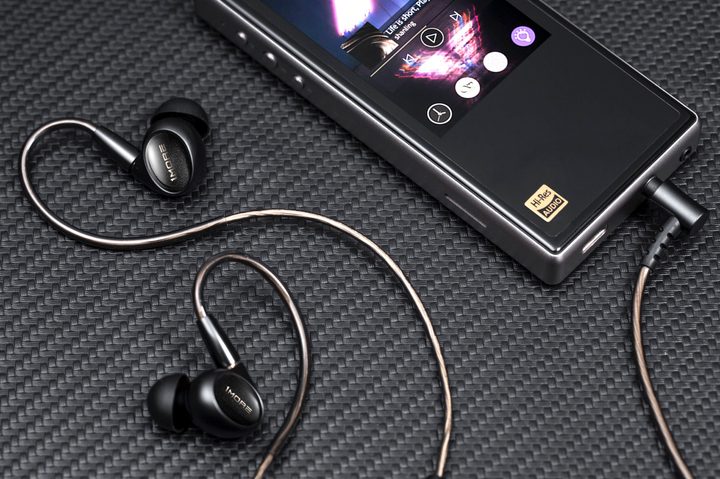
The new wired earbuds from 1More appear to be a technical tour de force. The Penta Driver P50 use five drivers per earbud and feature detachable MMCX connections. That’s what you might expect to find in a set of high-end in-ear monitors (IEMs), not a set of $170 wired earbuds, and yet that’s what the Penta Driver will cost when they go on sale in mid-September.
Multi-driver wired earbuds (and increasingly wireless earbuds) aren’t that unusual. The existing Triple Driver and Quad Driver earbuds from 1More are a testament to that. However, inside the Penta Driver is multi-driver combination I don’t think we’ve ever seen before: a diamond-like carbon (DLC) dynamic driver has been layered with four “planar diaphragm” drivers.

Normally, multi-driver earbuds mate several balanced armature (BA) drivers with each other, or in combination with a single dynamic driver, but planar diaphragm drivers are a different beast — or at least, they should be.
I’m honestly a bit perplexed by the label. In looking at an image of the driver and the exploded diagram of the Penta Driver, those so-called planar diaphragm drivers look nothing like the planar magnetic drivers I’ve seen in other IEMs like the Audeze Euclid. Instead, they look just like balanced armatures to me.


- 1. 1More’s planar diaphragm driver.
- 2. An exploded view of the Penta Driver, showing the circular dynamic driver and four box-shaped planar diaphragm drivers.
I’ve asked 1More for a full explanation of how the drivers work and will update this post when I hear back. In the meantime, the company says its unusual combo will deliver precise and balanced audio output across the entire frequency range.
The Penta Driver are made from aluminum alloy and are hi-res audio certified, which means they can reproduce frequencies as wide as 20Hz-40kHz. The included analog cable is made from silver-plated oxygen-free copper and terminates at the earbuds using MMCX connectors — a very handy feature that lets you use the Penta Drivers with any other third-party MMCX cable or wireless adapter. That’s a big change from the Triple Driver and Quad Drivers, which have permanently wired cables.

The cable also has an inline remote with a mic for calls, making it a good substitute for the wired buds that might have shipped with your smartphone — assuming your smartphone came equipped with a traditional 3.5mm headphone jack.
But even if your phone is USB-C (soon, even the iPhone will use this connector), 1More has you covered — it includes a USB-C to 3.5mm headphone adapter in the box, along with a protective pouch and eight different sizes and styles of silicone and foam ear tips.
The company hasn’t said what kind of digital-to-analog converter (DAC) is housed in the USB adapter, but it probably isn’t particularly high-end.
Once again, 1More has come up with an impressive value proposition — audiophile-grade wired earbuds for under $200. Of course, that’s on paper. But 1More has seldom let us down when it comes to real-world performance, so we’re very optimistic. We’ll let you know as soon as we give them a spin.